The 2026 accounts receivable report
Accounts receivable is no longer a back-office function. It is one of the primary drivers of cash flow, and for many businesses, the difference between stability and failure.
This report, based on a survey of 300+ accounting and finance professionals globally, identifies the practices, channels, and tools that separate businesses that get paid on time from those that do not.
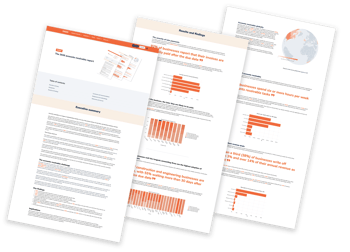
Download the report
The accounts receivable challenge in 2026
Most businesses treat accounts receivable as an administrative task. The data suggests that is exactly why so many are still waiting to get paid.
Cash flow is the engine of business survival, and late payments remain one of its biggest threats. Globally, late payments cost the economy over $40 billion every year (World Bank, 2021), and poor cash flow management is linked to 82% of business failures (U.S. Bank). The burden falls on businesses of every size, across every industry, in every market.
Yet the research also reveals something that should give finance leaders cause for optimism. The gap between businesses that collect quickly and those that do not is not explained by luck or by the behaviour of their customers. It is explained by how systematically they manage their receivables.
The 2026 accounts receivable report was conducted with 300+ accounting and finance professionals at businesses operating globally, to understand the current state of AR management, the impact of late payments on businesses, and the processes and tools that are making a measurable difference.
The report provides insights into:
- The prevalence and severity of late payments across industries, company sizes, and countries
- The time cost of accounts receivable management, and where that time is going
- Company demographics that carry the highest late payment and bad debt risk
- The accounts receivable processes employed by businesses that get paid faster
- How communication channel choices affect payment outcomes
- The role of AR automation software in improving collection performance
- Recommendations for businesses looking to take control of their cash flow in 2026