Accounts receivable is no longer an administrative function. It is one of the primary drivers of cash flow, and therefore business survival.
Late payments remain near-universal. 92% of businesses report that their invoices are typically paid after the due date, with 17% waiting more than 30 days. The scale of the issue is material: globally, late payments cost over $40 billion each year (World Bank, 2021), and in the United States alone, unpaid invoices total approximately $825 billion (Entrepreneur, 2016). Poor cash flow management is linked to 82% of business failures (U.S. Bank).
However, the impact of late payments is not limited to the value of outstanding invoices. It extends to the significant operational burden placed on finance teams. 76% of businesses spend three or more hours per week managing accounts receivable, and 40% spend six or more. This time is largely consumed by manual follow-up, reconciliation, and administrative tasks, displacing higher-value financial work.
This research, based on a survey of 300+ accounting and finance professionals globally, confirms that while late payments are widespread, outcomes are not fixed. The evidence is clear: businesses that adopt a structured, disciplined approach to accounts receivable consistently outperform those that do not.
Three factors stand out.
First, follow-up discipline is the single strongest driver of payment speed. Businesses that follow up on 100% of overdue invoices are 76% more likely to be paid within one week than those that do not. Leaving invoices uncontacted is a direct cause of delayed payment and increased bad debt.
Second, communication strategy materially affects outcomes. While email remains the dominant channel, businesses that combine SMS and email are 49% more likely to be paid within two weeks than those relying on email alone. A multi-channel approach increases the likelihood of reaching customers at the right moment.
Third, systemisation through technology changes performance. Businesses using accounts receivable automation software are 52% more likely to be paid within two weeks of the due date than those relying on manual processes. Consistency, not effort alone, is what drives results, and manual processes do not scale.
The gap between high-performing and underperforming accounts receivable functions is substantial. Businesses that treat receivables as a structured, actively managed process, supported by the right tools, convert revenue to cash faster, reduce bad debt, and free up time for strategic finance work.
The conclusion is clear. Late payments may be widespread, but they are not inevitable. Businesses that take control of their accounts receivable processes materially improve their cash flow outcomes.
Accounts receivable has never been more critical, or more challenging. The World Bank estimates that late payments cost the global economy over $40 billion every year (World Bank, 2021), and the problem shows no sign of easing. Across North America alone, the average business is currently owed $300,000 in late payments (Intuit QuickBooks, December 2021). In the United States, unpaid invoices across businesses total approximately $825 billion, equivalent to around 5% of GDP (Entrepreneur, 2016). Cash flow is the engine of business survival: according to U.S. Bank, 82% of business failures are attributable to poor cash flow management.
Meanwhile in Europe, the picture is equally stark. According to Intrum's European Payment Report 2023, a survey of over 10,000 companies across 29 countries, late payments cost European businesses €275 billion every year, and businesses are spending more than 74 days annually, over a quarter of the working year, chasing overdue invoices (Intrum, May 2023).
Against this backdrop, Chaser surveyed 300+ accounting and finance professionals at businesses operating globally to understand the current state of accounts receivable (AR) management: how prevalent late payments are, how much time teams spend on AR, which collection practices are most effective, and where technology is making a difference.
The findings paint a clear picture. Late payments are near-universal, bad debt is a persistent drain on revenue, and the time required to manage receivables is substantial. Yet the research also reveals a set of practices and tools that are strongly associated with better outcomes. Businesses that follow up diligently, use multiple communication channels, and support their processes with automation consistently outperform those that do not.
The research confirms that late payments remain a significant and widespread challenge. However, it also reveals that outcomes are not fixed. Businesses that take a structured, proactive approach to AR management, maintain consistent follow-up across their debtor book, adopt multi-channel communication strategies, and leverage automation tools are achieving materially better results. The gap between disciplined and undisciplined AR practice is substantial, and the opportunity for improvement is significant.
Businesses around the world are facing an accounts receivable crisis. Late payments cost the global economy over $40 billion every year (World Bank, 2021), and the burden falls disproportionately on the businesses that can least afford it. In the United States alone, businesses are collectively owed an estimated $825 billion in unpaid invoices, with the average business carrying $84,000 in outstanding receivables at any given time (Fundbox/Entrepreneur, 2016). In Europe, the scale of the problem is equally significant: late payments cost European businesses €275 billion every year, and the average business spends more than 74 days annually chasing overdue invoices (Intrum, May 2023).
The consequences extend well beyond inconvenience. U.S. Bank research shows that 82% of business failures are linked to poor cash flow management, and with approximately 600,000 U.S. businesses closing each year (Bureau of Labor Statistics, 2024), a significant share of those closures are attributable to the downstream effects of not being paid on time. Globally, 92% of businesses admit to paying their own suppliers late (Bottomline Technologies, 2019), creating a systemic cycle of deferred payment that erodes confidence and liquidity across supply chains.
Beyond the headline number, the hidden cost is time. Finance teams across businesses of all sizes are devoting significant working hours every month to chasing outstanding invoices, reconciling payments, and managing the administrative burden of accounts receivable. This research, conducted with 163 accounting and finance professionals across the UK, Australia, the US, and beyond, sets out to quantify the burden and identify the approaches most effective at reducing it.
The research examines:
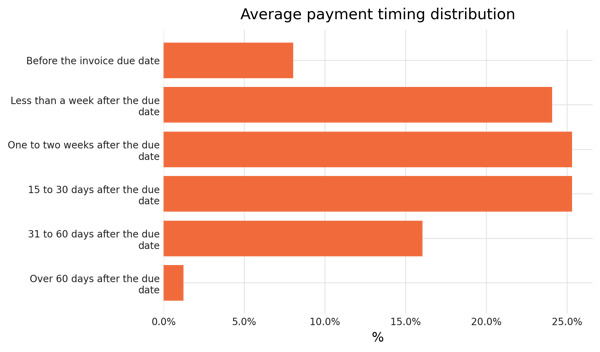
In an ideal world, every invoice a business issues would be paid before or on the due date. In practice, late payments are close to universal. Research from the CPA has previously noted a 209% increase in late payments since the global pandemic began in 2020, and the findings from this survey are consistent with that trajectory.
92% of businesses report that their invoices are typically paid after the due date
Only 8% of businesses surveyed report being typically paid before the invoice due date. The remaining 92% experience at least some degree of late payment as the norm rather than the exception. Across the full sample, 25.3% of businesses wait between 15 and 30 days beyond the due date, and a further 17.2% wait 31 days or more. Fewer than a quarter of respondents (24.1%) report being paid within a week of the due date.
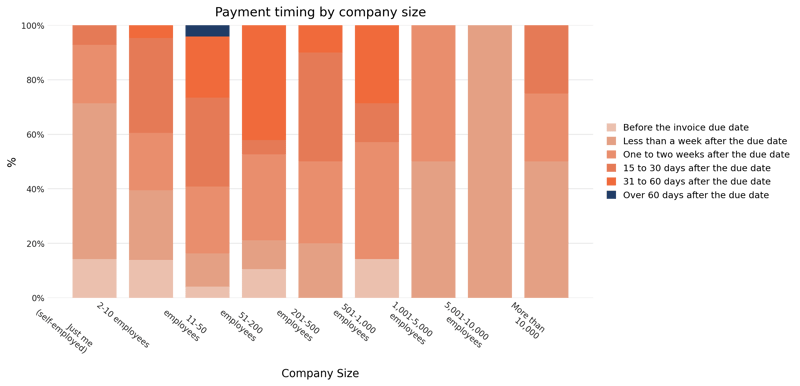
Company size is notably related to payment timing. Sole traders and businesses with fewer than 10 employees report relatively faster average payment, with a payment delay score of 1.2 and 1.9, respectively on a 0-5 scale (where 0 is payment before due and 5 is payment over 60 days late). Mid-sized businesses in the 11-200-employee range report consistently later-than-average payment, with scores in the range of 2.6. Businesses in the 201-500-employee bracket report that 100% of their invoices are paid late.
This mirrors findings from 2022 and suggests that as businesses scale, the complexity of their customer base and the length of payment terms they are expected to offer both increase, ultimately pushing out average collection times.
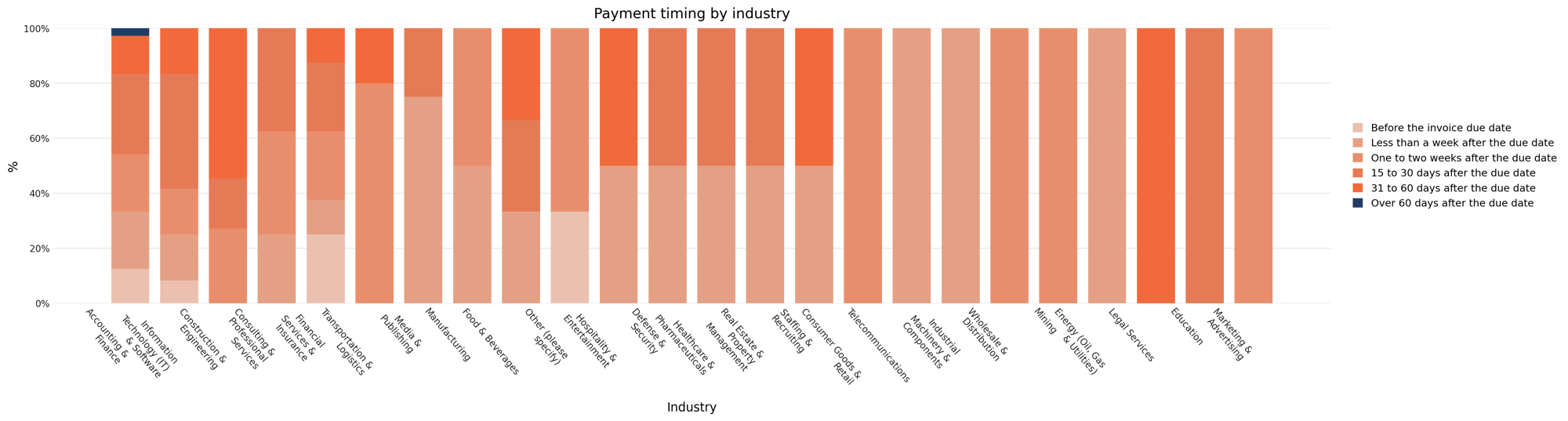
Industry is one of the strongest predictors of late payment severity in this survey. Of the three industries with sufficient sample size to draw reliable conclusions, Construction and Engineering stand out.
100% of construction and engineering businesses are paid late, with 55% waiting more than 30 days after the invoice due date
Businesses in Information Technology and Software are also significantly affected: 91.7% are paid late, and 16.7% wait 30 or more days after the due date. Accounting and finance firms, by contrast, show a more varied picture, with 87.5% paid late but a smaller proportion experiencing very long delays (16.7% waiting 30+ days). Accounting firms are also the most likely in this sample to have tried AR automation software (discussed further in the software section).
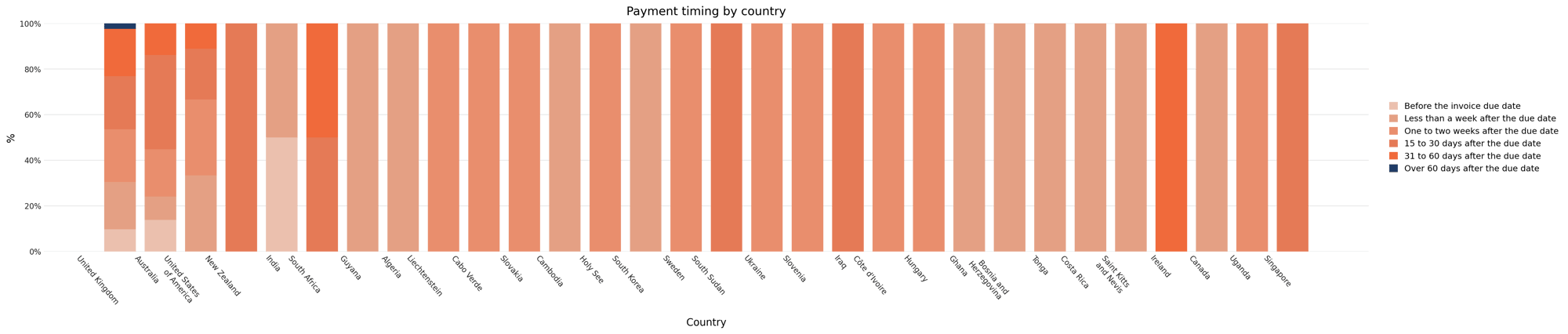
The UK and Australia show similar average payment delay scores: 2.32 and 2.31 respectively. UK respondents report 90% of invoices paid late, while Australian businesses report 86% paid late. Both countries show a concentration of payments in the 15-30 day and 31-60 day post-due brackets, suggesting that extended payment terms are a structural feature of business in both markets.
Bad debt write-offs vary sharply by country. The majority of UK businesses (64%) and Australian businesses (74%) write off less than 3% of annual revenue annually. In the United States, only 11% of businesses report bad debt at that level, with 88% writing off 3% or more and 38% writing off 6%-8% per year. This gap is notable given that US businesses in this survey also report the highest rate of complete invoice follow-up, suggesting that effort alone does not close the gap where structural credit risk and payment culture differ.
The time burden of AR management also differs considerably across the three markets. In the United States, 80% of businesses spend six or more hours per week on accounts receivable tasks. The equivalent figure is 25% in the UK and 22% in Australia. US finance teams are not only contending with more complex debtor books but are spending a significantly larger share of their working week on the consequences.
For businesses in all three markets, that proportion of time devoted to reactive chasing rather than strategic work represents a substantial and largely avoidable cost.
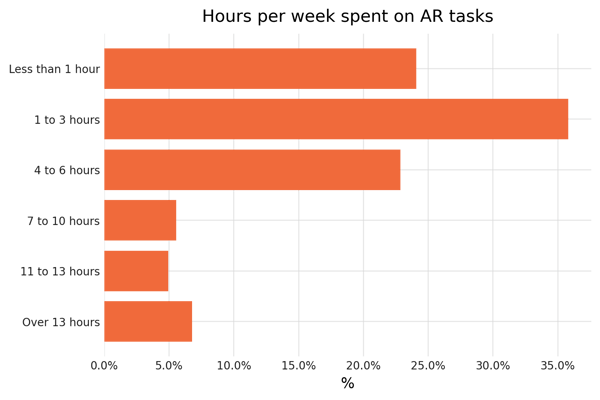
The cost of late payments is not limited to the sums outstanding. It also encompasses the considerable time finance teams invest in chasing overdue invoices, responding to customer queries, and reconciling payments. This hidden cost is frequently underestimated, yet it directly displaces time that could otherwise be spent on more strategic work.
40% of businesses spend six or more hours per week on accounts receivable tasks
76% of businesses spend three or more hours per week on AR tasks. The distribution skews heavily towards the upper end: 35.8% spend three to five hours, 22.8% spend six to ten hours, 5.6% spend eleven to twenty hours, 4.9% spend twenty-one to thirty hours, and 6.8% report spending more than thirty hours per week on receivables management. Only 24.1% of respondents report spending fewer than two hours per week on AR.
For finance teams in mid-sized businesses, the opportunity cost of this time is high. Hours spent on manual follow-up, dispute resolution, and cash application are hours not available for forecasting, financial planning, or supporting business growth decisions.
Beyond late payments, bad debt represents a structural loss that many businesses absorb without fully accounting for it. When invoices go unpaid, the revenue they represent must eventually be written off, reducing profit margins and distorting financial performance.
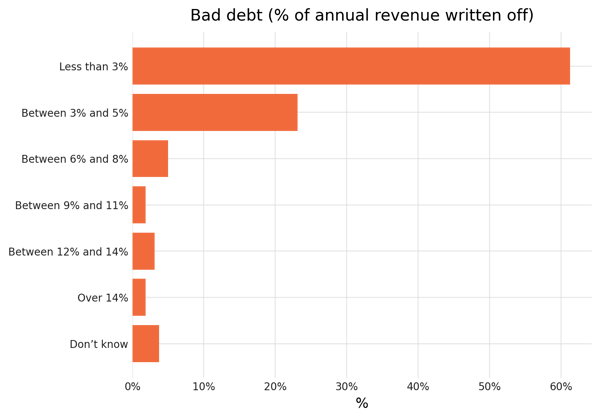
More than a third (38%) of businesses write off between 3% and over 14% of their annual revenue as bad debt
The majority of respondents (61.3%) report writing off less than 3% of revenue annually, which broadly aligns with industry benchmarks.
However, 23.1% write off between 3% and 5%, and a combined 10.0% write off 6% or more each year. A further 3.8% indicate they do not know their bad debt rate, which itself points to a measurement gap in AR management. Industry research suggests that 7.5% of all invoices issued end up being written off as bad debt (Sage), and the distribution in this survey is broadly consistent with that figure.
Construction businesses show the highest representation in the bad debt categories above 3%, with 9.1% of construction respondents writing off over 14% of revenue annually. IT and software businesses report relatively lower bad debt write-offs, with 91.7% falling into the less than 5% bracket.
A consistent theme in this research is that the outcomes businesses experience on late payments are closely linked to the rigour of their accounts receivable follow-up practices. Businesses that maintain thorough follow-up coverage achieve measurably better payment outcomes than those that allow invoices to go uncontacted.
Businesses that follow up on 100% of overdue invoices are 76% more likely to be paid within one week of the due date
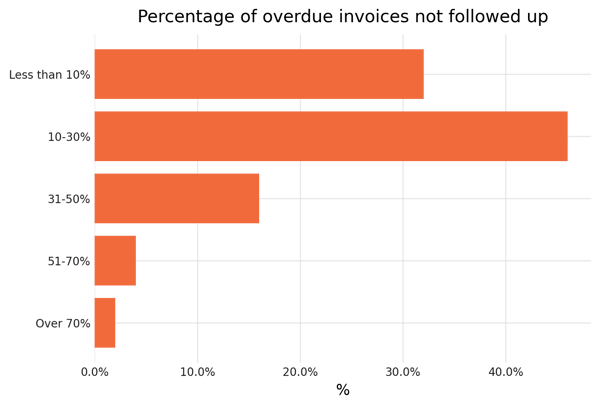
Among the 31% of businesses that do not follow up on all overdue invoices each month, the scale of the gap is considerable. 46% of that group leave between 10% and 30% of their overdue book unfollowed-up. 16% leave between 31% and 50% of overdue invoices uncontacted, and 2% leave more than 70% of their overdue book with no follow-up at all.
This has direct implications for cash collection. Trends in the data indicate that the higher the proportion of the debtor book that a business follows up with, the earlier their average payment date. Leaving invoices uncontacted is not a neutral choice: it is associated with later payment and higher bad debt risk.
The channel mix businesses use to communicate with customers about outstanding invoices varies considerably, and the choice of channel has a measurable effect on payment outcomes.
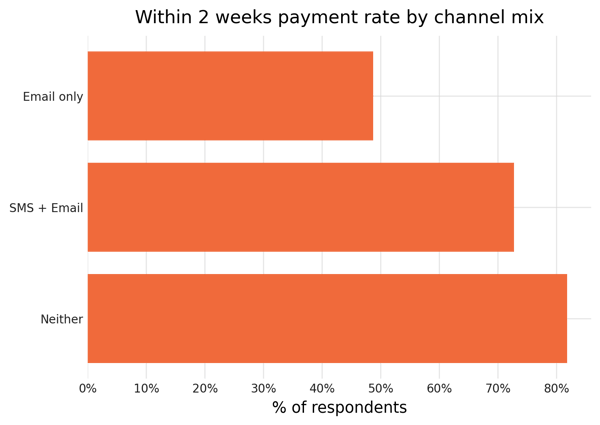
91% of businesses use email as a follow-up channel; combining SMS with email is associated with a 49% relative lift in being paid within two weeks
Email is the most widely used channel for AR follow-up used by 91% of respondents. Phone calls by a person are the second most common method, used by 56% of businesses. SMS text messages are used by 23%, WhatsApp by 15%, and LinkedIn by 10%. However, adoption of a channel does not tell the full story. The data shows that channel combinations matter as much as channel choice. Businesses using both SMS and email for payment reminders report being paid within two weeks 73% of the time, compared to 49% for businesses using email alone. That is a relative improvement of 49%.
This finding is consistent with the principle that customers respond to reminders through different channels at different times, and that a multi-channel approach increases the probability of reaching them at a moment when they are ready to act.
One of the clearest differentiators in this research is the relationship between the use of accounts receivable automation software and payment outcomes. Although the majority of businesses surveyed have not yet adopted dedicated AR tools, those that have consistently report better collection results.
Businesses using AR automation software are 52% more likely to be paid within two weeks than those that are not
Among the 43% of respondents who have tried AR automation software, 71% report being paid within two weeks of the invoice due date. Among the 57% who have not, that figure falls to 47%. The gap is consistent with the pattern observed in the follow-up and channel data: structured, systematic processes produce better outcomes, and software is the mechanism through which many businesses implement and sustain those processes.
Adoption rates vary significantly by industry. IT and software businesses show the highest adoption at 67%, compared to 36% for construction and 32% for accounting and finance. This variation may reflect differences in the sophistication of AR infrastructure across sectors, as well as differences in the perceived need for automation given the severity of late payment exposure.
The mechanism through which software improves outcomes is not simply the technology itself. AR automation tools allow businesses to systematise the follow-up process, send reminders before and after the due date across multiple channels, escalate consistently based on rules rather than capacity, and maintain complete visibility over their debtor book at all times. These are the same behaviours that, as this research shows, are associated with faster payment regardless of whether they are delivered manually or through software.
This research was conducted by Chaser Technologies Limited as part of the 2026 accounts receivable report. Survey responses were collected from accounting and finance professionals operating globally between late 2025 and early 2026.
Respondents were sourced from an internal database of accounting and finance professionals, supplemented by external professional databases and partner networks. A total of 163 complete, validated responses were included in the final analysis, following a data quality process that removed incomplete responses, duplicates, and speeders (respondents completing the survey in under two minutes).
The sample includes professionals based primarily in the United Kingdom and Australia, with further representation from the United States, New Zealand, India, South Africa, and more than 20 other countries. Respondents work across a range of industries, with Accounting and Finance the most heavily represented sector, followed by Information Technology and Software, and Construction and Engineering.
Business size representation ranges from sole traders through to large enterprises, with the largest concentrations in the 11-50 employee bands. The survey consisted of scaled-numeric, single-choice, and multiple-choice questions covering payment timing, time spent on AR tasks, follow-up practices, communication channels, bad debt, and AR software usage. Data was cleaned and analysed in Python using the Pandas library. Results with a minimum group size of 10 respondents are used for subgroup comparisons throughout this report.
In the 2022 late payments report, Chaser surveyed 200+ accounting and finance professionals globally. Comparing the headline findings across both studies reveals a consistent picture, with some notable shifts.
In 2022, 87% of businesses reported being paid after the invoice due date. In 2026, that figure has risen to 92%, suggesting that late payments have become even more prevalent in the intervening years, consistent with the broader economic pressures experienced globally since 2022.
The time cost of AR management has remained significant across both surveys. In 2022, 53% of businesses reported spending four or more hours per week on AR tasks. In 2026, 76% spend three or more hours, and 40% spend six or more hours. While the question framing differs slightly between surveys, the directional finding is consistent: AR management consumes a substantial share of finance team time, and there is no evidence that burden is decreasing.
The effectiveness of multi-channel communication has remained consistent. In 2022, using SMS alongside email was associated with a 56% improvement in the likelihood of being paid within one week. In 2026, the same combination is associated with a 49% relative improvement in being paid within two weeks. The finding holds across both studies: diversifying the channels through which businesses communicate with late-paying customers materially improves outcomes.
The role of AR software has similarly remained a consistent differentiator. In 2022, AR software users were three times more likely to be paid before the due date than non-users. In 2026, businesses using AR software are 52% more likely to be paid within two weeks. Taken together, the two studies make a compelling case: systematic, technology-supported AR management consistently outperforms ad hoc manual approaches, regardless of when it is measured.
The findings in this report point to a clear shift in how accounts receivable should be approached.
Accounts receivable can no longer be treated as a reactive, administrative function. It is a controllable system that directly determines how quickly revenue converts into cash. Businesses that continue to rely on informal processes, inconsistent follow-up, and single-channel communication are not simply operating inefficiently; they are materially weakening their cash position.
The evidence shows that outcomes are driven less by customer behaviour and more by operational discipline. Late payments may be widespread, but the speed and certainty of collection are strongly influenced by how systematically a business manages its receivables.
Three shifts are required.
First, from reactive to systematic.
Chasing invoices when time allows is no longer sufficient. High-performing businesses operate with complete visibility over their debtor book and ensure that every overdue invoice is followed up, every time. Consistency, not intensity, is what drives faster payment.
Second, from single-channel to multi-channel communication.
Relying on email alone is increasingly ineffective. Customers engage across multiple channels, and payment behaviour reflects this. Businesses that diversify how they communicate materially increase their likelihood of being paid sooner.
Third, from manual effort to scalable processes.
Manual accounts receivable processes cannot maintain the level of consistency required as a business grows. The constraint is not effort, but capacity. Systemised, technology-supported processes enable businesses to maintain discipline across their entire debtor book without increasing operational burden.
Taken together, these shifts represent a move from viewing receivables as a back-office task to treating it as a core financial operation. Businesses that make this transition convert revenue into cash more predictably, reduce bad debt exposure, and free up finance teams to focus on higher-value activities.
The following actions are grounded directly in the findings of this research.
The research is unambiguous: businesses that follow up on 100% of their overdue invoices every month are paid faster. Among those with complete follow-up coverage, 28% are paid within one week of the due date, compared to 16% among those who do not follow up on all invoices. Yet 31% of businesses admit to leaving some invoices uncontacted, and nearly a fifth of those are leaving more than 30% of their overdue book unchased each month. Building a reliable debtor tracking process that ensures every overdue invoice receives a follow-up communication is the single most direct lever available to improve collection performance.
Email is the default for the vast majority of businesses, but it should not be the only tool. Businesses using both SMS and email for payment reminders are paid within two weeks 73% of the time, compared to 49% for email-only businesses. That is a 49% relative improvement with the addition of a single additional channel. As inboxes become increasingly crowded, supplementing email with text message reminders increases the probability of reaching customers at a moment when they are ready to act.
The challenge with comprehensive follow-up is that it takes time: 76% of businesses already spend three or more hours per week on AR tasks. AR automation software allows businesses to systematise the follow-up process so that consistent, timely communication happens across every invoice without requiring manual effort for each one. Businesses using AR software in this survey are 52% more likely to be paid within two weeks, and the gap between software users and non-users is consistent with the 2022 findings. Automation is not a replacement for good AR practice: it is the mechanism through which good practice becomes sustainable at scale.
More than 3% of respondents do not know their own bad debt rate. Bad debt that is not measured cannot be managed. Establishing a baseline, tracking write-offs by customer, industry, and invoice age, and using that data to inform credit decisions and follow-up prioritisation are all essential components of a mature AR operation. The 7.5% of invoices industry-wide that are written off as bad debt (Sage) represent a recoverable loss for many businesses, and earlier intervention in the collection cycle is the most effective way to reduce it.
A significant proportion of finance team time is currently spent on manual chasing and administration.
By reducing the operational burden of accounts receivable, businesses can redirect this time towards forecasting, planning, and strategic decision-making; activities that have a direct impact on growth and resilience.
The overarching message is clear: improving accounts receivable outcomes does not require more effort, but better systems and stronger discipline. Businesses that act on this shift will see measurable improvements in cash flow, efficiency, and financial control.
The 2026 accounts receivable research confirms that late payments remain a structural and widespread challenge. 92% of businesses are paid late, finance teams are dedicating significant time to managing the consequences, and bad debt continues to erode revenue across industries.
However, the findings also make one point clear: outcomes are not fixed.
The variation in payment speed, bad debt, and time spent on receivables is not explained by external conditions alone. It is strongly influenced by how businesses manage their accounts receivable processes. Those that operate with discipline, consistency, and structure convert revenue into cash faster and more reliably than those that do not.
The difference between high-performing and underperforming accounts receivable functions is substantial. It is the difference between predictable cash flow and ongoing uncertainty, between controlled risk and silent revenue leakage, and between finance teams focused on strategic work and those consumed by manual administration.
Accounts receivable should no longer be viewed as a back-office necessity. It is a core financial operation with a direct impact on liquidity, resilience, and growth.
The implication is straightforward. Businesses that continue to treat receivables as a reactive process will continue to experience delayed payments and operational inefficiency. Those that adopt a systematic, technology-supported approach will materially improve their cash flow outcomes.
Late payments may be widespread, but they are not inevitable.
World Bank SME Finance (2021). SME Finance: Development news, research, data. Available at: https://www.worldbank.org/en/topic/smefinance
Intuit QuickBooks (December 2021). New QuickBooks research reveals the impact of late payments on mid-sized businesses. Available at: https://quickbooks.intuit.com/r/midsize-business/midsize-payments-research/
U.S. Bank. 82% of small business failures linked to poor cash flow management. Available via U.S. Bank research resources: https://www.usbank.com
Bureau of Labor Statistics (2024). Business closure data, United States. Available at: https://www.bls.gov/bdm/
Fundbox / Entrepreneur (2016). U.S. Small Businesses Owed $825 Billion in Unpaid Invoices. Entrepreneur. Available at: https://www.entrepreneur.com/starting-a-business/us-small-businesses-owed-825-billion-in-unpaid-invoices/285233
Bottomline Technologies (2019). Business Payments Barometer: 92% of businesses pay suppliers late. Available at: https://www.bottomline.com/resources/92-percent-businesses-pay-suppliers-late-payment-insights
Intrum (May 2023). European Payment Report 2023: Late payments cost European businesses €275 billion each year. Available at: https://www.intrum.com/insights/publications/epr-2023/
Sage. 7.5% of all invoices are written off as bad debt. Available via Sage research resources: https://www.sage.com/en-gb/blog/late-payment-statistics/
Hilton Baird Group (2023). Businesses write off 8% of revenue as bad debts annually. Available at: https://www.hiltonbaird.co.uk/resources/late-payment-statistics/
Chaser Technologies Limited (November 2022). The 2022 late payments report. Available at: https://www.chaserhq.com/blog/87-of-businesses-paid-late-insights-from-2022-late-payments-report
Chaser Technologies Limited (2026). The 2026 accounts receivable report (this document).