


















.svg.png?height=48&name=Zoho_CRM_(application).svg.png)







Uncollectible accounts, also called bad debt, are amounts owed to a business that are unlikely ever to be paid. Leaving uncollectible amounts unrecognized has direct consequences for financial reporting. Your accounts receivable balance overstates what the business will actually collect, which distorts the income statement and balance sheet.
This guide covers why estimating uncollectible accounts matters, the accounting methods and journal entries used to record them, how to manage a write-off, and the operational steps that reduce how many accounts reach this point in the first place.
How do accounts become uncollectible?
Several factors can contribute to accounts receivable becoming uncollectible:
- Customer bankruptcy: If a customer files for bankruptcy, their ability to repay outstanding credit balances over a reasonable period of time may be severely limited or completely eliminated.
- Financial difficulties: Customers may experience financial hardships due to economic downturns, job losses, or other unforeseen circumstances, making it difficult for them to meet their payment obligations.
- Fraud: In some cases, customers may intentionally deceive a company to obtain goods or services without the intention of paying.
- Disputes: Disputes over the quality of goods or services provided can lead to customers refusing to pay.
- Ineffective collection efforts: A company's own collection efforts may be inadequate, allowing delinquent accounts to age and become uncollectible.
Examples of accounts receivable that can’t be collected
|
Scenario |
Description |
|---|---|
|
Customer bankruptcy |
A customer files for Chapter 7 bankruptcy, and the court discharges their debt to your company. |
|
Unresponsive customer |
Despite multiple attempts to contact a customer with an overdue balance, they remain unresponsive and can’t be located. |
|
Dispute resolution failure |
A customer disputes the quality of goods, and after negotiations, no resolution is reached, leading to non-payment. |
|
Statute of limitations |
The legal time limit for collecting a debt has passed, rendering the debt legally unenforceable. |
|
Customer business closure |
A customer's business permanently closes, and they have no assets to pay outstanding debts. |
Why should you estimate uncollectible accounts?
Estimating uncollectible accounts is essential for several reasons, and it goes well beyond accounting compliance.
Accurate financial reporting
Reflects the true value of accounts receivable. Accounts receivable represent the money owed to a business by its customers. If a portion of those receivables is unlikely to be collected, the reported value becomes inflated and misleading. Estimating uncollectible balances produces a more accurate representation of assets.
Adheres to the matching principle. The matching principle states that expenses should be recognized in the same period as the revenues they helped generate. By estimating uncollectible receivables, bad debt expense is matched with the sales revenue earned in the same period.
Complies with the conservatism principle. When faced with uncertainty, accountants should err on the side of caution and anticipate potential losses. Estimating uncollectible accounts aligns with this principle by recognizing the possibility of bad debts and preventing an overstatement of assets and income.
Realistic financial health assessment
Provides a clearer picture of financial performance. By accounting for potential losses from uncollectible accounts, a business can present a more realistic picture of its financial health. This information is crucial for internal decision-making and for external stakeholders such as investors and creditors.
Aids in credit risk management. Estimating uncollectible accounts encourages businesses to assess their credit policies and customer creditworthiness. This helps identify high-risk accounts and implement appropriate credit control measures to minimize losses.
Tax implications
Allows for tax deductions. In many jurisdictions, businesses can claim a tax deduction for bad debts. This deduction is often contingent on demonstrating that reasonable efforts have been made to collect the outstanding amounts and that the uncollectible portion has been properly estimated.
Estimating uncollectible accounts is a fundamental practice that promotes transparency, accuracy, and prudent financial management.
How to record uncollectible accounts: journal entries and methods
There are two primary methods for accounting for uncollectible accounts: the allowance method and the direct write-off method. The allowance method is preferred under Generally Accepted Accounting Principles (GAAP). The direct write-off method is simpler but is generally not accepted for financial reporting because it violates the matching principle.
The allowance method
The allowance method estimates and records bad debt expense in the same period as the related revenue. It uses a contra-asset account called Allowance for Doubtful Accounts to offset gross accounts receivable on the balance sheet. This is the GAAP-preferred approach for any business where bad debt is material.
Three journal entries cover the full lifecycle of an uncollectible account under the allowance method.
Entry 1: Period-end allowance estimate
|
Account |
Debit |
Credit |
|---|---|---|
|
Bad debt expense |
XXX |
|
|
Allowance for doubtful accounts |
XXX |
This entry creates a reserve against expected future write-offs. Bad debt expense is recorded on the income statement in the same period as the revenue it relates to.
Entry 2: Write-off of a specific account
|
Account |
Debit |
Credit |
|---|---|---|
|
Allowance for doubtful accounts |
XXX |
|
|
Accounts receivable - [Customer name] |
XXX |
This entry doesn’t affect net income or total assets. The expense was already recorded in Entry 1. Writing off the account simply moves the balance from gross receivables to the allowance account, leaving net realizable value unchanged.
Entry 3: Recovery (if payment is received after write-off)
|
Account |
Debit |
Credit |
|---|---|---|
|
Accounts receivable - [Customer name] |
XXX |
|
|
Allowance for doubtful accounts |
XXX |
|
|
Cash |
XXX |
|
|
Accounts receivable - [Customer name] |
XXX |
The recovery entry uses two steps: first, reinstate the receivable (reversing the write-off), then record the cash receipt. This is also the correct pattern if a customer pays after their account has been written off under the direct write-off method.
Percentage of sales method
The percentage of sales method estimates bad debt expense as a fixed percentage of total credit sales for the period.
Formula: Uncollectible accounts expense = Credit sales x Percentage of uncollectible sales
To apply it: determine the historical percentage of credit sales that have become uncollectible, then multiply current period credit sales by that percentage. The result is the bad debt expense for the period.
Aging of accounts receivable method
The aging of receivables method categorizes outstanding balances by how long they have been unpaid and assigns escalating uncollectibility percentages to each bracket. The older the balance, the higher the estimated loss rate.
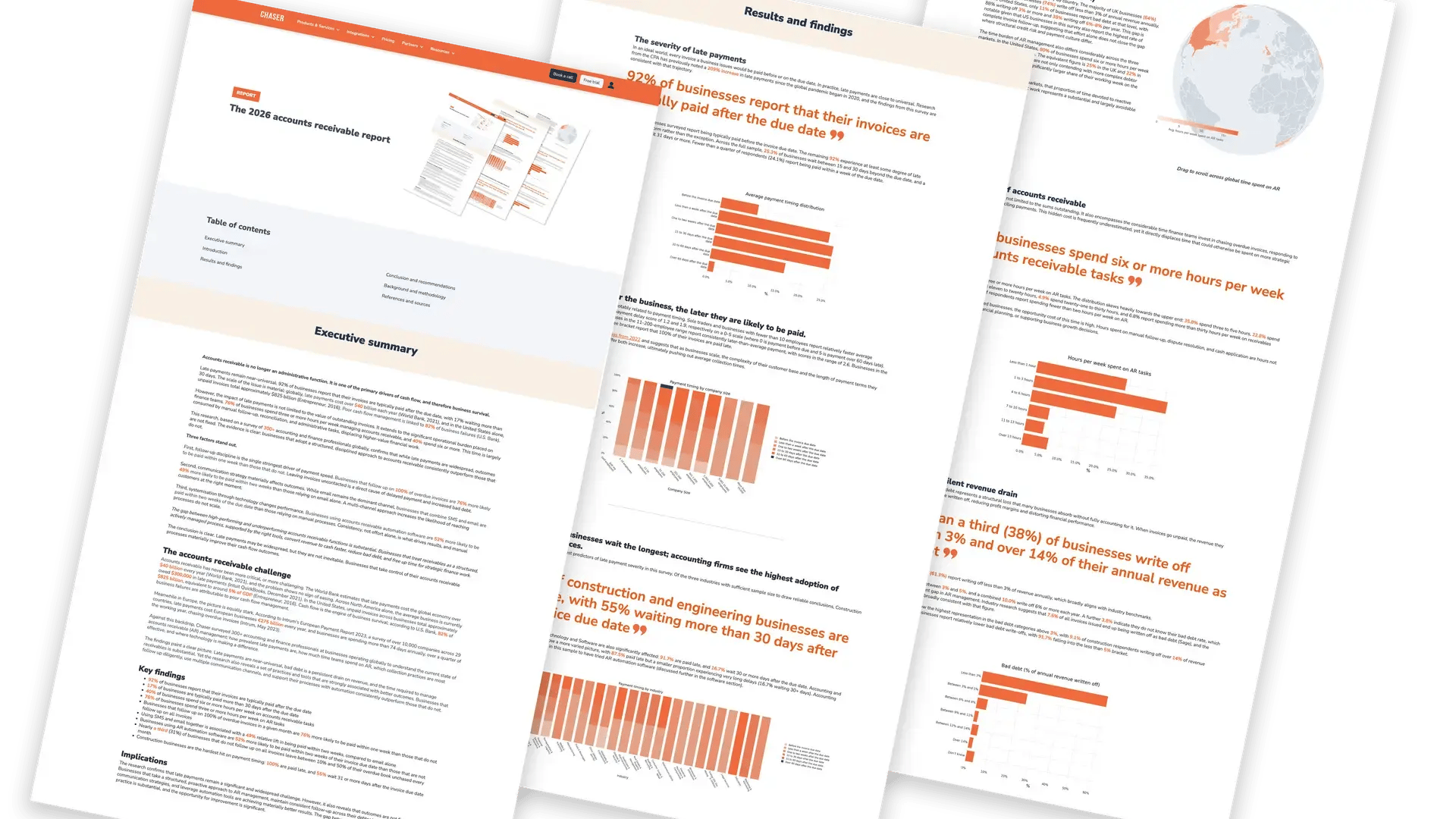
The table below shows a standard aging schedule with example percentages. But these are benchmarks, not guarantees. The right percentages for your business depend on your customer base and collection history. The Chaser 2026 Accounts Receivable Report shows, for example, that construction businesses write off at significantly higher rates than IT and software businesses, which means industry-specific calibration matters.
|
Age of receivable |
Estimated uncollectible % |
Notes |
|---|---|---|
|
0-30 days |
1% |
Low risk; most invoices in this range are paid late but recovered |
|
31-60 days |
5% |
Follow-up urgency increases |
|
61-90 days |
15% |
Significantly elevated risk |
|
Over 90 days |
40% |
High probability of non-recovery without escalation |
For a deeper breakdown of how bad debt expense is calculated and recorded, see Chaser's guide to bad debt expense.
The direct write-off method
The direct write-off method records bad debt expense only when a specific account is identified as uncollectible. It is simpler than the allowance method but is generally not GAAP-compliant for material amounts because it violates the matching principle; the expense is recognized in a different period from the revenue it relates to.
|
Account |
Debit |
Credit |
|---|---|---|
|
Bad debt expense |
XXX |
|
|
Accounts receivable - [Customer name] |
XXX |
Does writing off a debt cancel the legal obligation? A write-off is an accounting entry. The customer still owes the money, and the legal obligation to pay remains in place. If payment is subsequently received after a write-off, it is recorded as a recovery: debit Cash, credit Bad Debt Recovered (or Bad Debt Expense) for the amount received. Writing off the debt removes it from the books, but it doesn’t remove the customer's liability.
How to write off uncollectible accounts
Writing off an account is an operational decision as much as an accounting one. The journal entries sit in the section above. Here is the practical workflow for identifying when a write-off is appropriate and executing it.
Allowance method write-off process
When a specific account is identified as uncollectible, debit the Allowance for Doubtful Accounts and credit Accounts Receivable. Because the expense was already recorded at period end, this entry doesn’t hit the income statement again. The net realizable value of accounts receivable is unchanged.
Before writing off, document all collection efforts: dates and content of reminders sent, calls made, any payment arrangements agreed and broken, and the reason the account is being written off. That documentation is required for the tax deduction and protects the business if the customer later pays or disputes the write-off.
Direct write-off method process
When an account is deemed uncollectible under the direct write-off method, debit Bad Debt Expense and credit Accounts Receivable. There is no prior allowance to draw against, so the full amount hits the income statement at the point of write-off.
This method is acceptable for immaterial amounts or for businesses in jurisdictions where the allowance method isn’t required. For most mid-market B2B businesses, the allowance method is the correct approach.
For more on recording these transactions, see the accounts receivable journal entry guide.
Key considerations
Materiality: For businesses with immaterial amounts of bad debt, the direct write-off method may be acceptable. For most mid-market B2B businesses, the allowance method is correct.
Financial statement impact: The choice of method affects the income statement (timing of expense recognition), the balance sheet (whether an allowance contra-asset exists), and cash flow reporting.
Internal controls: Businesses should have clear criteria for when an account moves to write-off status, documented approval processes, and a process for recording recoveries if payment later arrives.
Allowance for uncollectible accounts on the balance sheet
The Allowance for Doubtful Accounts is a contra-asset account, meaning it reduces the value of the asset it relates to. On the balance sheet, it appears as a deduction from gross accounts receivable.
The resulting net figure (gross accounts receivable minus the allowance) is the net realizable value: what the business realistically expects to collect.
Reporting gross accounts receivable without the allowance would overstate assets and present an unrealistically optimistic picture of the business's financial position. The allowance ensures the balance sheet reflects what the business can actually expect to receive.
How to reduce uncollectible accounts
Most uncollectible accounts are preventable. The best time to act is before an invoice becomes seriously overdue. Four operational steps make the difference.
Set a clear credit policy before extending credit
Exposure to high-risk accounts starts with onboarding. Running credit checks and setting appropriate credit limits at the point at which a customer relationship begins reduces the likelihood of extending significant payment terms to businesses that can’t support them.
Credit limits should be defined by customer type and reviewed for long-standing customers whose payment behavior has deteriorated. A customer who paid on 30-day terms reliably two years ago may be a different risk profile today.
Follow up on every overdue invoice consistently
According to the 2026 AR Report, businesses that follow up on 100% of overdue invoices are 76% more likely to be paid within one week. That figure identifies the primary operational cause of accounts sliding toward write-off: inconsistent follow-up.
Accounts age at 30, 60, and 90 days because no one chased them at 15 days, or the chase at 30 days wasn’t followed up. By the time an account reaches write-off territory, the recovery window has usually closed.
Automate follow-up to maintain consistency at scale
Automation makes consistent follow-up sustainable across a full debtor book. The 2026 AR Report also shows that businesses using AR automation consistently outperform those that don’t.
That is because automated chasing ensures every overdue invoice receives a reminder on schedule, regardless of team capacity or the time of month. The follow-up that prevents write-offs is the one that actually gets sent.
Know when to escalate
When consistent follow-up fails and an account is at serious risk of becoming uncollectible, timely escalation increases recovery rates. The longer a debt ages past 90 days, the harder it becomes to recover. The aging table above shows why, with estimated uncollectibility rising to 40% for balances over 90 days.
Chaser Collections is a no-win-no-fee debt collection service that handles escalation for accounts that haven’t responded to internal follow-up. Introducing it earlier in the aging cycle, rather than as a last resort, improves recovery outcomes.
Reduce your uncollectible receivables with Chaser
The 2026 AR report shows that businesses using AR automation are 52% more likely to be paid within two weeks. Chaser is the AR automation platform that makes that possible. It gives mid-market B2B finance teams the follow-up consistency, early credit risk signals, and payment visibility needed to prevent receivables from becoming bad debt in the first place.
Most uncollectible accounts start as invoices that weren't followed up on consistently. Book a demo to see how Chaser automates follow-up across your full debtor book, so fewer receivables ever reach the write-off stage.
Key takeaways
- Uncollectible accounts, or bad debt, are accounts receivable that a business expects not to collect.
- Estimating uncollectible accounts is crucial for accurate financial reporting, matching expenses to revenues, and complying with accounting principles.
- The allowance method is preferred under GAAP for accounting for uncollectible debts. It records bad debt expense in the period of the related revenue and uses journal entries (debit Bad Debt Expense, credit Allowance for Doubtful Accounts) to build a reserve before write-offs occur.
- Uncollectible accounts expense can be calculated using the percentage of sales method or the aging of accounts receivable method; the aging table above shows standard brackets and uncollectibility percentages.
- The Allowance for Doubtful Accounts is a contra-asset account that reduces the reported value of accounts receivable on the balance sheet to net realizable value.
FAQs
When recording bad debt expense under the allowance method, debit Bad Debt Expense and credit Allowance for Doubtful Accounts. Under the direct write-off method, debit Bad Debt Expense and credit Accounts Receivable directly. For a worked example of both entries, see the accounts receivable journal entry guide.
The allowance method is the GAAP-preferred approach. Identify the account as uncollectible, debit the Allowance for Doubtful Accounts, and credit Accounts Receivable. Maintain documentation of all collection efforts. If the business hasn’t yet built a write-off reserve, the direct write-off method records the expense at the point of write-off by debiting Bad Debt Expense and crediting Accounts Receivable.
Under the allowance method, the account is written off against the existing allowance: debit Allowance for Doubtful Accounts, credit Accounts Receivable. This doesn’t affect net income because the bad debt expense was already recorded at period end. Under the direct write-off method, the write-off is recorded at the time the account is deemed uncollectible: debit Bad Debt Expense, credit Accounts Receivable.
Customer bankruptcy and financial difficulty are the most common causes. Inconsistent or inadequate collection follow-up is a significant and preventable contributing factor. Many accounts that eventually reach write-off status could have been recovered earlier with timely and consistent follow-up.
Yes, uncollectible accounts and bad debt refer to the same thing: amounts owed to a business that are unlikely to be recovered.
The estimate of uncollectible accounts reduces the net realizable value of accounts receivable on the balance sheet. An Allowance for Doubtful Accounts (a contra-asset account) is created, and the net figure (gross accounts receivable minus the allowance) represents what the business realistically expects to collect. The gross accounts receivable balance remains unchanged; only the net amount is reduced.


.png)