


















.svg.png?height=48&name=Zoho_CRM_(application).svg.png)






In short: Xero can project your cash position natively — the built-in short-term view covers the next 7 to 30 days, and Cash flow manager (part of Analytics Plus) extends that up to 180 days on eligible plans, predicting recurring transactions and expected payment dates from your history. What Xero cannot do is make customers pay on the dates it predicts. A reliable forecast combines Xero's projections with a 13-week rolling model and, most importantly, receivables data that reflects how customers actually pay rather than when invoices say they should.
Cash flow forecasting is the finance-team job with the biggest gap between how important it is and how much anyone trusts the output: 64% of finance leaders lack confidence in their cash flow data (CFO.com). For teams running on Xero the frustrating part is that most of the raw material for a good forecast is already in the ledger — invoices, bills, bank balances, payment history. This guide covers what Xero's native forecasting actually does, how to build a 13-week rolling forecast on top of it, why forecasts go wrong, and the receivables discipline that separates a forecast you check from a forecast you trust.
What Xero gives you natively
Xero's forecasting comes in two layers. Xero Analytics, included on eligible plans, provides the short-term cash flow view: a projection of selected bank accounts over the next 7 or 30 days, built from reconciled bank balances plus the invoices and bills already in Xero. It answers "what does the next month look like if everything pays as dated".
Cash flow manager, part of Analytics Plus (rolled out to business-plan customers from August 2025), goes further: projections at 7, 14, 30, 60, 90 or 180 days, predicted recurring transactions read from your last three months of reconciled activity, expected payment dates suggested from each customer's actual payment behavior, and scenario planning by adding or adjusting individual transactions.
Three practical caveats. First, the available horizons vary by plan and region — Xero's own pages describe them inconsistently, so check what your subscription actually shows rather than relying on comparison articles. Second, the projections are only as good as the ledger: unreconciled banks, undated invoices and re-dated bills feed the prediction engine bad patterns. Third, Xero's engine can predict when customers are likely to pay — it does nothing to change that behavior, which is where the rest of this guide comes in.
Building the 13-week rolling forecast
Alongside the native views, most SME finance teams get the greatest value from a 13-week rolling forecast: long enough to straddle payroll cycles, quarterly tax and supplier terms, short enough to stay anchored to real data. Built weekly, from Xero, it looks like this:
- Start from reconciled opening cash. The current bank balance after reconciliation, not an estimate. If reconciliation lags, fix that first — every number downstream depends on it.
- Map cash inflows by expected payment date, not due date. Take the open invoices from Xero's aged receivables and ask, for each material one: when will this customer actually pay, based on how they have paid before? This single substitution — expected date for due date — is the difference between a forecast and a wish.
- Map outflows with their real timings. Bills from aged payables at the dates you genuinely intend to pay them, plus the flows that never appear as bills until it is too late to plan: payroll, VAT and other tax, loan repayments.
- Roll it weekly. Opening balance + inflows − outflows = closing balance, carried into the next week, thirteen columns out. As each week closes, add a new week to the end.
- Review variance every week. Compare what the forecast said with what happened, and ask why. Variance review is where forecasts improve; skipping it is why most spreadsheet forecasts quietly die.
Why forecasts go wrong
Forecast failures are rarely calculation errors. They are almost always one of four things:
- Treating due dates as payment dates. Xero's own small business data shows average payment times running close to 30 days, with wide variation (Xero Small Business Insights, Oct–Dec 2025). A forecast that books every invoice on its due date systematically overstates near-term cash and understates risk.
- Dirty source data. Late reconciliation, invoices without realistic dates, and recurring costs that never got entered all feed the model — native or spreadsheet — fiction.
- No scenario planning. One forecast is one opinion. A base case, a downside case (your two slowest payers slip 30 days; a contract renewal is late) and an upside case turn the forecast into a decision tool: the downside case tells you when to act, and how early.
- Ignoring customer concentration. If a third of expected inflows come from one customer, your forecast confidence is really a judgement about that customer. Concentration belongs on the forecast page, not in a separate risk register.
The receivables connection: the lever that improves everything
Every improvement above depends on one input: how accurately you can predict when invoices will actually pay. That makes receivables management and cash flow forecasting the same discipline seen from two sides.
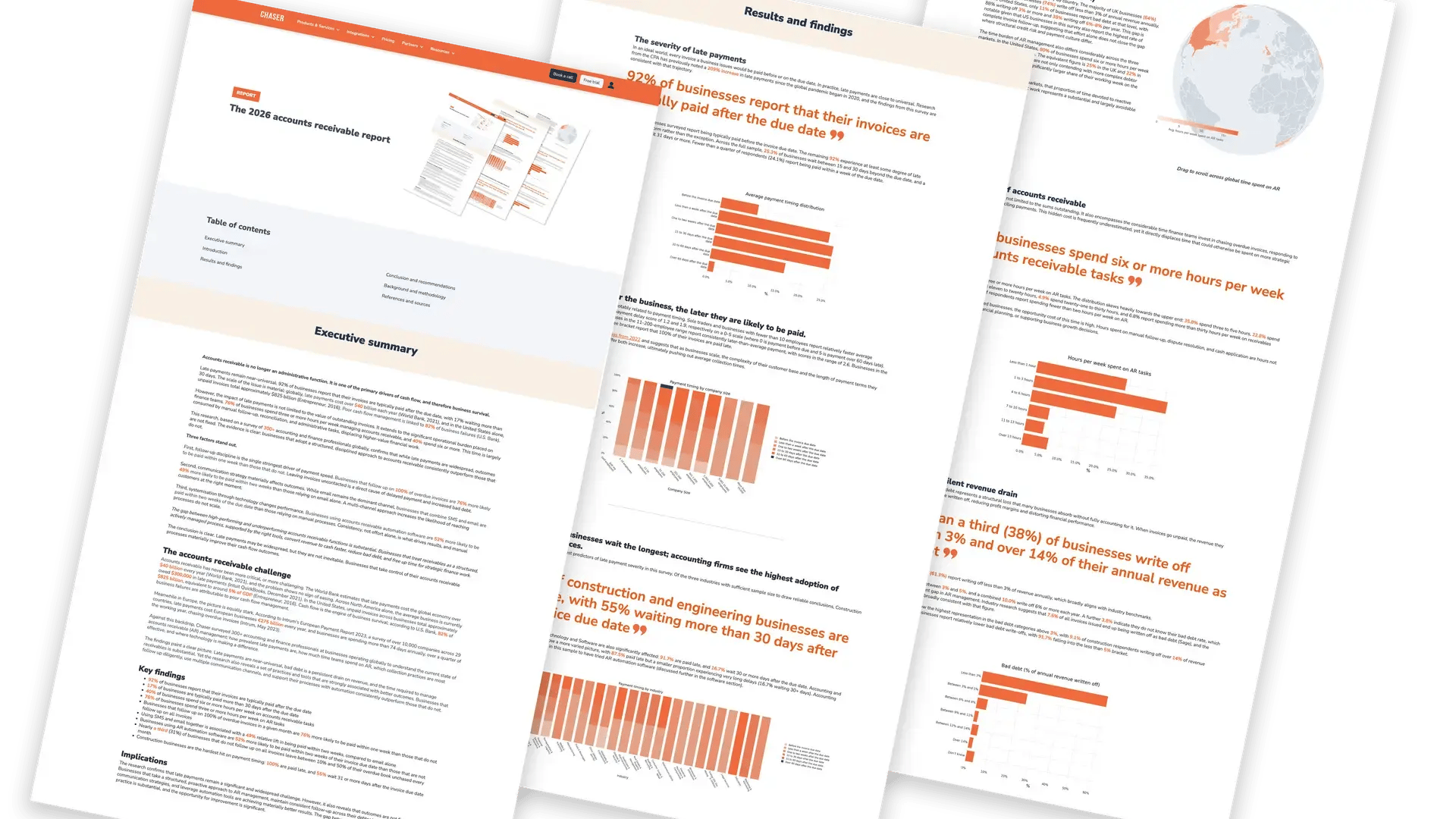
Xero's Cash flow manager already suggests expected payment dates from each customer's history, which is a good start. A dedicated receivables platform strengthens the loop in three ways. Payment-behavior tracking — such as Chaser's AI payer ratings and late payment prediction — turns each customer's track record into an expected-payment profile rather than a guess. Promise-to-pay tracking captures what customers actually say when chased ("we pay supplier runs on the 25th") — qualitative data no algorithm infers, and often the most accurate forecast input there is. And automated chasing narrows the gap between due date and payment date itself, which shrinks the uncertainty the forecast has to absorb: businesses using AR automation are 52% more likely to be paid within two weeks of the due date than those relying on manual processes (The 2026 accounts receivable report).
Chaser's receivables forecast and cash flow forecast build on exactly this data, and the Xero integration connects in minutes, so the forecast always reads the live ledger. For the chasing side of the same loop, see the guide to Xero credit control.
Getting started
The sequence that works: reconcile weekly as a hard rule; switch on Xero's native projection and check what horizon your plan gives you; build the 13-week model with expected payment dates instead of due dates; add a downside scenario; and hold a 30-minute weekly review comparing forecast with actuals. Then improve the input that drives everything — receivables predictability — by making chasing consistent and capturing what customers tell you about payment timing. Measure days sales outstanding alongside forecast variance (the DSO formula guide covers the calculation): as DSO stabilizes, forecast accuracy follows.
See what payment-behavior data could do for your own forecast.

FAQs
Can Xero do cash flow forecasting?
Yes, in two layers: Xero Analytics includes a short-term cash flow view over the next 7 or 30 days, and Cash flow manager (part of Analytics Plus) projects up to 180 days on eligible plans, predicting recurring transactions and expected payment dates from your transaction history. Available horizons vary by plan and region, so check your own subscription.
How far ahead can Xero forecast cash flow?
Cash flow manager offers projections at 7, 14, 30, 60, 90 or 180 days, drawing on bank balances, open invoices and bills, and predicted recurring transactions from the previous three months. The standard Analytics short-term view covers 7 or 30 days. Beyond 180 days, forecasting means building your own model or using dedicated software.
What is a 13-week cash flow forecast?
A rolling weekly forecast covering the next quarter: opening cash plus expected inflows minus outflows, week by week, thirteen columns out, refreshed every week. It is the standard operational horizon for SMEs because it spans payroll cycles, tax deadlines and supplier terms while staying close enough to real data to act on.
Why is my cash flow forecast always wrong?
Usually because it books invoices on their due dates. Average payment times run close to 30 days and vary widely by customer, so a due-date forecast systematically overstates near-term cash. Replace due dates with expected payment dates based on each customer's history, and review variance weekly so the assumptions keep improving.
Does chasing invoices improve forecast accuracy?
Yes, twice over. Consistent chasing narrows the gap between due date and payment date, which shrinks the uncertainty the forecast has to absorb; and the chasing process itself surfaces payment-timing information — replies and promises to pay — that becomes the most reliable forecast input you have.
Do I need separate software to forecast cash flow with Xero?
Not to start: Xero's native views plus a disciplined 13-week spreadsheet cover most SME needs. Dedicated tooling earns its place when payment-behavior data matters — platforms like Chaser read the live Xero ledger, track how each customer actually pays, and feed receivables and cash flow forecasts that update as behavior changes.


%20-%20Cash%20flow%20software%20(1).webp)