



















.svg.png?height=48&name=Zoho_CRM_(application).svg.png)






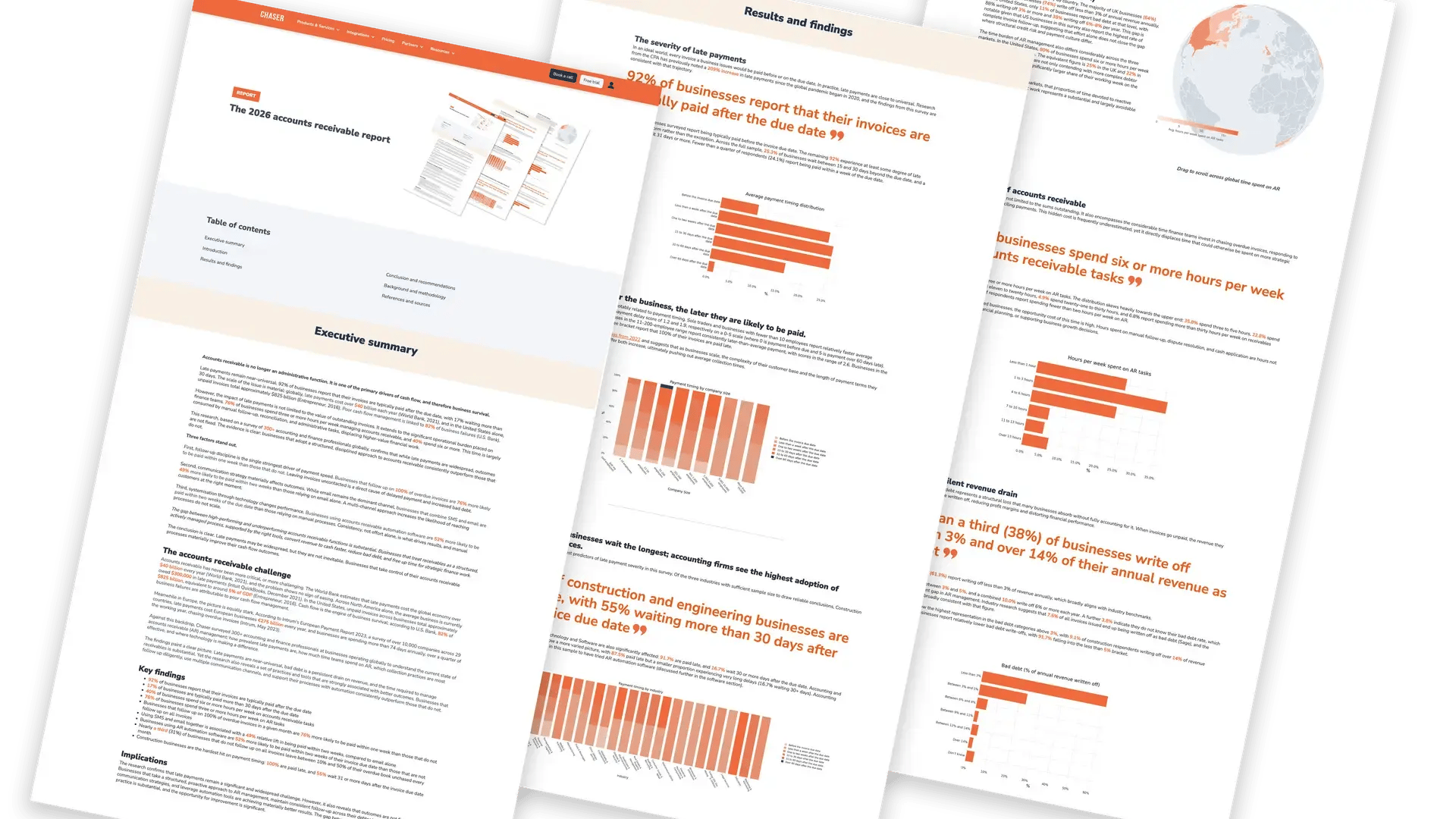

Prefer to work through this offline? Get the full guide as a designed, printable PDF — the same 90-day plan, ready to share with your team.
Download the free 90-day blueprintIn short: transforming your accounts receivable process works best in three 30-day phases. In days 1–30 you assess and stabilize: audit the process, clean your data, set baseline KPIs and review your tools. In days 31–60 you automate and optimize: build segmented reminder workflows, add AI-driven insight, centralize communication and give customers a branded payment portal. In days 61–90 you scale and succeed: measure the change, resolve stubborn accounts, and embed a monthly review so the gains hold. Most finance teams use this window to cut days sales outstanding (DSO) by 15–20% and automate around 80% of first-stage reminders.
Late payments are more than an operational headache. They limit your ability to plan, invest and grow. According to The 2026 accounts receivable report, 92% of businesses report their invoices are typically paid after the due date, and 17% wait more than 30 days beyond it – for many finance teams that gap between the sale and the cash is the single biggest drag on working capital. Late payment is estimated to cost the UK economy close to £11 billion GBP a year, so getting paid on time is a business-wide priority, not just a finance chore.
Yet accounts receivable (AR) is one of the most overlooked functions in finance. Manual chasing, scattered spreadsheets and inconsistent follow-up quietly cost you cash, time and customer goodwill. The good news: you do not need a system overhaul or a bigger team to fix it. You need a clear, phased plan.
This 90-day blueprint gives you that plan. It is built for finance professionals who want to reduce DSO, free up their team and improve the customer experience without sacrificing compliance or brand voice. Throughout, you will find practical guidance from Manfredi Pellitteri, Chaser's Product and Credit Control Manager, drawn from day-to-day work with finance teams.
“When data is messy and processes aren't clear, teams struggle to follow up on aged debts consistently – leading to confusion and missed opportunities to recover cash.”
Manfredi Pellitteri, Product and Credit Control Manager at Chaser
The 90-day plan at a glance
Each phase builds on the one before it. You stabilize first so automation has clean data to work with, then you scale once the workflows are proven.
| Phase | Focus | What you achieve |
|---|---|---|
| Days 1–30 | Assess and stabilize | A mapped process, clean segmented data, baseline KPIs and a clear view of tooling gaps |
| Days 31–60 | Automate and optimize | Segmented reminder workflows, AI-driven prioritization, a single communication hub and a branded payment portal |
| Days 61–90 | Scale and succeed | Measured results, resolved problem accounts and a monthly review that keeps DSO down for good |
Days 1–30: Assess and stabilize
You cannot improve what you cannot see. The first month is about understanding your baseline and putting order into the fundamentals, so everything you automate later stands on solid ground.
Step 1: Audit the existing process
Map the entire receivables journey, from invoice issuance to payment receipt. Document each step, the tools involved and who owns each stage. Clarify ownership at every hand-off – from chasing payments to reconciliation – and identify manual tasks, duplicated effort and delays.
The three inefficiencies that show up most often in a first audit are:
- No structured, documented accounts receivable process
- Little control over old debts more than a year past due
- Reliance on manual actions rather than automation
“Without a standardized accounts receivable process, businesses waste valuable time chasing payments too late or in inconsistent ways – and that directly impacts cash flow.”
Manfredi Pellitteri, Product and Credit Control Manager at Chaser
Step 2: Clean and segment the data
Accurate data is the foundation of effective AR. Review and update debtor records so contact names, billing addresses and communication preferences are correct. Remove duplicates, then segment customers by payment history and risk profile:
- Prompt payers
- Late payers
- High-risk or high-value accounts
This segmentation is what later drives prioritization and tailored workflows, so it is worth doing properly now.
Did you know? More than half of UK SMEs experience late payments each quarter – around 2.8 million firms (UK government-commissioned FSB research).
Step 3: Define your KPIs
Establish baseline metrics so you can measure progress at day 90. Track:
- Average days sales outstanding (DSO)
- Percentage of overdue invoices
- Average time between an invoice's due date and your first follow-up
- Number of manual follow-ups per team member
Then set clear 90-day objectives. Realistic targets for a first cycle include:
- Reduce DSO by 15–20%
- Automate 80% of first-stage reminders
- Improve your on-time payment rate by 25%
Did you know? 40% of businesses spend six or more hours a week on accounts receivable tasks, and 76% spend three or more (The 2026 accounts receivable report) – time that automation gives straight back.
Step 4: Review your current technology and tools
Work out whether your current systems let you:
- Send automated, personalized reminders
- Reach customers across multiple channels (email, SMS, letter and phone)
- Track every communication with a debtor in one place
- Integrate with your accounting or ERP platform
- Offer self-service payment portals
Note every gap that limits visibility, consistency or efficiency. Those gaps become your automation shortlist for the next phase.
Days 31–60: Automate and optimize
With a clean baseline in place, this is where the time savings and DSO gains start to show. You turn the segments you built into automated workflows and let technology carry the repetitive work. The payoff is well evidenced: businesses that automate more than half of their receivables workflows have cut DSO by around a third – roughly 19 days faster to cash (PYMNTS Intelligence).
Step 5: Implement segmentation-based workflows
Use the debtor behavior data from phase one to build distinct workflows:
- Friendly, spaced reminders for reliable customers
- Firm, proactive reminders for late payers
- Escalating notices for high-risk or habitually late accounts
Automation lets you run these tailored strategies at scale, improving recovery rates while protecting customer goodwill. Channel mix matters too: businesses that combine SMS and email reminders are 49% more likely to be paid within two weeks than those relying on email alone (The 2026 accounts receivable report).
Step 6: Introduce automation and AI-driven insight
Deploy tools that cut manual input and help you prioritize the accounts that matter. This is the heart of accounts receivable automation. Chaser's platform, for example, gives you:
- AI-generated payer ratings
- Late-payment predictors
- Recommended chase times based on each customer's behavior
These help your team focus on high-risk accounts and improve the accuracy of your cash flow forecasting.
“AI-powered segmentation in Chaser lets you identify bad payers early, so you can automatically prioritize follow-ups and reduce the risk of overdue invoices piling up.”
Manfredi Pellitteri, Product and Credit Control Manager at Chaser
Did you know? Businesses using AR automation software are 52% more likely to be paid within two weeks of the invoice due date than those relying on manual processes (The 2026 accounts receivable report).
Step 7: Centralize communication
Scattered team inboxes and Excel trackers create gaps and duplicated work. A single communication hub, where every AR interaction – emails, replies and escalations – is automatically logged and accessible, boosts collaboration, keeps your messaging consistent and removes the need for constant status updates and handovers.
Step 8: Introduce a branded payment portal
Payment friction, such as clunky processes or limited payment methods, is a leading cause of late payments. A branded portal lets your customers:
- View and download their invoices
- Submit queries
- Pay online instantly
This improves the customer experience and removes the need for unnecessary follow-ups. The Chaser Payment Portal gives customers 24/7 access to all their outstanding and upcoming invoices in one secure place, supports multiple payment methods and tracks customer interactions automatically – so your team can focus on higher-value work instead of chasing payment confirmations.
Days 61–90: Scale and succeed
The final phase locks in your gains. You measure what changed, tackle the accounts that still resist, and build a habit of continuous improvement so DSO stays down long after the 90 days are up.
Did you know? 62% of UK small businesses are currently owed money from unpaid invoices, and those that are owed money are owed an average of £21,400 GBP (Intuit QuickBooks 2025 UK late payments report).
Step 9: Measure outcomes and performance
Reassess the KPIs you set in the first 30 days:
- How has DSO changed?
- Are fewer manual follow-ups required?
- Has your team's workload decreased?
- Are escalations and disputes being resolved faster?
Visualize progress in a dashboard to keep momentum and spot any residual gaps.
Step 10: Resolve persistent challenges
Focus on the accounts that continue to delay payment. Options include:
- Adjusting credit limits or payment terms
- Placing new orders on hold until invoices are cleared
- Referring accounts for external collection support where appropriate
Collaborate with sales and account management so credit decisions stay aligned across the business.
“When your chasing workflow has run its course, don't wait – escalate the case proactively. Acting early is often the difference between getting paid and writing off a bad debt.”
Manfredi Pellitteri, Product and Credit Control Manager at Chaser
Step 11: Embed continuous improvement
Schedule a monthly accounts receivable review to:
- Analyze trends
- Refine workflows
- Evaluate how well your tools are performing
- Monitor changes in customer behavior
Use these reviews to keep adjusting your policies, templates and automation rules over time.
Step 12: Explore scalable support with Chaser Care
If your team lacks the internal bandwidth to run all of this, Chaser Care offers a hybrid option: a dedicated receivables specialist who manages collections with the support of Chaser's automation platform. You get:
- Tailored workflows built by experienced credit controllers
- Consistent, brand-aligned communications
- Full visibility and control
- Human follow-up, AI insight and automated execution together
“Many businesses assume outsourcing means losing control – over tone, visibility, or customer relationships. But with Chaser Care, you can scale your credit control without sacrificing your brand. It's not traditional outsourcing – it's intelligent, hands-on support that feels like an extension of your team.”
Manfredi Pellitteri, Product and Credit Control Manager at Chaser
Your 90-day accounts receivable checklist
Use this as a working checklist. Tick each item off as you go, and revisit it at your monthly review.
Days 1–30: Assess and stabilize
- ☐ Map the full receivables journey and confirm who owns each stage
- ☐ Clean debtor records and remove duplicates
- ☐ Segment customers into prompt payers, late payers and high-risk or high-value accounts
- ☐ Record baseline KPIs (DSO, % overdue, time to first follow-up, manual follow-ups per person)
- ☐ Set 90-day targets for DSO, automation and on-time payment
- ☐ Review your tools against the five capability checks and note every gap
Days 31–60: Automate and optimize
- ☐ Build segmented reminder workflows for each customer group
- ☐ Add automation and AI-driven prioritization (payer ratings, late-payment predictors, chase timing)
- ☐ Centralize all AR communication into a single logged hub
- ☐ Give customers a branded self-service payment portal
Days 61–90: Scale and succeed
- ☐ Reassess KPIs against your baseline and visualize progress
- ☐ Resolve persistent accounts with credit, order-hold or escalation measures
- ☐ Schedule a recurring monthly AR review
- ☐ Decide whether managed support (Chaser Care) fits your capacity
Templates and tools to support each phase
You do not have to build everything from scratch. These free resources map neatly onto the plan above:
- Accounts receivable dashboard – get instant visibility into AR performance and overdue invoices.
- Accounts receivable KPI tracker – track DSO, collection rate and overdue accounts in one spreadsheet.
- Invoice tracker – stay on top of invoice status, due dates and payment progress.
- 40 politely worded templates to get invoices paid – proven email scripts that prompt payment without damaging relationships.
- How to write a past-due invoice email – a step-by-step breakdown of tone, timing and structure.
- Customisable invoice template library – branded, editable invoices that reduce payment friction.
Bring your 90-day plan to life
Efficient credit control is not a luxury – it is essential to financial resilience. This blueprint gives you the foundation to modernize AR, improve cash flow and reduce manual workload while keeping your customer relationships strong.
Start by understanding your baseline. Then automate, optimize and review. Whether you run it on Chaser's platform independently or with the help of Chaser Care, the result is the same: a more predictable, sustainable receivables process that lets you grow with confidence.
Ready to put the plan into action? Download the designed 90-day blueprint to keep, print and share with your finance team.
Download the free 90-day blueprint
FAQs
How long does it take to improve your accounts receivable process?
With a focused plan, you can make measurable progress in 90 days. The approach works in three 30-day phases: assess and stabilize (days 1–30), automate and optimize (days 31–60), and scale and succeed (days 61–90). Most teams reduce DSO by 15–20% within this window.
What is the first step to reducing late payments?
Start by auditing your existing process and cleaning your debtor data. Map every stage from invoice to payment, confirm who owns each step, and segment customers by payment history and risk. Accurate, segmented data is what makes later automation effective.
How does automation reduce days sales outstanding (DSO)?
Automation sends consistent, timely reminders across channels, prioritizes high-risk accounts using AI, and removes the delays and gaps that come with manual chasing. Businesses that automate more than half of their receivables workflows have cut DSO by around a third – roughly 19 days faster to cash.
Which accounts receivable KPIs should you track?
Track average DSO, the percentage of overdue invoices, the average time between an invoice's due date and your first follow-up, and the number of manual follow-ups per team member. Record these as a baseline at the start so you can measure improvement at day 90.
What is a good DSO benchmark?
It varies by sector, but as a rule of thumb an “excellent” DSO is under about 30 days, while many UK businesses sit in the 45–70 day range. The goal is to reduce both the share of invoices that breach terms and how late those invoices are when they settle.
Should you outsource credit control or keep it in-house?
Either can work. If you have the internal bandwidth, running an automated platform in-house gives you full control. If you do not, a managed option like Chaser Care pairs a dedicated receivables specialist with the same automation, so you scale collections without losing your brand voice or visibility.
%20-%20Reduce%20DSO.webp)
-2.png)