


















.svg.png?height=48&name=Zoho_CRM_(application).svg.png)







A business credit application form is the document a new business customer completes before you sell to them on credit terms. It tells you exactly who you are dealing with, who pays the invoices, who else gives them credit, and how much credit they want, and it records their agreement to your terms and to your credit checks. Ask for one before the first order on credit, and again when a customer wants a higher limit or changes ownership.
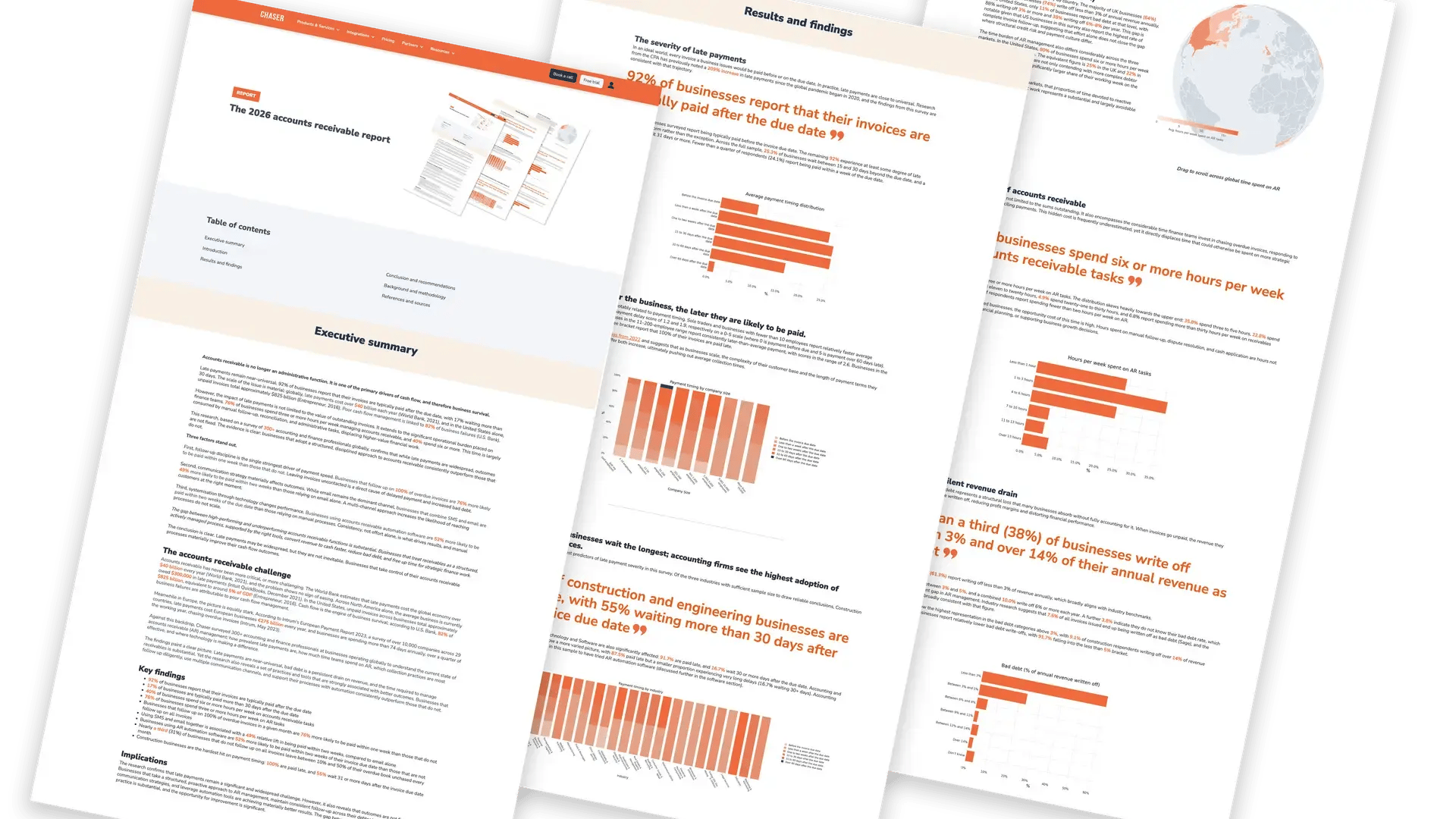
Late payment is the norm: in Chaser's 2026 accounts receivable report, 92% of businesses said their invoices are typically paid after the due date. You can't control every late payment, but you can control who gets credit and on what terms. A good application form is where that control starts. This guide covers what to include, gives you a US template and a UK template to copy, and explains how to assess a form when it comes back.
On this page
- What a business credit application is and when to ask for one
- The 12 sections every form should include
- A free US business credit application template to copy
- A free UK credit account application template to copy
- How to assess a returned form and set the credit limit
- The legal points to know in the UK and the US
What is a business credit application form?
A business credit application form, also called a trade credit application or, in the UK, a credit account application form, is a request from a business customer to buy from you now and pay later. The customer fills it in and signs it. You use it to decide whether to offer credit, how much, and on what terms.
The form does more than collect facts. The National Association of Credit Management (NACM) lists four purposes for a credit application: information for the credit decision, information for ordering and delivery, the customer's acknowledgment of your terms and conditions of sale, and information for collecting payment later. NACM also notes that, properly written, the application creates a contract between you and the customer. That is why the signature and the terms section matter as much as the company details.
It is the first step of the credit control process: everything that follows, from the credit limit to the first payment reminder, relies on what the form captured. If you are new to the discipline, start with what credit control is.
When should you ask for a credit application?
- Before the first order on credit terms. NACM advises using your application consistently for every prospect, so every customer is judged on the same information.
- When a customer asks for a higher limit. A fresh form and a fresh credit check show whether the risk has changed since you opened the account.
- When the customer's business changes. NACM recommends a new application whenever you learn of a substantive change in the customer's structure or organization, such as new owners or a sole trader incorporating.
- When an account has been dormant for a long time. Contacts, addresses, and finances may all have changed, so treat it like a new account.
What should a business credit application include?
Every form should let you identify the business, contact the people who pay, check the customer's credit, and prove later what was agreed. These are the 12 sections to include, drawing on NACM's guidance on structuring a credit application and on UK data protection rules. The templates below follow the same order.
| Section | What to ask for | Why it matters |
|---|---|---|
| 1. Legal identity | Legal name, trade name, business type, and registration number: the EIN in the US, the company number in the UK | Makes sure you contract with, invoice, and if necessary pursue the right legal entity |
| 2. Addresses | Registered or street address, billing address, and delivery addresses | Invoices sent to the wrong address can be paid late or missed |
| 3. Accounts payable contact | Name, direct phone, and email of the person who pays invoices, plus an invoice email address | Gives your reminders a named person to reach from day one |
| 4. Ordering rules | Who can place orders and whether invoices need a purchase order number | Invoices without a required purchase order number can get stuck in the customer's approval process |
| 5. Owners, directors, or officers | Names and positions, and home addresses only where you need them, such as for sole traders and partners | Shows who controls the business and who you may ask to guarantee the account |
| 6. Credit requested | The limit and payment terms the customer wants, and their expected monthly spend | Tells you how much risk you are being asked to take |
| 7. Tax details | VAT number in the UK; sales tax status and any resale or exemption certificate in the US | Lets you invoice the right tax from the first order |
| 8. Bank reference | Bank name, branch, contact, and the account details the bank needs to give a reference | Confirms the business banks where it says it does |
| 9. Trade references | Usually three suppliers that already give the customer credit, with a contact for each | Shows how the customer pays other suppliers |
| 10. Authorization and privacy wording | Permission to contact references and run credit checks, plus a UK privacy notice link | Lets references talk to you and tells applicants how their information is used |
| 11. Terms of sale | A statement that the customer accepts your terms and conditions, including payment terms and late payment charges | Makes your terms part of the contract from the first order |
| 12. Signature | Signature, printed name, position, and date, from someone authorized to sign; a personal guarantee only if your policy calls for one | NACM warns that an improperly signed application may be unenforceable |
Keep the form short enough that customers finish it. NACM's practice tip is to keep the application simple and direct, because an applicant faced with too much small print and legal language may not complete it. Put long terms and conditions in an attachment or behind a link, and refer to them in the signature section.
Free business credit application template: US version
Copy the template below into a document, add your logo, and replace every bracketed field. It is written for a US supplier selling on trade credit to other businesses. Before you use it, attach your terms and conditions of sale and have your attorney review the authorization and guarantee wording for your state.
[Your company name]: business credit application
[Your company address] | [Phone] | [Email for credit applications]
Please complete every section that applies, sign the form, and return it to [email]. Incomplete applications can't be reviewed.
1. Business details
Legal business name: ____________________
Trade name or DBA, if different: ____________________
Business type: [ ] Corporation [ ] LLC [ ] Partnership [ ] Sole proprietorship [ ] Other: ____________________
State of incorporation or organization: ____________________
Employer Identification Number (EIN): ____________________
Date business established: ____________________
Website: ____________________
Main phone number: ____________________
2. Addresses
Street address: ____________________
Mailing address, if different: ____________________
Billing address for invoices: ____________________
Delivery address or addresses: ____________________
3. Accounts payable and ordering
Accounts payable contact name: ____________________
Accounts payable email and direct phone: ____________________
Email address for invoices and statements: ____________________
Names and titles of people authorized to place orders: ____________________
Do invoices need a purchase order number? [ ] Yes [ ] No
4. Owners or officers
For a sole proprietorship or partnership, list the owners. For an LLC, list the members. For a corporation, list the officers.
Name, title, and business address: ____________________
Name, title, and business address: ____________________
5. Credit requested
Credit limit requested: $____________________ USD
Expected monthly purchases: $____________________ USD
Payment terms requested: [ ] Net 30 [ ] Other: ____________________
Sales tax status: [ ] Taxable [ ] Exempt or buying for resale. If exempt, attach a valid exemption or resale certificate.
6. Bank reference
Bank name and branch address: ____________________
Contact name, phone, and email: ____________________
Account type and account number, if the bank needs it for a reference: ____________________
7. Trade references
List three suppliers that sell to you on credit terms.
Reference 1 company, contact, phone, and email: ____________________
Reference 2 company, contact, phone, and email: ____________________
Reference 3 company, contact, phone, and email: ____________________
8. Authorization and agreement
The applicant certifies that the information in this application is complete and accurate, and that credit is requested for business purposes only, not for personal, family, or household use. The applicant understands that [Your company name] will rely on this information to decide whether to extend credit.
The applicant authorizes [Your company name] to obtain business credit reports and to contact the bank and trade references listed above, and authorizes those references to release information about their experience with the applicant.
The applicant agrees to [Your company name]'s terms and conditions of sale, attached or available at [link], including payment terms of [terms] and any late payment charges stated there.
Signature: ____________________
Printed name and title: ____________________
Date: ____________________
This form must be signed by an owner, officer, or another person authorized to sign for the business.
9. Personal guarantee: optional
Include this section only if your credit policy calls for a guarantee, and have your attorney write the guarantee wording.
Guarantor name: ____________________
Home address: ____________________
Guarantor signature, signed as an individual: ____________________
Date: ____________________
I authorize [Your company name] to obtain my personal credit report to evaluate this guarantee.
Signature: ____________________
Date: ____________________
For office use only
Date received: ____________________ | Credit check date: ____________________
Limit approved: $____________________ USD | Terms approved: ____________________
Approved by: ____________________ | Next review date: ____________________
A few notes on the US version. Leave out any question about race, color, religion, national origin, or sex: Regulation B bars creditors from asking, apart from narrow exceptions. If you plan to pull a personal credit report on an owner or guarantor, NACM suggests a separate authorization with its own signature line, which is why section 9 has one.
Free credit account application form template: UK version
The UK version asks for the same core information, using UK identifiers: the company registration number for limited companies and LLPs, and the VAT number. It also includes a short "how your information is used" section, because for sole traders, partners, and directors the form collects personal data. Link it to your own privacy notice, and ask your solicitor to review the declaration and any guarantee.
[Your company name]: credit account application
[Your company address] | [Phone] | [Email for credit applications]
Please complete every section that applies, sign the form, and return it to [email]. Incomplete applications can't be reviewed.
1. Business details
Registered business name: ____________________
Trading name, if different: ____________________
Business type: [ ] Limited company [ ] LLP [ ] Partnership [ ] Sole trader [ ] Other: ____________________
Company registration number, for limited companies and LLPs: ____________________
VAT registration number, if registered: ____________________
Date trading began: ____________________
Website: ____________________
Main phone number: ____________________
2. Addresses
Registered office address: ____________________
Trading address, if different: ____________________
Invoice address: ____________________
Delivery address or addresses: ____________________
3. Accounts payable and ordering
Accounts payable contact name: ____________________
Accounts payable email and direct phone: ____________________
Email address for invoices and statements: ____________________
Names and job titles of people who can place orders: ____________________
Do invoices need a purchase order number? [ ] Yes [ ] No
4. Directors, partners, or proprietor
For a limited company or LLP, list the directors or members. For a partnership, list the partners. For a sole trader, give the owner's details.
Name and position: ____________________
Name and position: ____________________
Home address, for sole traders and partners only: ____________________
5. Credit requested
Credit limit requested: £____________________ GBP
Expected monthly spend: £____________________ GBP
Payment terms requested: [ ] 30 days from invoice date [ ] Other: ____________________
6. Bank details for a bank reference
Bank name and branch address: ____________________
Account name: ____________________
Sort code and account number: ____________________
7. Trade references
List two or three suppliers that give you credit terms.
Reference 1 company, contact, phone, and email: ____________________
Reference 2 company, contact, phone, and email: ____________________
Reference 3 company, contact, phone, and email: ____________________
8. How your information is used
[Your company name] will use the information in this form to assess this application and to manage your account. To do this, [Your company name] will search the records of one or more credit reference agencies and contact the bank and trade references you give. This includes personal data about sole traders, partners, directors, and any guarantor. Full details, including how long information is kept and your rights, are in the privacy notice at [link].
9. Declaration
I confirm that the information in this application is complete and accurate, and that the account is for business use. I agree that [Your company name] may contact the bank and trade references above, and I ask those references to share information about their experience with this business.
I accept [Your company name]'s terms and conditions of sale, attached or available at [link], including payment terms of [terms].
Signature: ____________________
Printed name and position, such as director, partner, or proprietor: ____________________
Date: ____________________
10. Personal guarantee: optional
Use a separate guarantee document, written by your solicitor, if your credit policy calls for one. Each guarantor signs it personally.
For office use only
Date received: ____________________ | Credit check date: ____________________
Limit approved: £____________________ GBP | Terms approved: ____________________
Approved by: ____________________ | Next review date: ____________________
Notice that the UK version tells applicants about the credit search rather than asking for their consent to it. The legal section below explains why.
How does a customer fill out a credit application form?
Make the form easy to complete correctly and you will spend less time chasing missing details. Tell the customer:
- Who should sign. An owner, director, partner, or officer, not a junior buyer, so the signature binds the business.
- To use the full legal name. The registered name and number, not just the brand name on their website.
- To give a real accounts payable contact. A named person with a direct line, plus the inbox that receives invoices.
- To let their references know. That way the references expect your request and can answer it.
- Where to send it. One email address or online form, so applications don't sit in a salesperson's inbox.
How do you assess a returned credit application?
NACM's guidance is to treat what is on the application as unverified fact: the form tells you what to check, and the checks tell you what is true. Work through these steps for every new account.
1. Check the form is complete and signed
Send back any form with a blank legal name, registration number, accounts payable contact, or signature. Don't start the credit checks until you know which entity you are assessing.
2. Confirm the business exists as described
In the UK, search the Companies House register for the company number, registered office, and directors, and use GOV.UK's VAT number checker to confirm a VAT number is valid and registered to that business. In the US, check the entity's registration with the state where it says it is organized.
3. Run a credit check
A business credit report shows the customer's credit history, such as outstanding debts and payment history, and a credit score gives you a quick read of the risk. See how to run a customer credit check for the sources and red flags, and soft and hard credit checks for the difference between the two. With credit checking in Chaser, you can get a credit report and credit score for a prospective customer from the same software that automates your receivables.
4. Take up the references
Contact each trade reference and ask how long the customer has had an account, the credit limit, the terms, and whether they pay on time. Read the answers with care: NACM points out that applicants always give their best references, which aren't necessarily representative of how they pay everyone.
5. Weigh the five Cs of credit
The five Cs of credit give you a simple way to bring the evidence together.
| The C | The question | Where the answer comes from |
|---|---|---|
| Character | Is the customer willing to pay, and do the owners have a clean record? | Owners and directors on the form, credit report filings, trade references |
| Capacity | Can the business pay its debts on time and still generate cash? | Credit report, financial statements for larger limits |
| Capital | How much financial strength does the business have behind it? | Filed accounts or financial statements |
| Conditions | How exposed is the business to outside factors, such as changes in demand or regulation? | Your knowledge of the sector and the customer's markets |
| Collateral | Is there a second source of payment if cash flow falls short? | Assets offered as security, such as equipment or inventory, or a guarantee |
6. Set the credit limit and terms
Decide the limit and the terms, and they don't have to match what the customer asked for. For a customer you can't yet fully judge, one option is a lower starting limit that you review after a few months of on-time payments. See how to set credit limits for methods, and write your rules down in a credit control policy so every application is judged the same way.
7. Record the decision and tell the customer
Fill in the office-use box: who approved the account, the limit, the terms, and the next review date. Then tell the customer in writing. In the US, Regulation B sets timing rules for this notice, which the legal section covers.
What happens after you approve the account?
The application has done its job when the first invoice is paid on time. Turn what it captured into how you run the account:
- Confirm the account in writing. State the credit limit, the payment terms, the invoice email address, and any purchase order rules, so there is no doubt about what was agreed.
- Put the terms on every invoice. Show the due date and how to pay. See what payment terms are and how to set them.
- Load the accounts payable contact. Your reminders should go to the person who pays from the first invoice, not to the buyer who placed the order.
- Remind before the due date. A friendly note before the due date can catch invoices that are stuck in approval while there is still time to fix them.
- Watch for changes. Review the limit on the date you set, and sooner if the customer starts paying late.
Chaser helps you run that part automatically. It connects to your accounting system and lets you set up as many automatic payment reminders as you need, by email and SMS, across multiple schedules, so each customer is chased on the terms you agreed. With credit monitoring, you can monitor every customer's credit risk with alerts, which helps you prevent bad debt losses. See Chaser's credit control software for how it works.
Legal points to know
Your terms of sale and any guarantee are contract documents, so have a lawyer review them. A few data protection and fair lending rules also apply to the form itself, and they differ between the UK and the US.
UK: data protection and guarantees
- Company data isn't personal data, but some of the form is. The ICO explains that information about a limited company isn't personal data, while UK GDPR does apply to information about sole traders, partners, employees, and directors as individuals. A form from a sole trader or partnership, and the director and guarantor sections of any form, collect personal data.
- Tell applicants about credit checks rather than asking for consent. The ICO's guidance on credit says data protection law doesn't require an organization to have your consent before it searches your credit file, as long as it has a lawful basis and you have been told the search will take place. Its consent guidance gives the example of a credit card company that asks for consent to share data with credit reference agencies but would do it anyway: the ICO calls that misleading and says the company should have relied on legitimate interests from the start, while still telling customers.
- Give applicants your privacy information. Under the right to be informed, you must tell people your purposes for using their personal data, how long you keep it, and who you share it with. A short section on the form linking to your privacy notice covers this. The ICO notes this guidance is under review after the Data (Use and Access) Act, so check it for updates.
- Put guarantees in writing. In England and Wales, section 4 of the Statute of Frauds 1677 means no court action can be brought on a promise to answer for another person's debt unless the agreement, or a note of it, is in writing and signed by the guarantor or someone they authorized.
US: the Equal Credit Opportunity Act and Regulation B
- Regulation B covers business credit. The Equal Credit Opportunity Act (ECOA) is implemented by Regulation B, which defines business credit as credit primarily for business or commercial purposes and sets notification rules for business credit applicants.
- Trade credit has the lighter notification rules. For an extension of trade credit, and for a business with gross revenues over $1 million USD in its preceding fiscal year, you must tell the applicant of the action you took within a reasonable time, orally or in writing. If you decline and the applicant asks in writing within 60 days of your notice, you must provide a written statement of reasons and the ECOA notice. The official interpretation describes trade credit as a financing arrangement between a buyer and a seller, such as a supplier who finances the sale of equipment, supplies, or inventory. Applications for other business credit from businesses with revenues of $1 million USD or less follow fuller rules.
- Keep the records. For trade credit, Regulation B requires you to keep records for at least 60 days after you notify the applicant, and longer if they ask in writing in that time for reasons or for the records to be kept.
- Don't ask prohibited questions. Regulation B bars creditors from asking about race, color, religion, national origin, or sex, apart from narrow exceptions.
- Don't require a spouse as guarantor. If your credit standards call for a guarantor, Regulation B lets you ask for one. The applicant's spouse may serve as guarantor, but you can't require that the spouse be the one.
This section is general information for businesses, not legal advice. Laws change and depend on your circumstances, so ask a qualified solicitor or attorney to review your credit application, terms of sale, and any guarantee before you use them.
Common mistakes with credit application forms
- Extending credit before the form comes back. NACM calls the application the best time to get information and agreement to your terms. Once goods have shipped, the customer has less reason to sign.
- Accepting a trading name instead of the legal entity. You can only pursue the business that signed.
- No named accounts payable contact. Your first reminder goes to a generic inbox or to the buyer, and the invoice waits.
- Asking for more personal data than you use. In the UK, collect home addresses and personal details only where you need them, such as for sole traders, partners, and guarantors.
- Setting the limit once and never reviewing it. Put a review date on every approval and keep to it.
FAQs
What is a business credit application form?
A business credit application form is the document a business customer completes before a supplier sells to them on credit terms. It records who the customer is, how to contact their accounts payable team, their bank and trade references, and the credit limit and terms they want. Once signed, it also records their agreement to the supplier's terms of sale and their authorization for credit checks and reference requests.
What is the purpose of a credit application?
A credit application gives you the information you need to decide whether to offer credit, how much, and on what terms. It also gives you the details you need to invoice and collect, such as the accounts payable contact and purchase order rules, and a signed record that the customer accepted your terms of sale. If an invoice is disputed or goes unpaid later, the signed form is one of the first documents you will rely on.
Who fills out the credit application form?
The customer does. Someone with authority to sign for the business, such as an owner, director, partner, or officer, completes and signs it, sometimes with help from their accounts payable team. Your credit team then checks the details, runs the credit and reference checks, and records the decision in the office-use section.
How do I create a credit application form?
Start with the template on this page and adapt it to your business. Include business details and registration numbers, addresses, an accounts payable contact, owners or directors, the credit limit and terms requested, bank and trade references, an authorization for credit checks, acceptance of your terms of sale, and a signature block. Add a privacy notice link for UK applicants and have a lawyer review the final wording, especially any personal guarantee.
What is a credit account application form?
It is the usual UK name for a business credit application. A supplier asks a new trade customer to complete one before opening a credit account, so the customer can order now and pay later on agreed terms. It asks for the same core details as a US form, but uses UK identifiers such as the company registration number and VAT number.
Do you need consent to run a credit check on a business customer?
In the UK, information about a limited company itself isn't personal data, but information about sole traders, partners, and directors is. The ICO says data protection law doesn't require consent for a credit search as long as the organization has a lawful basis and has told the person the search will happen. So tell applicants about the check in the form and your privacy notice, rather than asking for consent you would not act on. In the US, NACM suggests a separate signed authorization before you pull a personal credit report on an owner or guarantor.
Do you have to tell a business why its credit application was declined?
In the US, Regulation B covers business credit. For trade credit, and for businesses with gross revenues over $1 million USD, you must tell the applicant within a reasonable time, orally or in writing, what you decided. If you decline and they ask in writing within 60 days of your notice, you must give a written statement of reasons and the ECOA notice. Whatever the rules where you trade, a short, polite explanation helps keep the relationship.
Should a credit application include a personal guarantee?
Only when your credit policy calls for one, for example a large limit for a young company with little credit history. Keep the guarantee separate from the main signature, with each guarantor signing personally. In England and Wales a guarantee must be in writing and signed by the guarantor to be enforceable in court. In the US, Regulation B lets you ask for a guarantor when your credit standards require one, but you can't insist that the applicant's spouse is the guarantor.
Check new customers and get paid on the terms you agreed
Chaser lets you pull credit reports, monitor customer credit risk with alerts, and send automatic, personalized payment reminders, all from the software that connects to your accounting system.
Start your free trial Book a demoThis article is general guidance for businesses, not legal advice. For advice on a specific contract, guarantee, or credit decision, speak to a qualified solicitor or attorney. Last reviewed 3 October 2026.
.png)