



















.svg.png?height=48&name=Zoho_CRM_(application).svg.png)







Most B2B revenue forecasts are built on what customers should pay, not when they actually will. The model itself is usually sound, but the numbers often come out wrong when cash that the forecast expected this month lands next month.
A quarter that looked covered comes up short. And the gap is never quite where anyone is looking, so it gets explained away as a one-off — until it happens again the next quarter, and the one after that.
For a mid-market finance team managing 30, 60, or 90-day terms across a debtor book of variable payers, that gap is the difference between a forecast you allocate capital against and one you distrust.
Beyond an inaccurate spreadsheet, inaccurate forecasting means you risk a hiring decision made too early, an investment deferred too late, or a board forecast that erodes your credibility every time it misses.
This guide walks through building a revenue forecast around your AR cycle:
- Why standard forecasting methods rarely help AR businesses,
- Which method fits which context,
- What to do when the data is incomplete, and
- How to make the forecast reflect actual AR behavior.
At the end, you’ll walk away with a forecasting strategy that reduces days' sales outstanding (DSO) and improves your cash flow visibility.
Why standard revenue forecasting breaks down for AR businesses
The typical B2B revenue forecasts miss the mark for AR businesses because clean data isn't prioritized. The inflow side runs on payment-term assumptions. But payment terms are not customer behavior. A customer on 30-day terms who has paid at 52 days for the last eight invoices is, for forecasting purposes, a 52-day payer. The term says 30. The model adopts the term. But the cash arrives three weeks after the forecast.
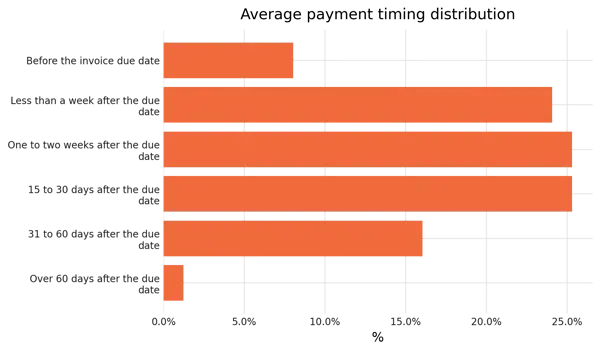
This isn't unique to one business. 92% of businesses report that their invoices are typically paid after the due date, and 17% are typically paid more than 30 days late. Forecast fails to predict the behavior, which is why a model built on correct methods still produces a wrong number.
Two common approaches in particular prove ineffective in similar and predictable ways. These approaches are:
1. Pipeline-based forecasting
Pipeline-based forecasting assigns closing probabilities to deals based on the stage they sit in. A deal in Proposal might carry 60%, one in Negotiation 80%, and the forecast weights expected revenue accordingly.
The problem is that those probabilities are assigned by convention, not by actual buyer behavior. Stage progression does not equal buying intent. In complex B2B sales with long cycles and procurement involvement, a deal sitting at 80% can disappear overnight with nothing visible in the customer relationship management (CRM) system to warn you.
Imagine a scenario where the forecast shows revenue weighted to close, mostly late-stage deals at 60 to 80% probability. Then a message arrives: two of those deals have been pushed to the next quarter after procurement flagged budget timing. A large chunk of expected revenue vanishes with no time left to pivot.
The natural question is how those deals were at 80% the day before. The answer is that nothing changed in the stage. Reality simply intervened, and the stage never reflected it.
2. Historical trend forecasting
Historical trend forecasting assumes future sales will mirror past performance. It takes prior periods, extrapolates the pattern forward, and produces a number.
This approach is inefficient for a growing business for two reasons:
- First, it has no mechanism to account for structural changes such as a new product launch, a pricing change, or a shift in customer mix. It assumes the shape of the past holds. For a business that is actively changing shape, that assumption does not survive contact with the next quarter.
- Secondly, it offers no visibility into the current period's receivables. Because it's backward-looking by design, it cannot tell you whether the cash you are counting on is actually on its way or quietly slipping.
Ultimately, approaches with a low forecast accuracy make effective working capital management near-impossible, and the consequences can be steep. Late payments cost the global economy over $40 billion a year, and 82% of business failures are linked to poor cash flow management. A forecast that misses is, in practice, working capital that you cannot see clearly enough to manage.
Now, let’s take an in-depth look at the forecasting methods available, which context each one suits, and then address the layer that all of them depend on: the accuracy of the inflow data feeding the model.
How to forecast revenue with AR performance in mind: step-by-step
You already understand why forecasting matters. What follows is the process itself, built so that each step addresses a specific decision.
Step 1: Define the forecast period and business context
Before choosing a method, define two things: the forecast horizon (monthly, quarterly, or annual) and the revenue model driving the business (recurring subscription, project-based, transactional, or mixed). Together, these determine which forecasting method will actually be reliable.
A subscription business with consistent monthly recurring revenue can use trend-based or run-rate methods with confidence. But a project-based B2B services business with lumpy invoicing and variable payment timing needs a different approach.
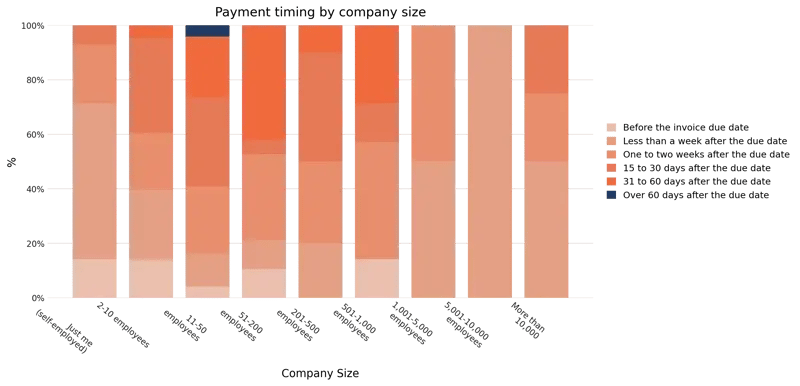
It's also important to consider that forecasting problems could worsen as businesses scale. Mid-sized businesses (11–200 employees) report consistently later-than-average payment, and businesses in the 201–500 bracket report 100% of invoices paid late.
Applying the wrong method to the wrong revenue model is a structural source of error before a single number is entered. That’s why this step is key to increasing cash flow with AR management.
Step 2: Choose the right forecasting method for your business
There are three core methods available to B2B finance teams. The goal here isn't to learn all three equally, but to identify which one fits your business. Method selection is context-dependent rather than a matter of picking the most sophisticated option.
|
Method |
Best suited for |
Breaks down when |
|
Run-rate / trend-based |
Businesses with consistent monthly recurring revenue (MRR) or stable historical growth patterns |
The business has undergone structural changes, or growth is lumpy |
|
Pipeline-based (weighted) |
Sales-led businesses with defined stage probabilities across short cycles |
Deals are complex, long-cycle, or procurement-driven, where stage does not equal intent |
|
Bottom-up (driver-based) |
Finance teams building from unit economics: headcount, capacity, or contract value |
Data is inconsistent, or granular inputs are not tracked reliably |
Run-rate forecasting takes current performance and projects it forward at a steady rate. It suits businesses with stable, recurring revenue and falls apart the moment growth becomes uneven.
Pipeline-based forecasting weights expected deals by stage probability. It suits short, predictable sales cycles and fails in complex environments where a deal's stage tells you little about whether it will actually close.
Bottom-up, driver-based forecasting builds the number up from underlying inputs such as headcount, capacity, or contracted value. It suits teams that track those inputs reliably and breaks down when the granular data is inconsistent or simply not captured.
No single method is the be-all and end-all. The point of choosing carefully is that the method has to match the business. Essentially, whether you’re using a spreadsheet or cash flow forecasting software, the real determinant of accuracy comes later with the quality of the inflow data.
Step 3: Gather and clean your revenue data
Regardless of method, a B2B revenue forecast needs four inputs:
- Historical revenue by period
- Current pipeline by stage and value
- Contracted recurring revenue, and
- Outstanding receivables (meaning how much is owed and by whom)
The harder question is what to do when that data is incomplete or unreliable.
For a newer business without enough history, run-rate methods are unreliable because there is no stable pattern to extrapolate. A bottom-up, driver-based approach using capacity, headcount, or contract value is more dependable because it builds from inputs you can actually observe rather than a trend you don’t have yet.
For a business with inconsistent payment data, the constraint is different. The model's inflow accuracy will be limited by how well the business understands when customers actually pay. That means clean historical revenue will not save a forecast if the timing of incoming cash is guesswork.
If gathering and cleaning this data is consuming the team, it may be worth understanding how accounts receivable outsourcing handles the underlying collection process that generates the data in the first place.
Step 4: Model the inflow side accurately
Every forecasting method above depends on the inflow side being accurate. If the model assumes customers will pay in 30 days, but your actual DSO is 58, the forecast will be structurally wrong, no matter how well the model is built. This is the step most guides skip, and it's where forecast accuracy is genuinely won or lost.
There are two ways to model inflow, and the difference between them is the difference between a forecast that holds and one that drifts. The two methods are:
- Payment-term-based: It assumes payment arrives on or near the invoice due date. It’s simple, but it’s usually wrong for any business whose customers pay late (which is most B2B businesses).
- Behavior-based: It models payment timing from each customer's actual payment history. For a business with 10, 50, or 100 customers, this approach is feasible and materially more accurate. The finance team already holds the data, because it lives in the AR aging report and the collections history.
However, collections history is only as reliable as the process behind it. Businesses that follow up on 100% of overdue invoices are 76% more likely to be paid within one week than those that do not. The same discipline that produces that result also produces a consistent payment record that the forecast can actually trust.
In practice, behavior-based inputs look like this: average days to pay by customer, payment pattern consistency (do they always pay late, or always early), and whether a specific customer is showing unusual delays relative to their own history.
These signals already exist in the AR system. Most forecasting models simply do not use them, which is why a correctly built model can still produce a wrong number.
Behavior-based inputs are exactly what a receivables forecast draws on, so you can see what's due, what's overdue, and when payment is realistically likely to land.
Step 5: Set assumptions, stress-test scenarios, and monitor
Once the model is built, state its assumptions explicitly. Payment timing, churn rate, and pipeline conversion should be written down as deliberate inputs, not left undocumented where no one can challenge or revise them.
Then stress-test. Run at least two scenarios alongside the base case: a downside case where key customers delay and a deal slips, and an upside case with strong collections and accelerated closes.
The purpose isn’t to produce three competing forecasts. It’s to understand the range of outcomes and, more importantly, to identify what signals would indicate the business is drifting toward the downside.
Finally, monitor the right cadence. A revenue forecast should be reviewed weekly or fortnightly, not monthly, so that emerging signals in AR collections or pipeline activity can update the model before they affect actual cash. Tightening that loop is the core of building real-time cash flow visibility into the finance function.
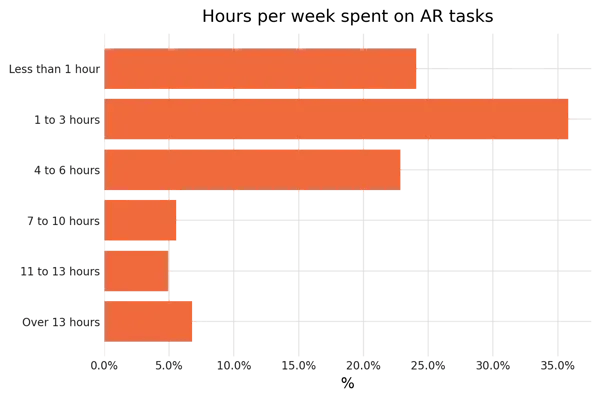
The obstacle here is rarely willingness, but time. 40% of businesses spend six or more hours per week on AR tasks, and 76% spend three or more — hours displaced from the forecasting, planning, and growth decisions a tighter review loop depends on. When the manual chase consumes the week, fortnightly forecast reviews are the first thing to slip.
How Chaser makes revenue forecasts more accurate
Most revenue forecasting guides stop at Step 5. The forecast is built, assumptions are stated, and scenarios are modeled. The structural problem, that the inflow side is built on payment term assumptions rather than actual customer behavior, is left unsolved.
AR automation tools improve revenue forecasting by building predictions based on customer behavior, rather than payment term assumptions. Chaser’s latest accounts receivable report shows that among the 43% of businesses that have tried AR software, 71% are paid within two weeks, against 47% of those that haven't.
That’s because the system executes collection while collecting the customer behavioral data that makes a B2B revenue forecast accurate. Not what customers should pay, but how and when they actually do.
Here’s how you can generate forecasts you can defend in board rooms with Chaser:
Revenue Forecast tool: built on how customers actually pay
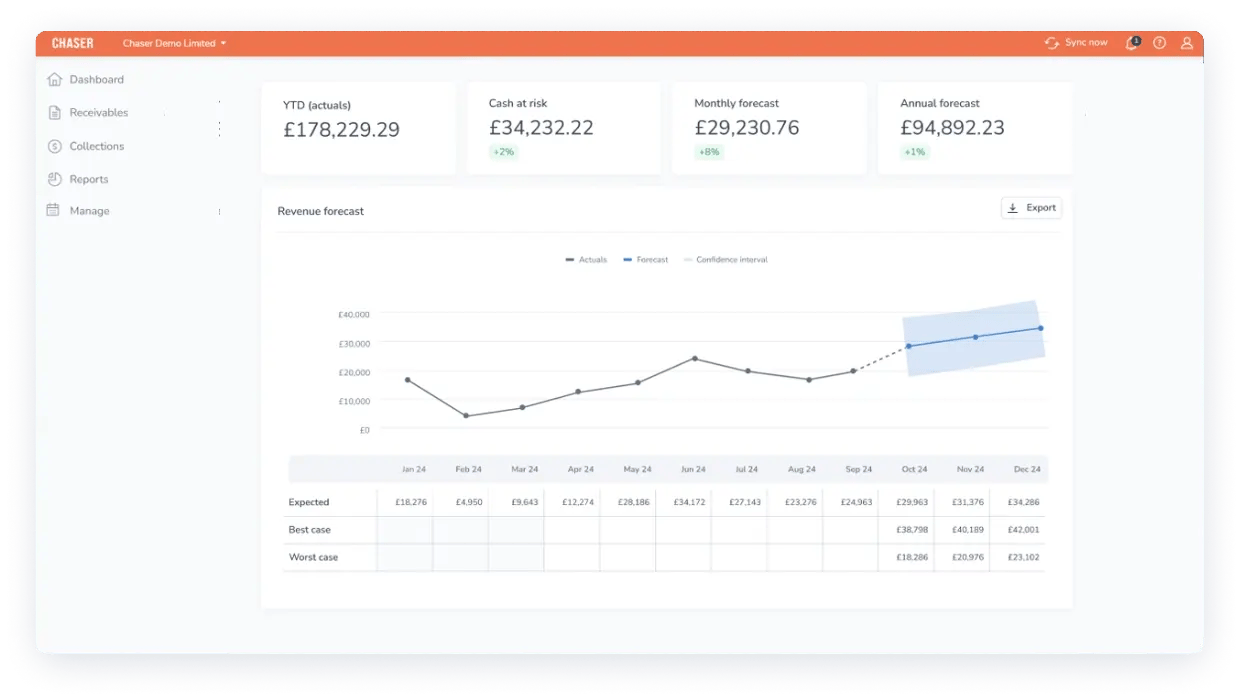
Chaser's Revenue forecast tool generates cash inflow projections by drawing on over 65 data points per customer, including individual payment history, geo-specific economic conditions, and seasonality.
Why does that distinction matter? Well, accounting software records what is owed based on invoice terms, but Chaser models when payment will actually arrive based on how that specific customer has behaved. That means a customer who consistently pays at 50 days on 30-day terms is forecast at 50 days, not 30.
Late Payment Predictor: flag inflow risk before it becomes a miss
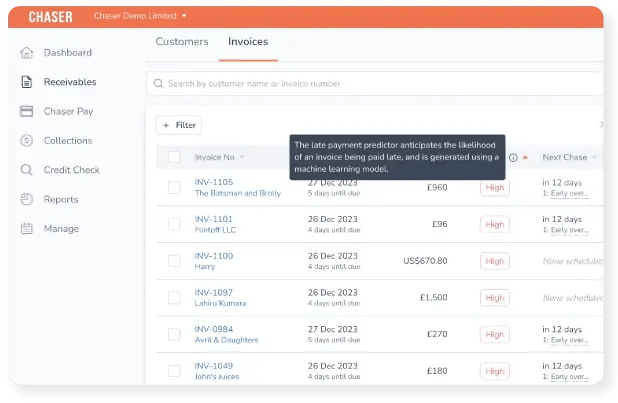
At-risk invoices can be flagged before they’re due, scored on the Late payment predictor using due date, invoice value, and the customer's payment history.
For a finance team building a revenue forecast, this is the signal layer that moves forecasting from reactive to proactive. Instead of updating the model after a payment is missed, you adjust the inflow projection before the miss happens.
The gap between a forecast and reality is most often the result of not knowing, in advance, which customers are going to pay late. Knowing earlier is what closes the gap.
AR automation that produces consistent, reliable collections data
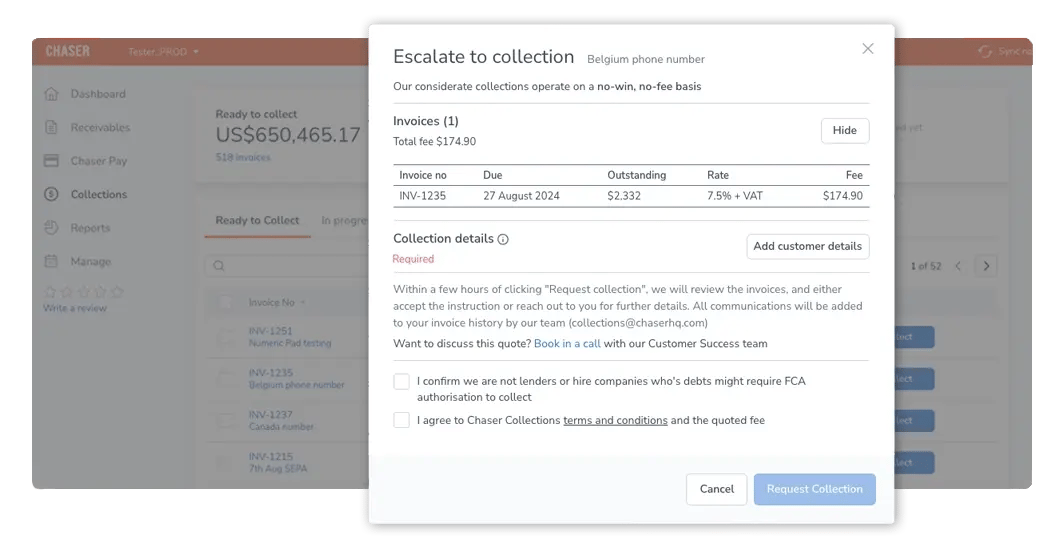
A forecast is only as good as the collections data underneath it, and a team that chases manually and inconsistently produces AR data that reflects neglect rather than customer behavior.
In fact, among businesses that don't follow up on everything, 46% leave 10–30% of their overdue books unchased each month. The payment patterns it generates are not genuine signals. They are artifacts of an inconsistent process, and a model trained on them will mislead.
Consistent AR automation removes that noise. When every overdue invoice is followed up on schedule, the payment patterns that emerge are real and are what the Revenue Forecast Tool draws on to produce accurate inflow projections.
The multi-channel capability across email, SMS, calls, and letters is the mechanism that maintains this consistency across a debtor book of any size. But the AR forecasting outcome is the focus.
Proven result: Huttie Group
Huttie Group is a mechanical and electrical contractor in Cambridge. Before Chaser, Tom Hays, Head of Finance, was spending two to three days each month on credit control, with no guarantee of a response or a payment at the end of it.
After implementing Chaser, over 80% of outstanding invoices were paid, and in Tom Hays' own words, cash flow forecasting became correct, and the team could budget accurately for the first time. This proves that a better collection of data produces a more accurate forecast. Read the full Huttie Group case study for the details. See how Chaser improves cash flow forecasting accuracy.