



















.svg.png?height=48&name=Zoho_CRM_(application).svg.png)







Working capital management is usually taught as a three-lever problem: tighten AR, extend AP, reduce inventory. For most B2B service businesses, that framing needs correcting.
Inventory often isn't part of the model. AP extension requires supplier leverage that mid-market businesses rarely have. In practice, there is one lever that actually moves: receivables. The businesses that manage working capital well aren't running a balanced optimization across three variables. They're running a disciplined AR operation and treating everything else as context.
Most AR management isn't disciplined in that way. Invoices get chased when someone has time, or when month-end surfaces an aging report that was already three weeks stale.
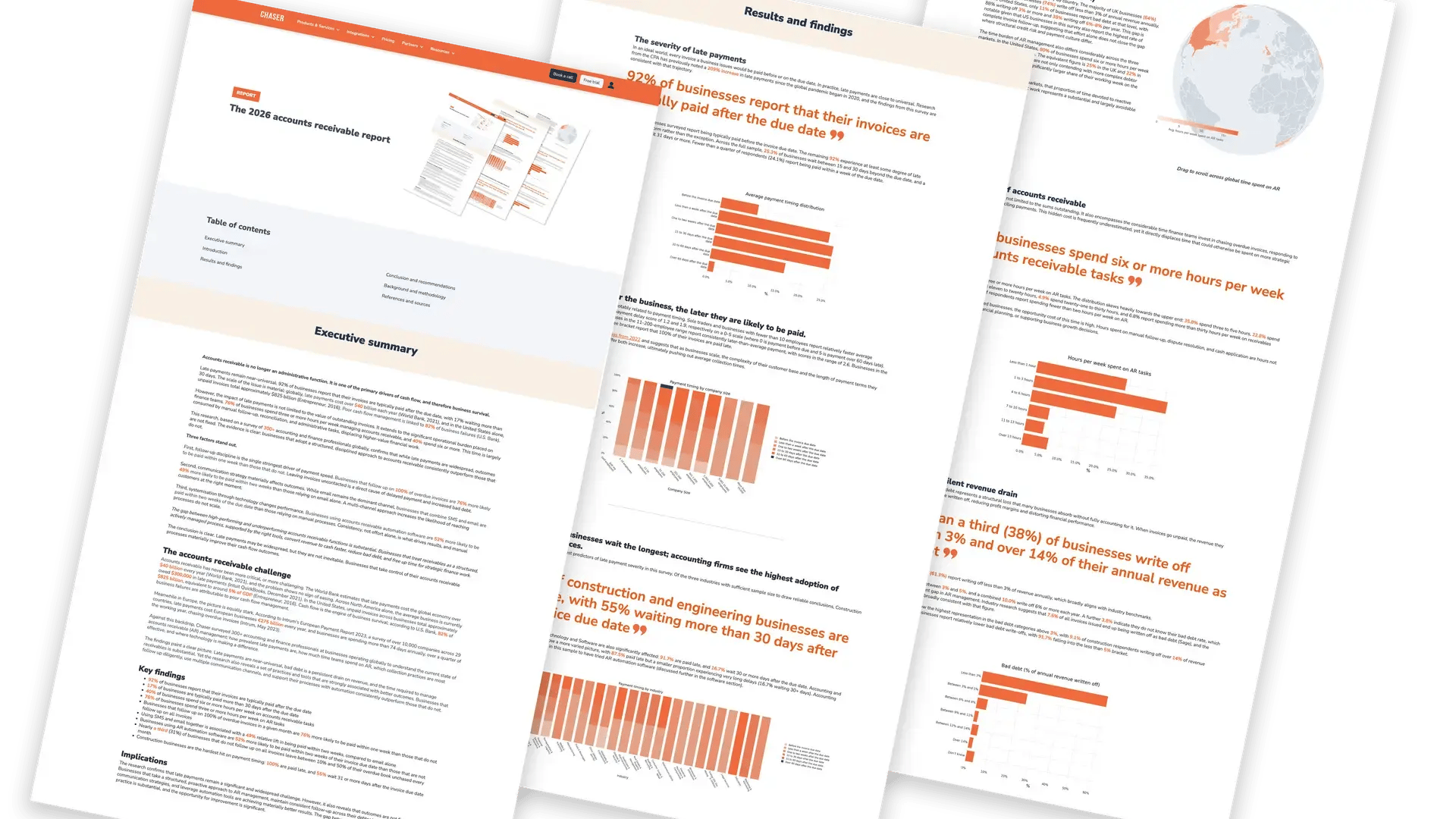
According to Chaser's 2026 AR report, 92% of businesses are paid late, but the gap between those that collect predictably and those that don't isn't explained by customer behaviour. It's explained by the consistency of their own process.
The answer is to stop managing working capital as a periodic financial exercise and start running AR as a continuous operational discipline.
That means every overdue invoice followed up on a consistent schedule, visibility real-time rather than month-end, and action taken before cash gets trapped rather than after.
This guide covers five principles for doing that: what the working capital number actually tells you, how to use the cash conversion cycle to locate your bottleneck, why AR is the primary lever for most B2B service businesses, how to build real-time visibility, and when external financing is a genuine complement rather than a sticking plaster.
Why most approaches to working capital management keep failing
Working capital gets managed periodically when the problem is continuous. By the time the number looks bad on a monthly report, cash has been trapped for weeks.
Three patterns keep showing up in how finance teams approach this, and each one makes the problem harder to solve.
Monitoring ratios monthly
By the time the working capital ratio moves, you already know cash has been sitting idle long enough to create a real gap. What you don't know is which invoices drove it, which customers changed their behavior, or what to do first. Monthly monitoring confirms damage after the fact, with no indication of where to start.
Applying all three levers without diagnosis
The standard playbook says to improve AR, extend AP, and reduce inventory, assuming all three levers are equally accessible. For a B2B service business, they aren't. Inventory often isn't part of the model. AP extension requires supplier leverage that most mid-market businesses can't exercise. Without knowing which lever is actually moving the gap, effort gets spread thin, and the bottleneck compounds.
Filling gaps reactively
Ad hoc chasing and short-term credit lines address the pressure of the moment. The payment behaviour that created the gap remains unchanged, and the process that would prevent it from recurring next quarter never gets built.
The cost of this pattern is measurable. The same Chaser AR report found that 40% of finance teams spend six or more hours per week on AR tasks, and 76% spend three or more hours — time that is largely consumed by reactive chasing rather than structured process. The constraint isn't capacity. It's the absence of a system that runs without someone pushing it.
The five principles of continuous working capital management
Working capital management works when it runs continuously, not when it surfaces at month end. The five principles below move a finance team from reactive gap-filling to proactive cash availability. For most B2B service businesses, that process consistently points to one primary lever: accounts receivable.
Principle 1: Understand what working capital actually tells you and what it does not
The working capital formula (current assets minus current liabilities) signals whether a liquidity problem exists. A positive position means current assets exceed obligations. In subscription or prepaid models, a negative position can reflect operational strength rather than financial stress. A healthy ratio can still coexist with a genuine cash gap when receivables are aging, and obligations are landing on schedule.
Two ratios are commonly used as health checks. The working capital ratio divides current assets by current liabilities. The quick ratio removes inventory from current assets to test whether the business can meet short-term obligations without relying on stock conversion.
Locating the problem means pulling apart DSO, DIO, and DPO individually, since trade receivables, inventory, cash, and accounts payable each move at different speeds and respond to different actions. Knowing which one is driving the position is what turns a balance sheet warning into a prioritized decision.
For most B2B service businesses, that investigation points to receivables.
Principle 2: Use the cash conversion cycle to diagnose your bottleneck before acting
The cash conversion cycle tells you exactly where cash is getting stuck and which lever to prioritize before spreading effort across AR, AP, and inventory. It combines three metrics into a single diagnostic: DSO plus DIO minus DPO. The shorter the cycle, the faster cash moves through the business.
- DSO (Days Sales Outstanding): how long customers take to pay after invoicing
- DIO (Days Inventory Outstanding): how long inventory sits before it's sold
- DPO (Days Payable Outstanding): how long you take to pay suppliers
All three move at different speeds and respond to different interventions.
Consider a B2B service business with a DSO of 58 days, a DIO of zero (no inventory), and a DPO of 30 days. The cash conversion cycle sits at 28 days, and the entire gap sits in receivables. That single calculation makes the priority obvious without spreading effort across levers that don't apply.
For most B2B service businesses, the cash conversion cycle diagnosis points to the same place almost every time: receivables. The cycle is the tool that makes that conclusion data-driven rather than assumed.
Principle 3: Prioritize AR as the primary lever for B2B service businesses
For a B2B service business, the current assets side of your working capital equation comes down to receivables. The bottleneck is almost always here, and it's also the fastest one to move.
Treating AR as an operational system changes three things in practice. Chasing runs on a consistent schedule rather than when someone finds time. Visibility into customer payment behavior flags risk before invoices go overdue. And the payment process has low enough friction that customers can settle quickly when they're ready. When those three things work together, DSO tracks below payment terms rather than drifting past them.
Reducing how long customers take to pay unlocks cash earlier without changing revenue, raising prices, or renegotiating supplier terms. For most B2B service businesses, no other lever delivers that speed.
The data makes the case directly: businesses that follow up on 100% of overdue invoices are 76% more likely to be paid within one week. Those using AR automation are 52% more likely to be paid within two weeks than those relying on manual processes. The difference between those outcomes and the average isn't customer behaviour. It's whether the AR process runs consistently or only when someone has time.
Chaser connects directly to live receivables data, showing which invoices to prioritize, which customers are showing signs of delay, and when to follow up for the best chance of payment. That visibility keeps AR management running continuously rather than kicking in when things get tight.
Principle 4: Make working capital management continuous not periodic
Most finance teams find out DSO has deteriorated when the month-end report lands. By then, the accounts driving it have been aging for weeks, the window to act early has closed, and the gap is already in the numbers.
The finance teams that stay ahead of this run a different cadence: DSO tracked weekly rather than monthly, aging buckets reviewed in real time, and customer-level payment behaviour visible as standard. That means unusual delays are flagged before an invoice crosses its due date, not after it surfaces in a report three weeks later.
That cadence requires live data. Periodic aging reports and spreadsheet-based tracking are already stale by the time anyone looks at them.
Chaser's live sync with your accounting software gives you real-time DSO trends, aging bucket visibility, customer-level payment behavior, and risk signals across your receivables, turning working capital management from a monthly review into a daily operational discipline.
Principle 5: Know when financing is the right complement
Invoice financing and short-term credit facilities have a legitimate role: bridging timing gaps during growth phases or seasonal peaks. Drawing on external financing while DSO is high and payment behavior is inconsistent doesn't change what caused the gap.
The invoices keep aging, the interest keeps accruing, and a structural AR problem funded by short-term credit quietly becomes more expensive than it first appeared. Left unaddressed, it also increases exposure to bad debt and the kind of B2B debt collection that becomes necessary when receivables have been deteriorating for too long.
The right sequence is AR first. Once DSO is reducing consistently and your cash position is predictable, financing becomes a strategic tool you reach for by choice. Lenders and invoice financiers price risk based on the quality and consistency of your receivables, so a healthier AR position also translates directly into better terms and lower rates when you do need external capital.
How to implement this framework with Chaser
The gap between knowing what to do and being able to do it every day is usually an infrastructure problem. The five principles above require live data, consistent follow-up, and visibility at the account level. Chaser provides the operational layer that makes each one workable in practice, not just in theory.
Real-time visibility into where working capital is trapped
Most AR tools show you what has already gone wrong. Chaser is built around a different premise: that the finance team should be acting on signals before invoices become a problem, not compiling reports after they already are.
Chaser's live sync with your accounting software means DSO trends, aging buckets, and customer-level payment behaviour are continuously current rather than month-end snapshots. When a customer starts showing signs of delay like payment behaviour shifting and invoices clustering in a particular aging bucket, that signal surfaces in Chaser before the invoice crosses its due date. The window to act early stays open because the data never goes stale.
Consistent AR management that reduces DSO
The reason 31% of businesses leave invoices unchased every month is that manual processes run on whoever has time, and time is finite. Chaser's automated follow-up sequences mean chasing happens across every overdue invoice on a consistent schedule, regardless of workload.
What makes this different from a generic automation tool is where the intelligence sits. Chaser's Recommended chasing times identifies the optimal contact window for each individual customer based on their payment history, increasing the likelihood of a response without increasing the volume of contacts.
The Payment Portal removes friction at the point a customer is ready to pay, cutting the lag between intent and settled invoice. The result is that DSO comes down and stays down because the process doesn't depend on someone pushing it.
Cash flow forecasting built on receivables intelligence
Most cash flow forecasts use the invoice due date as a proxy for when cash will actually land. For finance teams with customers who routinely pay late, that assumption makes every forecast systematically optimistic.
Chaser's forecasting is built on debtor Intelligence: a customer-level analysis of payment behaviour and risk that replaces the due date with a prediction of when each invoice is likely to be settled. The cash flow forecast reflects how your customers actually pay, not how your payment terms assume they will.
Proven results: Glaze Digital
Glaze Digital cut average days to pay from 88 to 64 days using Chaser outsourced credit control, freeing cash 24 days earlier. For a Belfast marketing agency with no inventory, that is a direct working capital improvement with no change to revenue or pricing. The mechanism was straightforward: consistent, scheduled follow-up across every invoice, running without manual intervention.
Most finance teams only see where working capital is stuck after the damage is done. See how Chaser gives you the visibility to stay ahead of it.


%20-%20Accounts%20receivable%20process_%20Challenges.%20examples%2c%20and%20how%20to%20improve.webp)