


















.svg.png?height=48&name=Zoho_CRM_(application).svg.png)






%20-%20AR%20collection%20process.webp?length=1248&name=Blog%206%20(Nov)%20-%20AR%20collection%20process.webp)
Most finance teams do not need another textbook explanation of the accounts receivable collection process. The problem is not a lack of theory. It is the reality of living inside a broken process every day.
- Emails go out manually
- Spreadsheets never quite match the ERP
- Remittance advice lives in inboxes
- Fridays disappear into reconciling partial payments
Instead of acting as a strategic partner to the business, the finance function ends up feeling like a call center and data entry team.
That grind is not just annoying. A weak collections process effectively gives customers a free, high interest loan. Cash that should be paying vendors, funding growth, or reducing debt sits trapped in unpaid invoices. The result is strained working capital, reliance on credit lines, and constant anxiety about whether upcoming payments will clear.
This guide takes a different approach. Instead of simply listing steps in the accounts receivable collection process, it offers a practical three part framework built on process, technology and data. The goal is simple. Move from chasing to actually getting paid. Turn collections from a cost center into a predictable cash flow engine.
Think of it as swapping an informal IOU system for a disciplined funding operation. Customers still receive credit, but that credit is controlled, monitored and collected in a way that protects cash and relationships at the same time.
The real cost of a broken collections process (it is more than just late payments)
Slow payments are the visible symptom. Underneath sits a collection of operational and financial problems that quietly eat away at cash, capacity and relationships.
The daily grind of manual firefighting
In many businesses, the accounts receivable collection process looks like this.
- Export data from the accounting system into Excel
- Sort and filter to work out who is overdue
- Cross check email threads to see who has been contacted
- Chase each customer individually from a personal inbox
- Try to match partial payments, credit notes and deductions back to invoices
- Update the spreadsheet manually so nothing is missed
That cycle repeats every week. New invoices are added. New exceptions appear. The ledger never quite aligns with reality.
The cost is not just hours lost. Firefighting crowds out higher value work such as credit risk analysis, customer relationship building, and strategic planning. The team constantly reacts to problems instead of shaping a better process. Burnout rises and job satisfaction falls, because highly skilled people spend most of their time doing low leverage tasks.
The hidden financial drain
From a financial perspective, a weak collections process shows up in a high Days Sales Outstanding figure. The longer it takes to convert credit sales into cash, the more working capital is trapped in receivables.
That trapped cash has a real price. It can force a business to:
- Draw down on credit lines
- Delay investments and hiring
- Pay suppliers late and damage terms
- Miss out on early payment discounts
Another useful concept is the cost to collect. Large enterprises with sophisticated automation often sit in the 2 to 5 percent range. Many small and mid sized businesses operate closer to 8 to 15 percent once salaries, systems, bank fees and external services are added up. The gap is significant. It means smaller teams often pay more to collect the same pound or dollar of revenue.
In other words, a broken process does not just slow cash. It also makes every collected pound more expensive.
The silent customer relationship killer
Collections problems are often blamed on “bad customers.” In reality, internal inefficiencies frequently sit at the heart of disputes and delays.
Common issues include:
- Invoices sent with errors in pricing, tax or purchase order details
- Customers chased for invoices that are already paid
- No easy way for customers to see their full account or download statements
- Confusing or clunky payment portals that require multiple steps or logins
From a customer’s perspective, this all feels unprofessional. Queries bounce between departments. Small mistakes lead to repeated calls. Eventually, frustration builds. When a competitor offers a smoother billing and payment experience, switching becomes much easier to justify.
A modern accounts receivable collection process must protect relationships as carefully as it protects cash.
The modern AR collections framework: process, technology and data
A sustainable fix for collections does not start with one more spreadsheet or a handful of new email templates. It starts with a simple framework.
- A pro ctive, clearly defined process
- Technology that removes manual effort
- Data that guides priorities and measures success
Pillar 1: Designing a proactive collection process
Most legacy collections approaches are reactive. Nothing happens until an invoice is overdue. Then someone calls or sends a stern email. By that point, the chance of on time payment has already dropped sharply.
A proactive process looks very different. It sets out a communication schedule that starts before the due date and escalates gently but firmly over time. For example:
- At invoice issue: friendly email with clear due date and direct payment link
- 7 days before due date: soft reminder that payment is coming up
- On due date: quick nudge making it easy to pay immediately
- 7 days overdue: firmer reminder, invitation to discuss any issues
- 14 to 21 days overdue: escalation to SMS or phone call for key accounts
- 30 days overdue and beyond: contact from a senior stakeholder and discussion of next steps
The tone should stay professional and courteous throughout. The aim is to prompt action, not to damage the relationship.
A multi channel approach is crucial. Some customers respond quickly to email. Others ignore their inbox but react to an SMS. Key accounts may merit phone calls. Combining channels intelligently increases response rates and shortens delays.
For practical message ideas at each stage, templates such as those in effective collections email templates can be adapted to fit brand voice and customer segments.
Pillar 2: Leveraging technology as a force multiplier
Even the best process fails if it relies entirely on manual execution. Technology turns a good design into something sustainable.
At minimum, a modern collections stack should include:
- Deep integration with the accounting system such as Xero or QuickBooks, so invoice and customer data sync automatically
- A customer self service payment portal where clients can view open invoices, download statements and pay at any time
- Automated reminder workflows that send messages on schedule without manual intervention
- Automatic logging of all activity, so anyone can see who was contacted, when, and what response came back
This type of setup eliminates re-keying and ensures there is a single source of truth. Instead of copying balances into spreadsheets, the team works directly from live data. Instead of guessing what happened with a customer last month, the full history is a click away.
For businesses that use several systems, seamless ERP integration for AR data is especially important. Integrations and CSV based connections allow the collections tool to sit on top of existing finance infrastructure, rather than replacing it.
Pillar 3: Moving beyond DSO: the trifecta of AR metrics
DSO is the most common metric in collections, but on its own it is blunt. It can be dragged up by a single large slow payer or improved by tightening terms without changing actual behavior.
A more complete view uses three core measures:
- DSO (Days Sales Outstanding) shows overall speed of collection relative to sales. A falling DSO indicates quicker conversion of invoices into cash.
- CEI (Collection Effectiveness Index) compares how much was actually collected in a period with how much could have been collected. It reveals whether the team is effectively working the full portfolio or just the easiest accounts.
- ADD (Average Days Delinquent) focuses on how late invoices are on average beyond terms. It highlights chronic lateness even when DSO looks acceptable.
Tracking all three gives a rounded picture. For deeper analysis of DSO and CEI, resources on key AR performance metrics can be useful reference points.
These metrics also create a dashboard for progress. As the new process and technology bed in, DSO should fall, CEI should climb above 85 percent, and ADD should drift downward as chronic late payers change behavior.
Your toolkit for conquering common collection nightmares
Once the framework is in place, attention can shift to the specific situations that cause the most frustration.
Taming the beast of unapplied cash and complex payments
Unapplied cash is the classic headache. Payments arrive that do not match invoice totals due to:
- Short pays and deductions
- Overpayments and credits
- Combined payments covering multiple invoices
- Bank transfers with poor or missing references
Manually resolving these is slow and error prone. Staff may need to cross check bank statements, emails and spreadsheets just to allocate one payment correctly. In the meantime, the customer may receive a reminder for an invoice that is actually paid.
A better approach combines disciplined processes with automation. Key elements include:
- Standard rules for how to handle small variances or short payments
- Automated matching that looks at amount, customer, timing and historical patterns
- Work queues that highlight exceptions for human review rather than forcing a manual review of every payment
The goal is to make correct matching the default and exceptions of the minority. When the system can automatically allocate most payments to the right invoices, unapplied cash shrinks and the ledger reflects reality far faster.
How to be persistent without being a pest
One of the biggest fears about tightening the accounts receivable collection process is damaging customer relationships. No one wants to become the supplier that hounds clients with aggressive messages.
Persistence and professionalism can coexist when communication is structured carefully. Practical guidelines include:
- Start with polite, helpful language that assumes good intent
- Make it as easy as possible to pay, with direct links to a secure payment portal in every message
- Offer payment plans when a client is clearly struggling, rather than pushing for a lump sum that will never arrive
- Use internal escalation thoughtfully. A reminder from a director or senior manager can signal seriousness without hostility.
This approach respects the customer while also reinforcing that payment is expected. Over time, it often improves relationships, because clients experience consistent, clear communication and simple ways to resolve issues.
For more tactics on shaping this balance, strategies to reduce late payments can provide additional ideas and examples.
What to do when an invoice is seriously overdue
Despite best efforts, some invoices will still age into the difficult territory. At that point, a clear escalation path matters.
A typical sequence might look like:
- Confirm the basics internally. Is the invoice accurate, received and undisputed
- Make one final, personal attempt through a phone call or tailored email
- Offer structured options such as a payment plan with specific dates
- Set a firm final internal deadline and communicate what happens next
- If no progress is made, escalate to an external collection route
The external route does not have to mean aggressive third parties that damage the brand. Integrated, ethical debt collection services can recover funds while remaining aligned with the relationship focused ethos of the business.
Real world examples illustrate what is possible. One company using a modern, integrated collection service recovered around £800,000 GBP in aged debt that had previously been considered almost lost.
This kind of result transforms both cash flow and confidence in the process. For a structured walkthrough of handling very late invoices, guides such as how to collect highly past due invoices can be useful reference material.
How to know you have succeeded: measuring your collections transformation
Activity alone is not success. Logging more calls or sending more emails does not automatically mean the accounts receivable collection process is fixed.
Success shows up when both numbers and experiences change.
On the quantitative side, the earlier metrics provide clear thresholds.
- DSO drops meaningfully, often by 10 to 20 days or more over a few months
- CEI climbs above 85 percent, indicating that most collectible revenue is being collected within the window
- ADD trends downward as late payers either improve or are addressed through revised terms and risk policies
On the qualitative side, the workday feels different. The finance team spends less time on repetitive, manual tasks and more time on analysis and decision support. Conversations with sales and leadership shift from “why is cash tight again this month” to “how can available cash support growth plans.”
Customer relationships also change. Instead of confused, frustrated calls about missing invoices or incorrect balances, clients experience clear statements, helpful reminders and simple ways to pay. Many prefer the move to self service portals that offer 24/7 access to their accounts.
Case studies bring these outcomes to life. The Huttie Group, for example, achieved response rates of around 90 percent by introducing structured, automated multi channel chasing. That level of engagement changes the dynamics of collections entirely. Instead of chasing silence, the team manages active conversations and resolves issues quickly.
When numbers improve and daily stress levels fall, it is a strong sign that the transformation is real, not just theoretical.
The logical next step: from manual management to automated excellence
A modern collections framework is only as strong as the systems supporting it. Once the pillars of Process, Technology and Data are clear, the next question is how to implement them in practice without creating even more work.
This is where dedicated automation tools such as Chaser come into play. Chaser is designed to embody the framework described above.
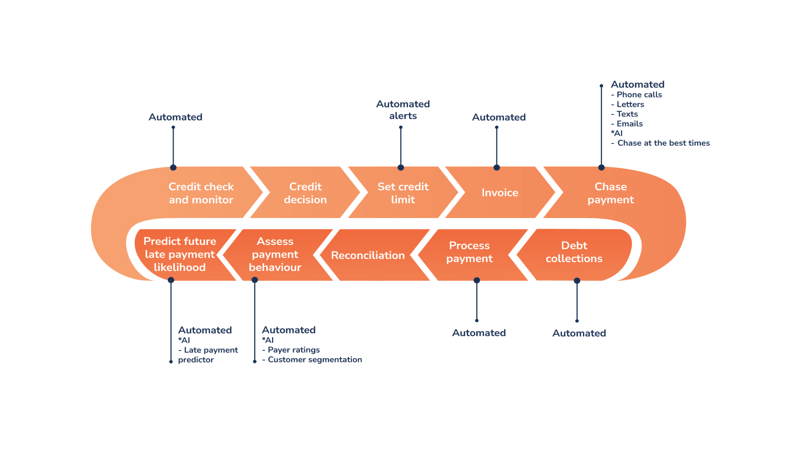
On the process side, Chaser allows creation of automated, personalized chasing schedules. Different customer groups can follow different paths, from soft pre-due reminders to stronger post-due escalation. Payment plans for struggling customers can be set up and managed automatically, with each installment tracked and chased according to an agreed schedule.
On the technology side, Chaser integrates deeply with leading accounting platforms such as Xero and QuickBooks. Invoices and customer data sync automatically, and payments made through connected gateways are written back to the ledger so there is no double handling. The customer Payment Portal provides a simple way for clients to see what they owe and pay instantly by card, bank transfer or other supported methods.

On the data side, Chaser adds intelligence that manual processes simply cannot match. The Late Payment Predictor uses historical behavior to highlight which invoices are most at risk of becoming overdue. Payer Ratings classify customers based on payment reliability, helping the team focus attention where it is most needed. Over time, this delivers a more accurate view of expected collections and risk.
The impact on daily workload can be dramatic. Love Brands, a fashion distribution business, reported saving more than 15 hours each week on manual collection tasks after implementing Chaser. Those hours were redirected toward higher-value work and strategic initiatives instead of chasing invoices line by line.
For teams that are ready to step out of firefighting mode, this type of tool provides a practical path. The entire framework described in this guide moves from theory into an automated reality.
Ready to stop firefighting and start getting paid? See how Chaser automates the entire framework just described through a guided product tour or demo.
Conclusion: reclaim time and cash flow
A broken accounts receivable collection process is not just a back-office nuisance. It is a strategic risk that slows cash, inflates costs, and damages relationships. The good news is that it is also one of the most fixable problems in finance.
By designing a proactive process, selecting technology that automates the grind, and tracking the right data, any finance team can turn collections from a source of stress into a source of strength. Cash previously trapped in receivables is released. Staff move from manual chasing to strategic contribution. Customers enjoy a smoother, more professional experience.
The choice is not between theory and reality. A modern framework backed by the right tools converts good ideas into daily practice. Implemented well, it unlocks trapped cash, frees the team from endless firefighting, and supports a more resilient, financially healthy business.


%20-%20Reduce%20DSO.webp)