
























A payment request letter is the first formal, polite request you send a customer to pay an invoice. It restates what the invoice is for, the amount, and the due date, asks for payment by a specific date, and makes paying easy. Send it at the due date or a few days after, before any overdue reminder or warning, and keep it short, specific, and friendly.
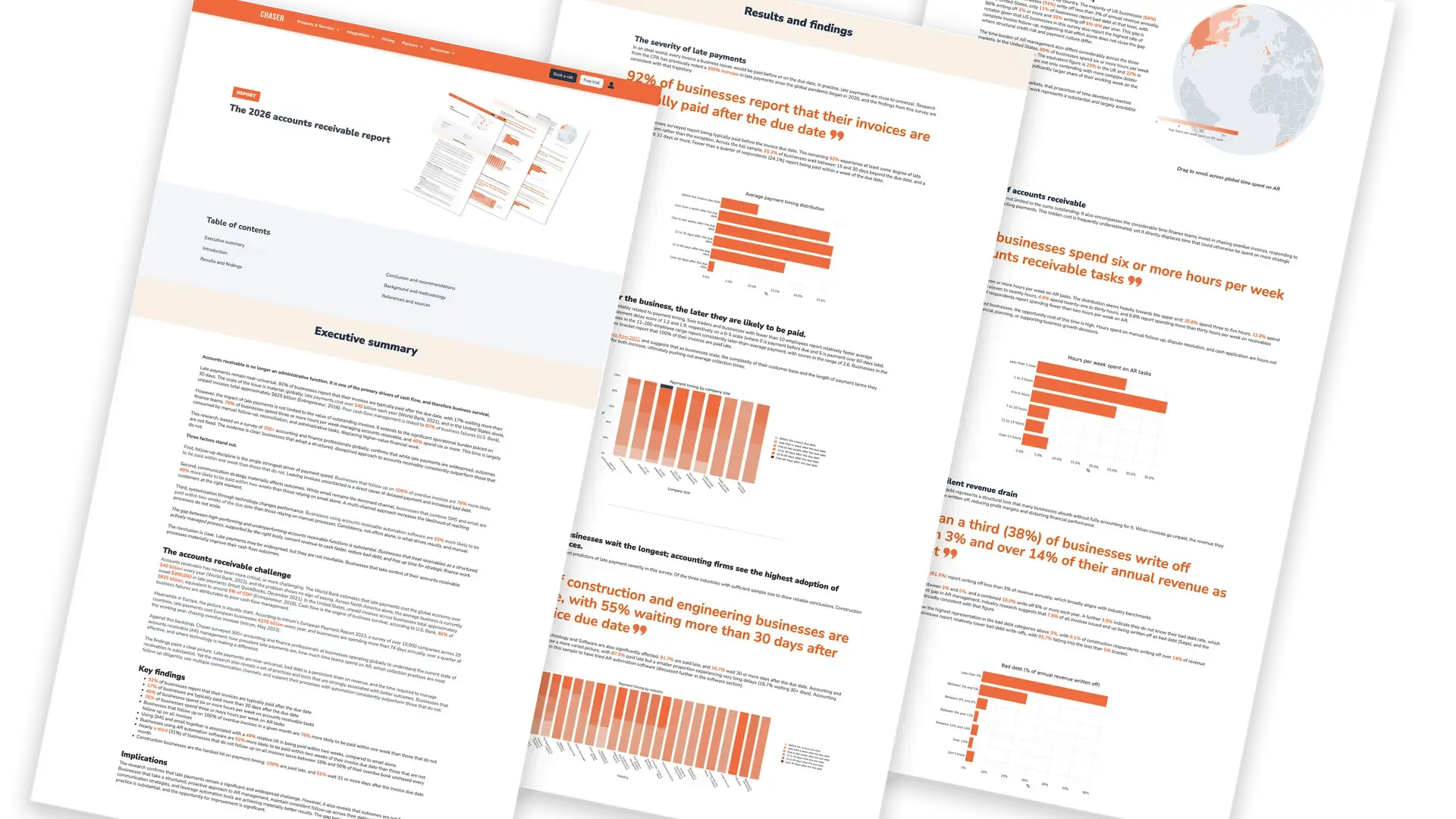
Most invoices need a nudge: in Chaser's 2026 accounts receivable report, 92% of businesses said their invoices are typically paid after the due date. A clear first request is one of the simplest ways to change that, because it catches the invoice that was forgotten, lost, or stuck waiting for approval before it turns into a chase. This guide gives you five templates to copy, an email version, the details every request needs, and what to do if the customer still doesn't pay.
Which template do you need?
- Template 1: the standard request, sent on the due date.
- Template 2: a request for payment for services rendered.
- Template 3: a request for the remaining balance after a deposit or part payment.
- Template 4: a first request when the due date has just passed and you haven't been in touch yet.
- Template 5: a request to pay by installments under a payment plan.
What is a payment request letter?
A payment request letter is a short business letter asking a customer to pay money they owe you under an invoice. It is sometimes called a request for payment letter or a letter requesting payment. It isn't a new bill and it isn't a warning. Its job is to make sure the right person has the invoice, knows the amount and date, and has everything they need to pay.
It is the first rung of a ladder. If the first request goes unanswered, each later letter gets firmer and more formal. Knowing which letter you are writing keeps the tone right: a first request that reads like a final demand can damage a relationship over what may be an oversight.
| Stage | When you send it | What it does |
|---|---|---|
| 1. Payment request letter | On the due date or a few days after, as your first contact | Asks politely, restates the invoice details, and makes paying easy |
| 2. Payment reminders | When the first request goes unanswered, in stages | Follows up, getting firmer at each stage. See dunning letter templates |
| 3. Demand letter | After reminders have been ignored | Sets a final deadline and states what happens next. See the demand letter for payment |
| 4. Collection agency letter | When an agency takes over the debt | Comes from the agency, not from you. See debt collection letter templates |
This page covers stage 1 only. If you are writing to a customer who has already ignored a request, skip to the dunning letter templates for staged reminders, or to the demand letter guide if you are ready to set a final deadline.
What should a payment request letter include?
A payment request works when the customer can act on it without looking anything up. Include these details every time:
- Your details and theirs: your company name, address, and contact details, and the customer's name, company, and address.
- The date of the letter. Use a full date, such as 30 September 2026.
- A subject line with the invoice number, the amount, and the due date, so the letter can be matched to the invoice at a glance.
- What the invoice is for: a one-line description of the goods or services, plus any purchase order number the customer gave you.
- The amount due and the due date, with the currency written in full, such as $4,800 USD or £4,800 GBP.
- A clear request: one sentence asking the customer to pay by a specific date.
- How to pay: bank details, a payment link, or both. The easier it is, the sooner you are paid.
- A named contact for questions, with an email address and phone number.
- A copy of the invoice, attached or enclosed.
The letter restates the invoice, so the invoice itself has to be right. In the UK, GOV.UK lists what an invoice must include: a unique number, both businesses' names and addresses, a description, the supply date, the invoice date, the amounts, VAT if it applies, and the total. For the payment terms and wording on the invoice itself, see invoice wording for immediate payment.
5 payment request letter templates
Each template below is ready to copy. Replace every bracketed field, attach the invoice, and keep a dated copy of what you send. They are written for business customers in the UK and the US: swap the currency and the spelling in your own letters to suit your customer.
Prefer to edit in Word? Download all five templates and the email version as a Word document. No sign-up needed.
Template 1: payment request letter on the due date
Use it when the invoice falls due today and you want a formal, friendly request on record.
[Your company name]
[Your address]
[Your email] | [Your phone number]
[Date]
[Customer's name]
[Customer's company name]
[Customer's address]
Subject: Payment request for invoice [invoice number], [amount], due [due date]
Dear [Customer's name],
Thank you for your business. This is a request for payment of invoice [invoice number], dated [invoice date], for [short description of goods or services]. The amount of [amount] is due on [due date].
Please arrange payment by that date, or let us know the date your payment will be made. You can pay by bank transfer to [bank details] or online at [payment link]. Please quote [invoice number] as the payment reference.
A copy of the invoice is enclosed. If you have any questions about it, or if anything is holding up payment, please contact [contact name] at [email] or [phone number].
Kind regards,
[Your name]
[Your job title]
[Your company name]
Template 2: letter requesting payment for services rendered
Use it when you have finished a piece of work and want the request to confirm that the work was delivered as agreed.
[Your company name]
[Your address]
[Your email] | [Your phone number]
[Date]
[Customer's name]
[Customer's company name]
[Customer's address]
Subject: Request for payment for [service], invoice [invoice number]
Dear [Customer's name],
Thank you for choosing [your company name] for [description of the service]. The work was completed on [completion date], as agreed in [your proposal / contract / purchase order number] dated [date].
Please find enclosed invoice [invoice number] for [amount], which is due on [due date]. I would be grateful if you could arrange payment by that date, by bank transfer to [bank details] or online at [payment link].
If you would like any part of the work explained, or need anything else to approve the invoice, please contact me at [email] or [phone number].
Kind regards,
[Your name]
[Your job title]
[Your company name]
If the customer is unhappy with the work, deal with that first. A request for payment on disputed work is unlikely to be paid until the dispute is settled, so see how to resolve invoice disputes before you chase.
Template 3: letter requesting payment of a remaining balance
Use it when the customer has paid a deposit or part of the invoice and you are asking for the rest for the first time.
[Your company name]
[Your address]
[Your email] | [Your phone number]
[Date]
[Customer's name]
[Customer's company name]
[Customer's address]
Subject: Balance due on invoice [invoice number]: [balance amount]
Dear [Customer's name],
Thank you for your payment of [amount paid], received on [date received], towards invoice [invoice number] for [invoice total].
This leaves a balance of [balance amount], which is due on [due date]. Please arrange payment of the balance by [date], by bank transfer to [bank details] or online at [payment link], quoting [invoice number].
An updated copy of the invoice showing your payment is enclosed. If your records show a different balance, please contact [contact name] at [email] or [phone number] so we can reconcile it.
Kind regards,
[Your name]
[Your job title]
[Your company name]
For when to ask for a deposit or staged payments in the first place, see when and how to ask for partial payments.
Template 4: first request when the due date has just passed
Use it when the due date passed a few days ago and this is your first contact about the invoice. It assumes the payment was missed, not refused. If you have already sent a request or reminder, use a follow-up reminder instead.
[Your company name]
[Your address]
[Your email] | [Your phone number]
[Date]
[Customer's name]
[Customer's company name]
[Customer's address]
Subject: Invoice [invoice number] for [amount], due [due date]
Dear [Customer's name],
I am writing about invoice [invoice number] for [amount], which was due on [due date]. Our records show it as unpaid. If you have already sent payment, thank you, and please ignore this letter.
If not, please arrange payment by [date], by bank transfer to [bank details] or online at [payment link]. A copy of the invoice is enclosed in case the original didn't reach the right person.
If something is holding up payment, such as a missing purchase order number or a question about the invoice, please contact [contact name] at [email] or [phone number] and we will sort it out.
Kind regards,
[Your name]
[Your job title]
[Your company name]
Template 5: letter requesting payment by installments
Use it when the customer has told you they can't pay the full amount on the due date and you have agreed to accept installments. The letter asks for the first payment and puts the plan on record.
[Your company name]
[Your address]
[Your email] | [Your phone number]
[Date]
[Customer's name]
[Customer's company name]
[Customer's address]
Subject: Payment plan for invoice [invoice number]: [total balance]
Dear [Customer's name],
Thank you for speaking with me on [date of conversation]. As agreed, you will pay the balance of [total balance] on invoice [invoice number] in [number] installments of [installment amount], due on [date 1], [date 2], and [date 3].
Please arrange the first payment of [installment amount] by [date 1], by bank transfer to [bank details] or online at [payment link], quoting [invoice number].
If you can't make an installment on its due date, please contact [contact name] at [email] or [phone number] before that date. If an installment is missed without notice, the full remaining balance will become due.
Please confirm that these terms are correct by replying to this letter or to [email].
Kind regards,
[Your name]
[Your job title]
[Your company name]
Only include the last sentence about a missed installment if your contract or your agreement with the customer allows it. Chaser's payment plans let you split an invoice into installments and chase each one automatically on its own due date.
Payment request email: the short version
You'll often send the first request by email, either on its own or with the formal letter attached as a PDF. Keep the email shorter than the letter: the customer should be able to act on it from the preview pane.
Subject: Invoice [invoice number] for [amount], due [due date]
Dear [Customer's name],
Invoice [invoice number] for [amount], for [short description], is due on [due date]. Please arrange payment by that date. You can pay online at [payment link] or by bank transfer to [bank details].
The invoice and a formal payment request letter are attached. If you have any questions, just reply to this email or call me on [phone number].
Kind regards,
[Your name]
[Your company name]
For a full sequence of reminder emails before and after the due date, see these payment reminder email templates. For when to use email, phone, text, or a letter, see how to ask for payment professionally.
How to write a payment request letter that gets paid
The templates handle the structure. These five habits make the wording work.
1. Lead with the facts
Put the invoice number, amount, and due date in the subject line and the first paragraph. The person who opens the letter may not be the person who approves payment, so make it easy to forward.
2. Ask for payment by a specific date
Write "please arrange payment by 30 September 2026", not "at your earliest convenience". A date gives the customer something to put in their payment run, and it gives you a clear point to follow up.
3. Be polite, but don't apologize
Thank the customer for their business and assume the delay is an oversight. Avoid lines such as "sorry to bother you", which make the request sound optional. You are asking for money you have already earned under terms you both agreed.
4. Make paying the easy option
Include your bank details and a payment link, and ask for the invoice number as the reference. Every extra step, such as finding the invoice or setting up a new payee, is a reason to put it off until later.
5. Leave out threats, fees, and legal language
A first request isn't the place for interest, late fees, or talk of collection agencies. In the UK you can claim statutory interest and debt recovery costs when another business pays late, but mentioning them in a first request sets a hostile tone before you know why the invoice is unpaid. Save them for later stages, and see how to apply late payment fees when you get there.
When should you send a payment request letter?
Send it on the due date, or within a few days after it if you prefer to give the customer's payment run a chance to catch up. Waiting weeks before the first contact tells the customer your due dates are flexible.
If you didn't agree a payment date, the date the invoice counts as late depends on the law where you trade. In the UK, GOV.UK explains that a business payment with no agreed date is late 30 days after the customer receives the invoice, or 30 days after you deliver the goods or service if that is later. Agreeing clear payment terms up front avoids the question entirely.
You can also send a friendly note a few days before the due date. That is a reminder rather than a request, and it often means you never need to send the letter at all.
Should you send it by letter or by email?
Email is the default. In Chaser's 2026 accounts receivable report, 91% of businesses used email to follow up on invoices and 56% used phone calls. Email is fast, free, and easy to track, which makes it the right choice for most first requests.
A posted letter on your letterhead reads as more formal, and it reaches customers whose inbox filters or accounts payable teams keep missing your emails. You can also send both: the email for speed, with the letter attached, and a printed copy for larger invoices or customers who haven't replied to email before.
Whichever you choose, keep a dated copy. If the invoice is still unpaid weeks later, your record of the first request is where every later letter starts.
What if the customer doesn't respond?
If the customer replies with a payment date or a question about the invoice, answer quickly and confirm any promised date in writing. If you hear nothing, move up the ladder one step at a time:
- Follow up with staged reminders. Send a reminder if the request goes unanswered, then firmer ones if that is ignored too. The dunning letter templates cover each stage and how long to leave between them.
- Pick up the phone. A short call often finds the real reason an invoice is stuck. How to ask for payment professionally covers when to switch channels.
- Send a demand letter. Once reminders have been ignored, a demand letter for payment sets a final deadline and says what happens if it passes.
- Escalate to a collection agency. Only after the steps above. The debt collection letter templates show what that stage looks like.
Legal points to know
A payment request letter is an ordinary business letter. It doesn't create the debt: the debt comes from your contract and invoice. Two points are still worth knowing.
- UK: for most business-to-business contracts, statutory interest is an implied term under section 1 of the Late Payment of Commercial Debts (Interest) Act 1998. It applies unless your contract sets its own substantial remedy for late payment, so leaving it out of a first request doesn't give it up. GOV.UK sets out when a payment becomes late and what you can claim.
- US: the federal Fair Debt Collection Practices Act covers consumer debts, and its definition of a debt collector excludes a creditor's own employees collecting in the creditor's name. It includes a creditor who uses a name that suggests a third party is collecting. So write business payment requests in your own company's name, and check your state's rules before you write to consumers.
How to send payment request letters automatically
Writing one letter is easy. Sending the right one, on the right day, for every invoice, takes time: in Chaser's 2026 accounts receivable report, 76% of businesses spent three or more hours a week on accounts receivable tasks. With Chaser, you can:
- Schedule letters around the due date. Add a letter to your chasing schedule and it is posted automatically, a set number of days from each invoice's due date. See Chaser letters.
- Personalize every letter automatically. Editable templates fill in details such as the business name, address, due date, and invoice amount, with your logo on the letterhead.
- Make paying instant. Each letter can carry a QR code that takes the customer to their payment portal, where they can see their invoices and pay by card, bank transfer, or other methods you connect.
- Keep the record for you. Every letter sent is logged on the customer and invoice record, with a PDF copy you can download, so you always know what was asked and when.
The same schedule can send your emails and texts too, so the first request, the follow-ups, and the final letter go out on time without anyone writing them by hand.
FAQs
How do I write a formal letter requesting payment?
Put your company details, the date, and the customer's details at the top, then a subject line with the invoice number and amount. In the body, state what the invoice is for, the amount, the invoice date, and the due date, then ask for payment by a specific date and explain how to pay. Attach the invoice, give a named contact for questions, and close politely. Keep it to one page and leave out threats, interest, and legal wording.
How do you ask for payment politely in a letter?
Be specific and courteous at the same time. Thank the customer for their business, state the invoice number, amount, and due date, and ask them to arrange payment by a named date. Offer a named contact in case anything is holding the payment up. Don't apologize for asking, and don't hint at consequences in a first request.
How do I word a request for payment?
Use one clear sentence with the facts in it, for example: "Please arrange payment of $4,800 USD for invoice INV-1042, which is due on 30 September 2026." Follow it with how to pay and who to contact. Specific wording gets a specific answer, while a vague line such as "please settle your account" is easy to put off.
How do I write a letter requesting a payment arrangement?
If you are the business owed money, confirm the plan in writing: the total balance, the number and amount of each installment, the dates they fall due, how to pay, and what happens if an installment is missed. If you are the customer asking for more time, write to the supplier before the due date, explain briefly why you need it, and propose specific amounts and dates you can keep to.
How do I write an email for a payment request?
Use a subject line with the invoice number, amount, and due date, then keep the body to three or four sentences: what the invoice is for, the amount and due date, how to pay, and who to contact. Attach the invoice as a PDF and include a payment link if you have one. If you are also sending a formal letter, attach it to the email as well.
How do you politely ask when to expect payment?
Ask a direct, friendly question with the invoice details in it, for example: "Could you let me know when you expect to pay invoice INV-1042 for $4,800 USD?" Asking for a date gets you a commitment you can plan around. When the customer gives you one, confirm it in writing the same day.
Is a payment request letter the same as a demand letter?
No. A payment request letter is the first polite ask, sent at the due date or just after it, and it contains no threats or deadlines beyond the payment date. A demand letter comes much later, after reminders have been ignored, and states a final deadline and what you will do if it passes, such as court action or a collection agency.
Does a payment request letter need to be sent by post?
No. Email is fine for a first request and is faster. A posted letter on your letterhead reads as more formal, so some businesses send one for large invoices or customers who don't answer email. Whichever you choose, keep a dated copy, because it is your record that you asked.
Send every payment request on time, automatically
Chaser connects to your accounting system and sends polite, personalized payment requests and reminders by email, text, and post, so customers know exactly what to pay and how, and you don't have to write each one by hand.
Start your free trial Book a demoThis article is general guidance for businesses, not legal advice. For advice on a specific debt or contract, speak to a qualified solicitor or attorney. Last reviewed 26 November 2026.