


















.svg.png?height=48&name=Zoho_CRM_(application).svg.png)






The best order-to-cash software in 2026
The best order-to-cash software depends on your team's size and stack: HighRadius and Sidetrade lead on enterprise-scale automation, while Chaser suits mid-market finance teams that want automated chasing and integrated collections without a long implementation. The single most important selection criterion is how much of the cycle a platform actually covers, because most tools labelled "order to cash" only automate one or two stages. This guide compares 14 platforms across the full cycle, with the selection criteria published in full below.
Key takeaway: "Order-to-cash software" covers everything from credit checking to cash application. Very few platforms do all of it. Before comparing features, map which stages of your own cycle are actually costing you time and cash, then shortlist only the platforms that automate those stages and connect to your accounting system.
How we chose these platforms
This comparison is maintained by Chaser, which is one of the platforms listed. To keep it useful rather than self-serving, every platform on this list, including Chaser, is assessed against the same five criteria, and Chaser is placed where the evidence puts it rather than at the top.
- Cycle coverage: how many order-to-cash stages the platform automates, from credit approval through to cash application and collections.
- Integration depth: whether it connects natively to common accounting and ERP systems, and how long that connection takes to set up.
- Team size fit: whether the platform is realistically deployable by a small finance team, or needs a dedicated implementation project.
- Independent user reviews: ratings and review volume on G2 and Capterra, weighted by how recent and how numerous the reviews are.
- Pricing transparency: whether pricing is published or quote-only, which is a practical filter for smaller teams.
Where a vendor does not publish pricing, this is stated rather than estimated. Ratings move over time, so check the current figures on G2 or Capterra before making a decision.
What is order-to-cash software?
Order-to-cash (O2C) software automates the process that runs from a customer placing an order through to the payment landing in your bank and being reconciled. A complete order-to-cash cycle has seven stages: order capture, credit approval, order fulfilment, invoicing, collections and chasing, payment processing, and cash application with reporting.

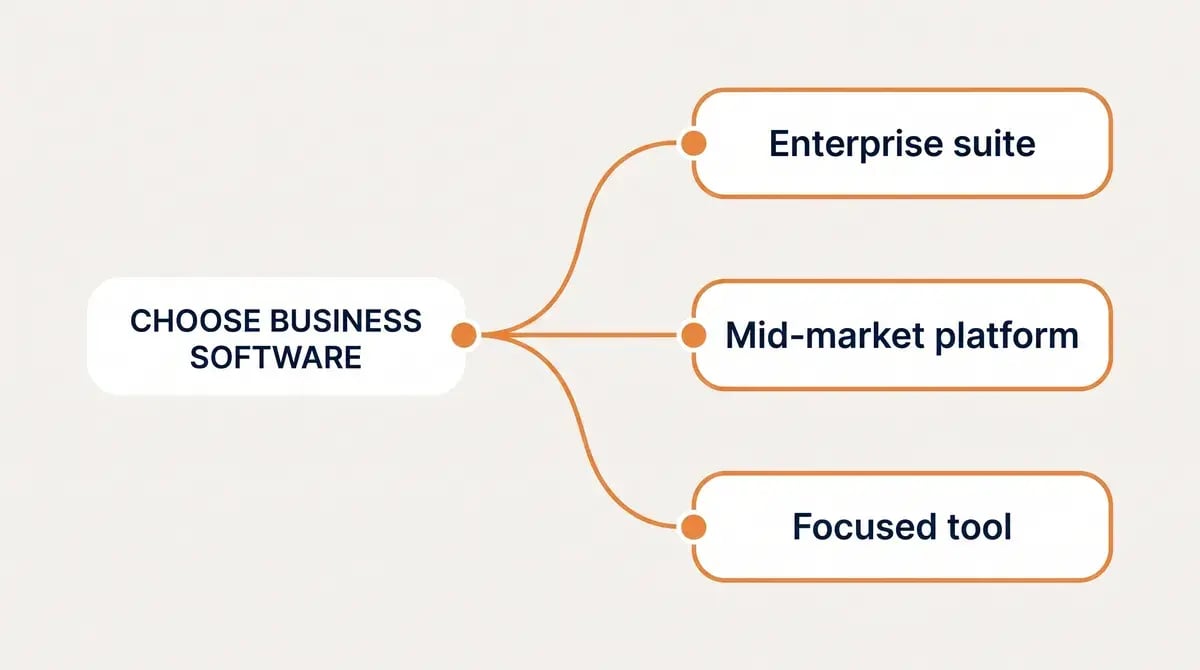
Most platforms marketed as order-to-cash software do not cover all seven stages. Enterprise suites tend to cover the whole cycle but require significant implementation. Focused tools automate one part of it, usually collections or cash application, and connect to your existing accounting system for the rest. Knowing which stages are costing you money is what makes the shortlist manageable.
Order-to-cash software compared
| Platform | Best for | Cycle coverage | Pricing |
|---|---|---|---|
| HighRadius | Large enterprises wanting one suite | Full cycle | On application |
| Sidetrade | AI-led collections at scale | Most stages | On application |
| Chaser | Mid-market teams wanting chasing plus collections | Invoicing to collections | Published |
| Billtrust | High-volume B2B invoicing | Most stages | On application |
| Esker | Teams automating AR and AP together | Full cycle | On application |
| Corcentric | Managed AR with funding options | Full cycle | On application |
| Quadient AR | Mid-market AR with a customer portal | Invoicing to payment | On application |
| Versapay | Collaborative AR with customers | Invoicing to cash application | On application |
The eight highest-profile platforms are shown here. All 14 are covered in full below.
The 14 best order-to-cash software platforms in 2026
1. HighRadius — best for large enterprises wanting the entire cycle in one suite
HighRadius is the most comprehensive order-to-cash platform on this list, covering credit management, invoicing, collections, deductions, cash application and forecasting in a single suite. It is built for large finance teams with dedicated AR functions and complex, high-volume ledgers.
Key features: AI-based cash application, credit risk scoring, deductions management, collections workflows, and analytics across the full cycle. Pros: unmatched breadth; strong automation for cash application at volume. Cons: implementation is a project rather than a setup, and cost and complexity put it out of reach for most mid-market teams. Pricing: on application.
2. Sidetrade — best for AI-led collections at scale
Sidetrade focuses on applying AI to collections and cash forecasting, using a large dataset of B2B payment behavior to predict which invoices are at risk and prioritize chasing accordingly. It is aimed at larger organizations with substantial receivables ledgers.
Key features: payment prediction, automated dunning workflows, dispute management and cash forecasting. Pros: genuinely strong predictive capability; established enterprise credentials. Cons: enterprise pricing and onboarding; more than smaller teams need. Pricing: on application.
3. Chaser — best for mid-market teams that want automated chasing and collections together
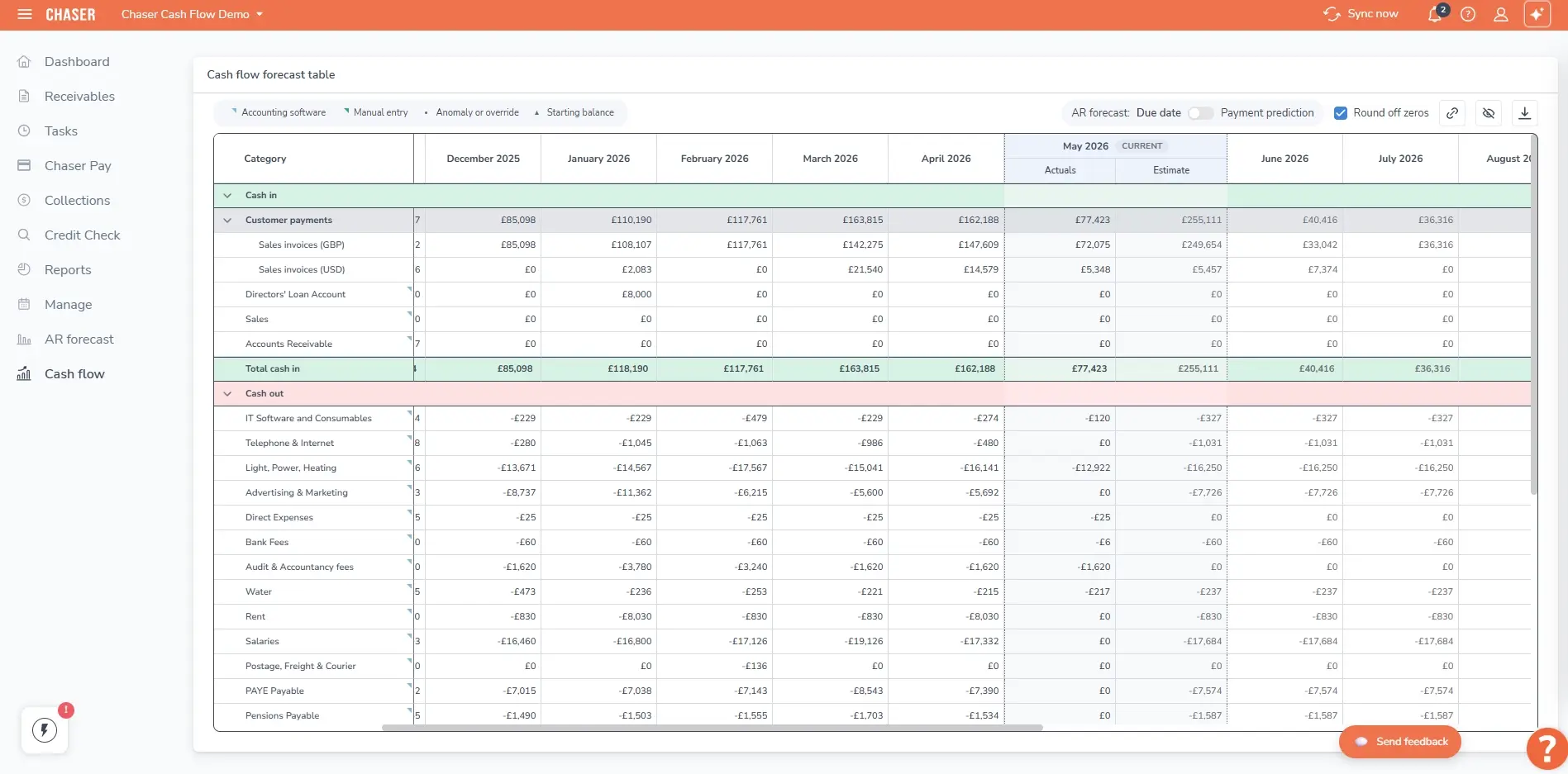
Chaser automates the invoicing-to-collections stretch of the cycle: multi-channel payment chasing, a customer payment portal, AI payer ratings, and an integrated debt collections service for the invoices that chasing does not recover. It is aimed at mid-market finance teams rather than enterprises, and it is the only platform on this list that pairs self-serve automation with a managed collections and outsourced credit control service under one roof.
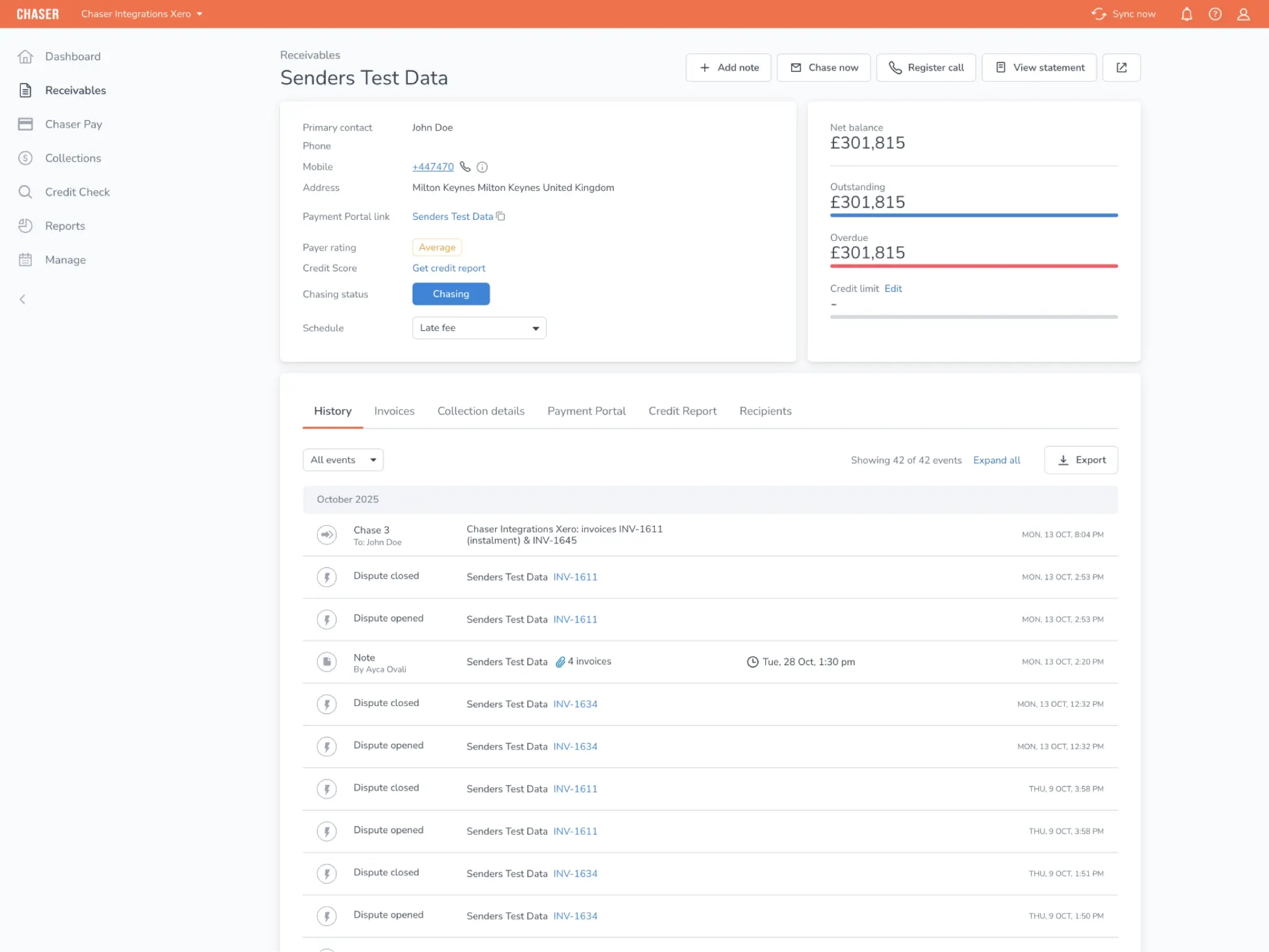
Key features: automated email, SMS and letter chasing; branded payment portal; AI payer ratings and late-payment prediction; integrated debt collections; outsourced credit control (Chaser Care). Pros: integrations with Xero, QuickBooks Online, Sage, NetSuite and Dynamics 365 Business Central connect in minutes rather than months; published pricing; escalation to collections without leaving the platform. Cons: does not cover order capture or credit approval, so it is not a single-suite replacement for an enterprise O2C platform; teams needing deductions management at scale should look at HighRadius or Esker. Pricing: published on the Chaser pricing page. Evidence: Xero App Partner of the Year (2016 and 2023).
4. Billtrust — best for high-volume B2B invoice delivery and payments
Billtrust specialises in getting invoices delivered and paid at volume, with particular strength in electronic invoice presentment and integration with customer accounts payable portals. It suits distributors, manufacturers and wholesalers with large customer bases.
Key features: multi-channel invoice delivery, payment processing, cash application and a business payments network. Pros: excellent at invoice delivery and AP portal integration. Cons: collections workflow is less developed than specialists; US-centric. Pricing: on application.
5. Esker — best for teams automating accounts receivable and accounts payable together
Esker offers order-to-cash and procure-to-pay automation in one platform, which appeals to finance teams that want a single vendor across both sides of the ledger. Coverage spans order management, invoicing, collections and cash application.
Key features: order management, e-invoicing, collections management, cash application, plus AP automation. Pros: genuine full-cycle coverage; strong document automation heritage. Cons: broad rather than deep in collections; enterprise implementation timelines. Pricing: on application.
6. Corcentric — best for managed AR with funding options attached
Corcentric combines order-to-cash software with managed services and receivables funding, so finance teams can outsource elements of the process or accelerate cash through Corcentric's funding arm rather than simply automating in-house.
Key features: managed AR services, e-invoicing, collections, and non-recourse receivables purchase. Pros: useful where the goal is offloading the function or accelerating cash. Cons: less suited to teams that want to keep control in-house; commercial terms need careful review. Pricing: on application.
7. Quadient AR — best for mid-market AR with a strong customer portal
Quadient AR, formerly YayPay, automates collections and gives customers a self-service portal to view and pay invoices. It targets mid-market finance teams and integrates with common ERPs and accounting systems.
Key features: automated reminders, customer payment portal, AR analytics and cash forecasting. Pros: good balance of capability and usability for mid-market teams. Cons: no integrated collections escalation; pricing not published. Pricing: on application.
8. Versapay — best for collaborative AR where customers and suppliers work in one place
Versapay's distinguishing idea is collaborative accounts receivable: customers and the finance team resolve queries and disputes inside a shared portal rather than over email, which shortens dispute resolution.
Key features: collaborative customer portal, invoice presentment, payment processing and cash application. Pros: genuinely reduces dispute friction; strong ERP integrations. Cons: value depends on customers actually adopting the portal. Pricing: on application.
9. Emagia — best for enterprises wanting an AI-first order-to-cash suite
Emagia provides an enterprise order-to-cash platform built around AI-driven analytics and automation, covering credit, collections, deductions and cash application for large, complex finance operations.
Key features: AI analytics, credit management, collections, cash application and receivables reporting. Pros: broad enterprise coverage. Cons: enterprise-only in practice; substantial implementation. Pricing: on application.
10. Serrala — best for finance teams standardizing across multiple entities
Serrala offers finance automation across receivables, payables and treasury, and appeals to multi-entity organizations that need consistent processes and controls across regions, often alongside SAP.
Key features: receivables and payables automation, cash application, treasury and payments. Pros: strong fit for complex, multi-entity, SAP-centric environments. Cons: heavyweight for single-entity businesses. Pricing: on application.
11. Invoiced — best for teams wanting straightforward AR automation quickly
Invoiced provides accounts receivable automation covering invoicing, payment collection, chasing and a customer portal, positioned as quicker to adopt than enterprise suites.
Key features: automated chasing, payment portal, subscription billing and cash application. Pros: fast to deploy; clear feature set. Cons: narrower collections capability; less established in the UK market. Pricing: on application.
12. Tesorio — best for cash flow forecasting alongside collections
Tesorio leans towards cash flow performance, combining collections workflow with forecasting so finance teams can see the cash impact of collections activity rather than only tracking overdue invoices.
Key features: collections workflow, cash forecasting, AR analytics and ERP integrations. Pros: strong forecasting; useful for finance leaders reporting on cash. Cons: less depth in invoice delivery and payment processing. Pricing: on application.
13. Upflow — best for smaller B2B teams wanting a clean, focused tool
Upflow focuses on collections workflow and AR visibility for growing B2B companies, with an emphasis on ease of use and a fast setup rather than breadth of coverage.
Key features: collections workflows, AR dashboards, payment links and accounting integrations. Pros: genuinely easy to adopt; good for smaller teams. Cons: limited coverage beyond collections; no integrated recovery route. Pricing: on application.
14. Kolleno — best for consolidating AR, AP and reconciliation in one place
Kolleno combines receivables, payables and reconciliation for small and mid-sized businesses that want one system rather than separate tools for each.
Key features: collections automation, payment processing, reconciliation and AP. Pros: useful consolidation for smaller finance teams. Cons: smaller vendor with a shorter track record; fewer deep ERP integrations. Pricing: on application.
Order to cash automation software: which stages can actually be automated?
Order-to-cash automation software can fully automate four of the seven cycle stages: invoicing and delivery, payment chasing, payment processing, and cash application. Credit approval can be partly automated using scoring rules and third-party credit data, but usually keeps a human decision step for larger limits. Order capture and fulfilment normally sit in the ERP or order management system rather than an AR platform.
This matters when comparing vendors, because a platform claiming end-to-end coverage may be automating stages you already handle elsewhere. The stages where automation reliably returns time are chasing and cash application, which are also the most repetitive.
How to automate the order to cash process
Automating the order-to-cash process works best in stages rather than as a single switchover. Start by mapping your current cycle and recording a baseline for days sales outstanding, the percentage of invoices overdue, and how many hours the team spends chasing each week. Without that baseline you cannot tell whether the software worked.
Then automate in this order: invoice delivery first, because it is low risk; payment chasing second, because it returns the most time; payment acceptance third, through a portal that lets customers pay without contacting you; and cash application last, since it depends on the previous stages being clean. Chaser's guide to accounts receivable automation covers the sequence in more detail.
Are there tools that automate the order-to-cash process for mid-market finance teams?
Yes. Mid-market finance teams are generally better served by focused AR platforms than by enterprise suites, because enterprise order-to-cash software assumes a dedicated AR function and a multi-month implementation. Platforms aimed at the mid-market, including Chaser, Quadient AR, Versapay and Tesorio, connect to an existing accounting system and automate the chasing-to-cash stages without replacing the finance stack.
The practical test is integration time. If a platform connects to your accounting system in minutes and starts chasing from your existing invoice data, a small team can run it. If it requires a data migration project, it is an enterprise tool regardless of how it is marketed.
How to choose the right order-to-cash software
Work through these questions before booking demos, because they eliminate most of the list quickly:
- Which stages are actually costing you? If chasing is the pain, a collections-focused platform will beat a full suite you only use a tenth of.
- What does it connect to? Native integration with your accounting system or ERP is the difference between a week and a quarter to go live.
- Who will run it day to day? Enterprise suites assume a dedicated AR team. Be honest about your capacity.
- What happens to invoices that chasing does not recover? Platforms without an escalation route leave you managing a separate collections agency relationship.
- Is pricing published? Quote-only pricing usually signals an enterprise sales process and a longer implementation.
Want to see how automated chasing and integrated collections work on your own ledger?

Which order-to-cash software is right for your finance team?
If you run a large enterprise with a dedicated AR function and complex deductions, HighRadius, Esker or Sidetrade are the realistic shortlist. If you are a mid-market finance team whose main problem is chasing invoices and recovering the ones that go quiet, a focused platform will deliver faster and cost less: Chaser, Quadient AR and Versapay all sit in that bracket, with Chaser the only one that escalates into managed collections without changing systems.
If chasing and collections are the stages costing you most time, the comparisons of accounts receivable software and credit management software go deeper on those tools specifically.
Whichever you choose, record your baseline first. Days sales outstanding, percentage of invoices overdue, and hours spent chasing each week are the three numbers that will tell you in ninety days whether the software earned its place.
FAQs
What is the best order to cash software?
There is no single best platform, because coverage needs differ. HighRadius and Sidetrade lead for large enterprises needing the full cycle, while Chaser, Quadient AR and Versapay suit mid-market teams automating invoicing through to collections. Match the platform to the stages that are costing you time.
What are the seven stages of the order-to-cash cycle?
Order capture, credit approval, order fulfilment, invoicing, collections and chasing, payment processing, and cash application with reporting. Most software covers only part of this, so knowing which stages you need automated is the fastest way to shorten a shortlist.
How much does order-to-cash software cost?
Most enterprise platforms price on application, which usually means an annual contract and an implementation fee. Mid-market AR tools are more likely to publish pricing. If a vendor will not indicate a range early, expect a longer sales and implementation process.
How long does it take to implement order-to-cash software?
It varies enormously. Platforms that connect natively to an accounting system such as Xero, QuickBooks or Sage can be live in minutes to days. Enterprise suites that require data migration and process redesign typically take three to nine months.
Does order-to-cash software reduce days sales outstanding?
Yes, mainly by making chasing consistent rather than occasional. Automated reminders go out on schedule regardless of workload, and a payment portal removes the friction of customers having to request invoice copies before paying. Track DSO before and after so the effect is measurable.
Do I need order-to-cash software if I already use Xero or QuickBooks?
Accounting systems record invoices but do very little chasing. If your team is manually following up overdue invoices, an AR platform that layers on top of Xero or QuickBooks automates that follow-up without replacing your accounting system.

.webp)