
























If your finance team runs Esker and you only need to replace the accounts receivable side of its suite, this guide compares seven accounts receivable platforms you could realistically consider instead: Chaser, Billtrust, Gaviti, HighRadius, Quadient AR, Versapay and Sidetrade. Each one automates collections and connects to the ERPs and accounting systems that mid-market and enterprise finance teams run. Esker's procurement and accounts payable products are out of scope. Listed by the size of business each platform is built for, smallest first.
Before you switch: what Esker offers
Esker, founded in Lyon, France, in 1985, describes itself as an agentic AI suite for the office of the CFO. It sells source-to-pay software, including accounts payable, and order-to-cash software: customer inquiries, order management, claims, and an accounts receivable suite covering credit, invoice delivery, payment, cash application, deductions and collections, plus e-invoicing compliance in more than 60 countries. Check three points before you replace it:
- Modules. Esker says its solutions can be deployed on their own, and that most customers deploy two or more within 12 to 18 months. If you use only one or two receivables modules, compare those, not the whole suite.
- Users. Esker says all of its accounts receivable solutions include unlimited user access.
- Integrations. Esker names pre-built connectors for SAP, Microsoft, Oracle and Sage, and connects other ERPs through its Connectivity Suite. It does not name Xero or QuickBooks, so ask how either would connect.
Who this comparison is for, and how the platforms were chosen
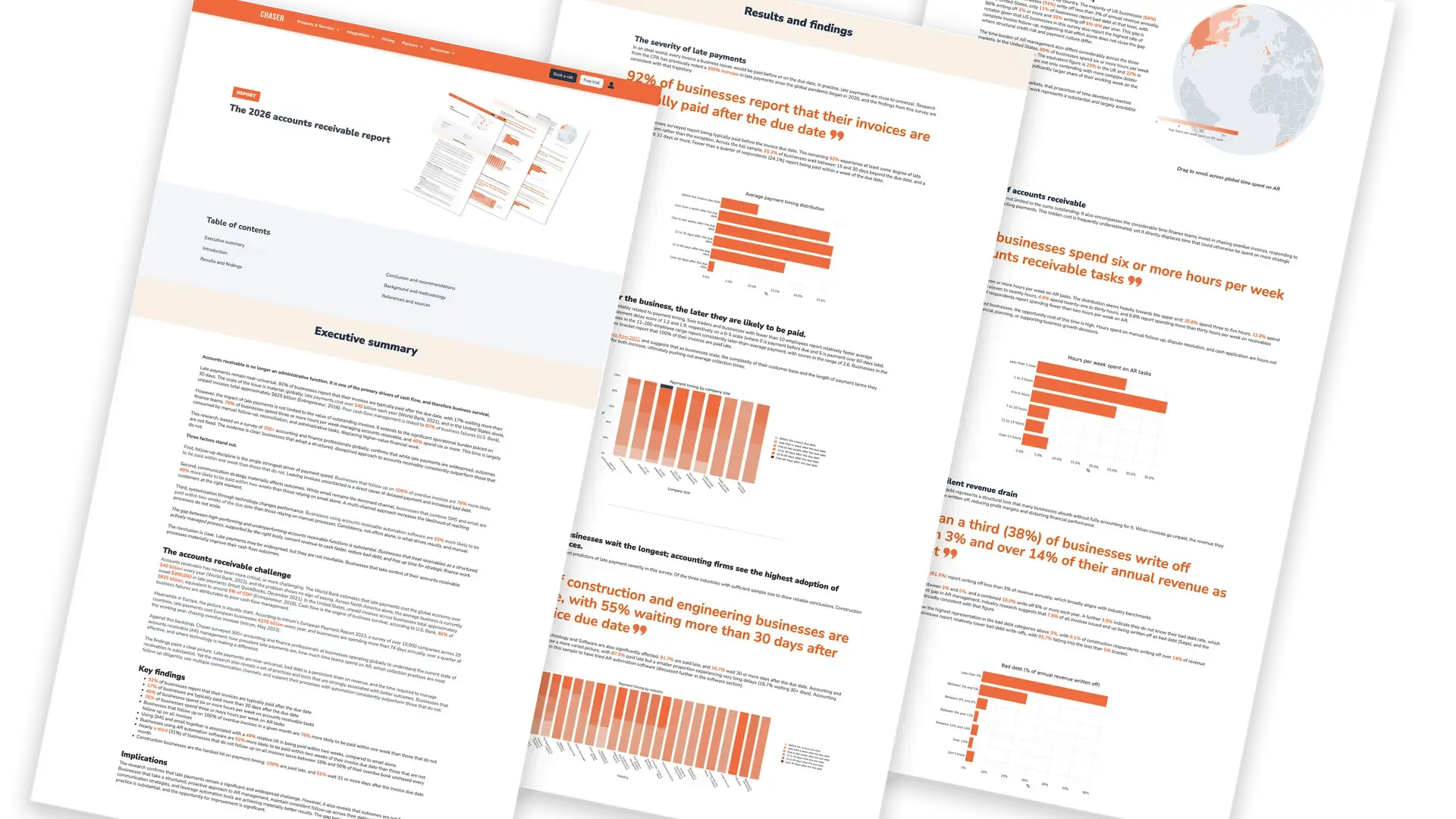
This guide is for finance leaders and AR managers at mid-market and enterprise B2B companies, in the UK, US and elsewhere, who use Esker and want to replace only its receivables modules. Follow-up matters whichever platform you choose: according to Chaser's 2026 accounts receivable report, businesses that followed up on 100% of their overdue invoices in a month were 76% more likely to be paid within one week than those that did not.
A platform is included only if all three of these are true:
- Its own website says it serves mid-market or enterprise finance teams.
- It automates collections and covers at least one of credit, payments or cash application.
- It connects to ERPs such as NetSuite, Sage, Microsoft Dynamics, SAP or Oracle, natively or through an API or file import.
Each platform is described on the same criteria: who it is built for, key features, integrations, pricing model, pros and cons. This guide is published by Chaser, which appears in the list.
Which part of Esker are you replacing?
Match the Esker modules you use today to the platforms here that list them.
| Esker module you use | What to look for instead | Platforms here that list it |
|---|---|---|
| Collections management | Segmented reminders, several channels and escalation | All seven |
| Credit management | Credit checks, monitoring and risk signals | Billtrust, Chaser, Gaviti, HighRadius, Quadient AR, Sidetrade |
| Payment processing | A customer payment portal or payment links | Billtrust, Chaser, Gaviti, HighRadius, Quadient AR, Versapay |
| Cash application | AI matching of payments and remittances | Billtrust, Gaviti, HighRadius, Quadient AR, Sidetrade, Versapay |
| Deductions and claims | Deduction identification and recovery | Gaviti, HighRadius, Sidetrade |
| Invoice delivery and e-invoicing | AP portal delivery and e-invoicing compliance | Billtrust, HighRadius, Sidetrade |
| Order management and customer inquiries | Order capture and inquiry handling | Sidetrade lists e-ordering; otherwise keep Esker for this part |
From each vendor's own website, checked on 25 September 2026. A platform missing from a row may still cover it, so confirm in a demo.
Quick comparison: 7 Esker alternatives
| Platform | Built for (vendor's description) | Integrations named by the vendor | Pricing |
|---|---|---|---|
| Chaser | Mid-market finance teams | Xero, QuickBooks, Sage (50, 200, Business Cloud, Intacct), NetSuite, Business Central, AccountsIQ, Odoo, iFinance; SAP and Oracle via API or CSV | Published on its pricing page |
| Billtrust | B2B companies with mid-to-high invoice volumes | ERP-agnostic, 40+ pre-built connectors; 260+ AP portals | Not published |
| Gaviti | Medium to large enterprises and shared service environments | ERP-agnostic, cloud or on-premise, several ERPs at once | Quote based on usage |
| HighRadius | Large enterprises and mid-sized organizations | SAP, Oracle, Microsoft Dynamics, NetSuite | Not published; outcome-based option |
| Quadient AR | Businesses with multiple ERPs or subsidiaries | SAP, Microsoft, Sage, Acumatica, NetSuite, Oracle EBS, Infor, Workday, QuickBooks | Not published |
| Versapay | Mid-market and enterprise finance teams | NetSuite, Sage Intacct, Dynamics 365 | Not published |
| Sidetrade | Large multinational enterprises | ERP, CRM, billing and banking systems; SAP named | Not published |
| Esker (for reference) | Large organizations (its order-to-cash suite) | SAP, Microsoft, Oracle, Sage; other ERPs through its Connectivity Suite | Not published |
Listed by the size of business each vendor says it serves (see "Built for"), smallest first; platforms serving similar businesses are listed alphabetically. Every feature, integration and pricing model is from the vendor's own website, checked on 25 September 2026. "Not published" means no list price is shown.
Esker alternatives compared
Chaser
Chaser is accounts receivable software for mid-market finance teams. It connects to your accounting system or ERP, automates payment reminders by email, SMS, automated phone call and letter, and brings payment tools, credit risk insight and cash flow forecasting into the same platform. When chasing is not enough, a debt collection service and an outsourced credit control service are available inside Chaser too.
Key features
- Automated reminder schedules by email, SMS, automated phone call and letter, set by invoice due date and customer segment.
- Email templates in your own branding and tone, with a record of every reminder sent to each customer.
- A payment portal, payment links in reminders, and payment plans with automated installment chasing.
- Credit monitoring and reports, AI debtor risk insights and late payment prediction.
- Cash flow, revenue and receivables forecasts.
- Integrations with AccountsIQ, iFinance, Microsoft Dynamics 365 Business Central, NetSuite, Odoo, QuickBooks Online, Sage 50 (UK), Sage 200, Sage Business Cloud Accounting, Sage Intacct and Xero, plus Stripe for payments and the Chaser API and CSV import for other systems.
- Debt collection services and Chaser Care, which pairs the software with a dedicated AR specialist.
Pros
- Your AR team sets up and changes reminder schedules and templates itself.
- Reminders, payment collection, credit risk, forecasting and escalation to collections sit in one platform.
- Connects to common mid-market accounting systems in a few clicks, with a 10-day free trial and no setup required.
- Chaser Care is available as an add-on to every plan if you would rather not chase in-house.
Cons
- No deductions management, cash application, accounts payable or treasury modules, which enterprise order-to-cash suites include.
- SAP and Oracle ERP connect through the Chaser API or CSV import, not a native connector.
- The entry plan includes 4 users and 4 automated workflows. Unlimited users and workflows, multi-entity support and the receivables forecast need a higher plan.
Esker vs Chaser: what changes if you move
Chaser covers the collections side of Esker's receivables suite: reminders, credit risk, payment collection and escalation. It does not replace Esker's cash application, deductions, e-invoicing, order management or payables products, so if you rely on those today, plan where they will live. In return, your AR team builds and edits its own reminder schedules and templates.
Connecting SAP, Oracle or Sage
If you run SAP or Oracle ERP, you connect through the Chaser API or Chase Import, its CSV upload tool, so build a regular data export into your setup. See all Chaser integrations.
Pricing and getting started
Chaser publishes its plans on the Chaser pricing page. Plans are set by annual revenue, not per user. The entry plan includes 4 users and 4 automated workflows, and higher plans include unlimited users and workflows.
Want to see how Chaser would handle collections alongside your ERP and the Esker modules you keep?
Book a demoBilltrust
Billtrust runs invoicing, payments, credit, collections and cash application as one accounts receivable platform. It describes its customers as B2B companies with mid-to-high invoice volumes, in manufacturing, distribution, business services, healthcare and transportation, and says the platform is ERP-agnostic.
You can buy its Cash Engine and Cash Accelerator products separately or together, which lets you replace Esker's invoice delivery, payment and cash application modules in stages rather than all at once, starting with the module that matters most to you.
Key features
- Invoice delivery through one interface to more than 260 customer AP portals, including Ariba, Coupa, Tungsten and Basware.
- Payments across multiple methods and channels.
- Cash application that uses confidence-based machine learning rather than static matching rules.
- Credit, collections, cash forecasting and dispute prevention on the same platform.
- An ERP-agnostic design with more than 40 pre-built connectors.
Pros
- Invoicing, payments, credit, collections and cash application come from one vendor.
- AP portal delivery helps if your largest customers require invoices through their own portals.
- Lists SOC 1, SOC 2, PCI DSS Level 1 and ISO 27001 certifications.
Cons
- Pricing is not published, so you need a sales conversation to compare costs.
- Its stated focus is high invoice volume, so a team chasing a smaller number of overdue invoices may not use much of the platform.
- Deductions management is not among the modules in its platform menu, so check how deductions would be handled if you rely on Esker for them.
Pricing: not published; quote-based. For more options, see the guide to Billtrust alternatives.
Gaviti
Gaviti describes its platform as tailored to medium to large enterprises and shared service environments, and says it serves hundreds of B2B businesses worldwide. It calls itself ERP-agnostic, supports on-premise and cloud ERPs, and can connect several ERPs at once, which suits groups where business units or subsidiaries run different systems.
Its invoice-to-cash platform runs from credit checks through collections to cash application and deductions, with a customer portal and analytics on top. If you are leaving Esker but keep a mixed ERP estate, multi-ERP support is the main reason to shortlist it.
Key features
- Credit and risk management, with credit checks and ongoing risk assessment from AI and credit reports.
- Collections automation with personalized workflows, reminders, escalations and task prioritization.
- AI cash application with automated payment matching, and deduction management with code recognition.
- Dispute management with clear ownership and automated routing.
- A customer self-service payment portal with autopay options, plus analytics and cash forecasting.
- Zero-fee ACH payments through the portal.
- An agentic AR assistant (AI chat) for your team.
Pros
- Consolidates collections across several ERPs, including legacy on-premise systems.
- Credit, collections, cash application, deductions and disputes sit in one platform.
- Customers can pay through the portal at any time of day.
- Priced on usage rather than per user, with unlimited users and workflows included.
Cons
- Pricing is quote-only, so you cannot compare costs before a sales conversation.
- Its ERP compatibility page does not name specific connectors, so confirm your own system in a demo.
Pricing: tailored quote based on usage, not per user.
HighRadius
HighRadius sells order-to-cash software (collections, cash application, deductions, credit and electronic invoicing) alongside accounts payable, B2B payments, treasury and financial close products, and says more than 1,500 finance teams use it. Its site lists large enterprises and mid-sized organizations as the company sizes it serves.
Like Esker, it also sells accounts payable software, which matters if you want to keep receivables and payables with one vendor after you leave Esker. It names customers such as 3M, Unilever and Red Bull.
Key features
- Collections management, credit management and deductions management.
- Cash application management.
- Electronic invoicing, with an e-invoicing portal.
- B2B payments, including a payment gateway.
- Accounts payable, treasury and financial close products on the same platform.
- More than 190 AI agents orchestrated on a single platform, according to HighRadius.
Pros
- Covers deductions and cash application, as Esker's receivables suite does.
- One vendor for receivables and payables if you want to keep both together.
- An outcome-based pricing option, launched in February 2026, with no implementation fee and no subscription charge until go-live, after which customers pay a share of the realized gains.
Cons
- List prices are not published, so you need a sales conversation to compare costs.
- HighRadius states a go-live of three to six months under its speed-to-value method, so plan for an implementation project.
- Its site lists ERP integrations for SAP, Oracle, Microsoft Dynamics and NetSuite, so if you run another ledger, ask how it would connect.
Pricing: not published; subscription or outcome-based. For more options, see the guide to HighRadius alternatives.
Quadient AR
Quadient acquired YayPay, and the product is now sold as Quadient Accounts Receivable. It brings credit, collections, disputes, payments and cash application together, alongside Quadient's wider customer communications products. It connects invoice delivery, payments and collections to reduce manual work, and Quadient says it supports businesses with multiple ERP systems and complex multi-subsidiary environments.
For a team leaving Esker's receivables modules, the main draw is receivables automation on a broad range of ERPs, including Sage, Acumatica and QuickBooks, with a stated implementation time you can plan around.
Key features
- Credit management with automation to reduce customer risk.
- Automated collections, with triggers that send reminders and handle escalation based on your rules.
- Dispute management with centralized tracking.
- Customer payments, and cash application with automated payment matching and reconciliation.
- AI that predicts payment behavior, prioritizes collections and supports cash flow forecasting.
- Integrations with SAP, Microsoft, Sage, Acumatica, Oracle NetSuite, Oracle E-Business Suite, Infor, Workday, Salesforce, IFS, Zuora and QuickBooks.
Pros
- One of the broadest named ERP lists in this comparison.
- Quadient states an average implementation of 72 days, with training included before go-live.
- Invoices and payment reminders, in print or digital form, are created and sent from one dashboard.
Cons
- Pricing is not published.
- Quadient notes that timelines vary with your ERP setup, data complexity and custom requirements.
- Deductions management is not among the capabilities listed on its accounts receivable page, so check how deductions would be handled if Esker covers them today.
Pricing: not published; quote-based. For more options, see the guide to Quadient alternatives.
Versapay
Versapay says it is built for both mid-market and enterprise finance teams, and highlights manufacturing, wholesale distribution and professional services. It combines a self-serve customer portal, collections, cash application and B2B payments on one platform that runs from invoicing to reconciliation.
Versapay describes its implementation as configuration-based, with self-service changes to workflows and customer segments, which matters if you want your AR team to adjust its own processes after Esker.
Key features
- Digital invoicing with a customer portal where customers pay, manage invoices and flag disputes.
- Collections management and AI-powered cash application.
- B2B payments, including ACH and credit cards.
- AI built for accounts receivable to reduce manual work and speed up collections.
- Native integrations with Oracle NetSuite, Sage Intacct, Dynamics 365 Business Central and Dynamics 365 Finance and Supply Chain Management.
Pros
- Customers and your AR team work in one shared portal on invoices, disputes and payments.
- Cash application is part of the core platform rather than a separate module.
- Versapay describes changes to workflows and customer segments as self-service.
- Sold as a subscription, packaged for mid-market and enterprise teams.
- Named support contacts in North America, according to Versapay.
- Versapay says teams and their customers can adopt it without dedicated IT operations.
Cons
- Pricing is not published.
- Native connectors cover four ERPs. Others connect through open APIs or flat files.
- Deductions management is not among the products in its site menu, so plan for deductions if you use Esker for them.
Pricing: not published; subscription. For more options, see the guide to Versapay alternatives.
Sidetrade
Sidetrade describes itself as an AI-native order-to-cash company. Founded in 2000 and listed on Euronext Growth Paris, it employs 450 people across Europe, North America and Asia-Pacific, and serves enterprise customers in 85 countries.
Sidetrade says it primarily serves large multinational enterprises with high invoice volumes, international receivables, shared service centers and large ERP environments. Its product menu lists order-to-cash applications only, so it maps onto Esker's receivables and order modules rather than its payables products.
Key features
- Credit risk assessment and exposure management.
- E-ordering and e-invoicing automation, including invoice generation, validation and reconciliation.
- AI-driven collections, plus dispute and case management.
- Deduction identification and recovery workflows.
- Cash application that consolidates remittances from banks, portals, email, EDI and PDF files.
- Payment prediction and recommended collection actions, trained on Sidetrade's own order-to-cash data.
- Role-specific AI agents for collections, cash application, disputes, billing and credit, plus a studio for building your own agents.
- Customer self-service, embedded analytics and forecasting.
Pros
- Covers deductions, disputes and cash application, as Esker's receivables suite does.
- Lists e-ordering, the closest match on this list to Esker's order management.
- Sidetrade says its cash application handles partial payments, multiple currencies and multiple entities.
Cons
- Pricing is not published, and its site offers demos rather than a pricing page.
- Its company page says it primarily serves large multinationals, so ask for references at your own size.
- SAP is the only ERP named on its cash application page, so confirm how your own ERP connects.
Pricing: not published; demo-led.
Which Esker alternative fits your situation?
- You rely on deductions and cash application. Gaviti, HighRadius and Sidetrade list both; Billtrust, Quadient AR and Versapay list cash application.
- Your largest customers want invoices through their AP portals. Billtrust delivers to more than 260 of them.
- You want payables and receivables with one vendor. HighRadius sells accounts payable products alongside order-to-cash.
- You run several ERPs or a shared service center. Gaviti and Quadient AR state multi-ERP support; Sidetrade names shared service centers among its users.
- You want customers to resolve invoices in a shared portal. Versapay is built around one.
- Your main problem is chasing overdue invoices on a mid-market ledger. Chaser focuses on collections automation, credit risk and escalation.
See also the guides to accounts receivable software, order-to-cash software and credit control software.
FAQs
What are the main alternatives and competitors to Esker?
For accounts receivable, platforms to compare with Esker include Chaser, Billtrust, Gaviti, HighRadius, Quadient AR, Versapay and Sidetrade. Gaviti, HighRadius and Sidetrade include deductions management, while Chaser focuses on collections automation, credit risk and escalation.
What is Esker software used for?
Esker software automates finance processes on both sides of the ledger: procurement, accounts payable and supplier payments on one side, and customer inquiries, orders, credit, invoicing, payments, cash application, deductions and collections on the other. It also sells global e-invoicing.
What is Esker on Demand?
Esker on Demand is Esker's cloud platform. Esker moved its solutions onto it in 2007, and customers still use Esker on Demand as the login for them.
How much does Esker cost?
Esker does not publish its prices. It sells through demos and quotes, and says its accounts receivable solutions include unlimited user access.
Can one platform handle both accounts payable and receivable?
Yes. Esker and HighRadius both sell accounts payable and accounts receivable software. If you only need to replace receivables, choose a platform that connects to your ERP and fits your size, and test it on your own invoices.