
















.svg.png?height=48&name=Zoho_CRM_(application).svg.png)





The best accounts receivable software for your business is the one that connects to the ledger you already run, chases every overdue invoice without you writing the emails, and shows you when cash is actually going to arrive. Beyond that, the right choice splits sharply by size: a business invoicing a few hundred times a month needs a tool it can switch on this week, while an enterprise processing tens of thousands of invoices needs cash application, deductions and dispute management, and will spend months implementing it. This guide compares 12 AR platforms across that whole range, with G2 ratings and pricing checked on 3 September 2026.
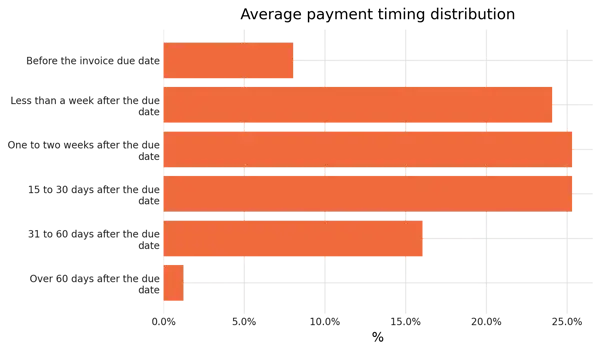
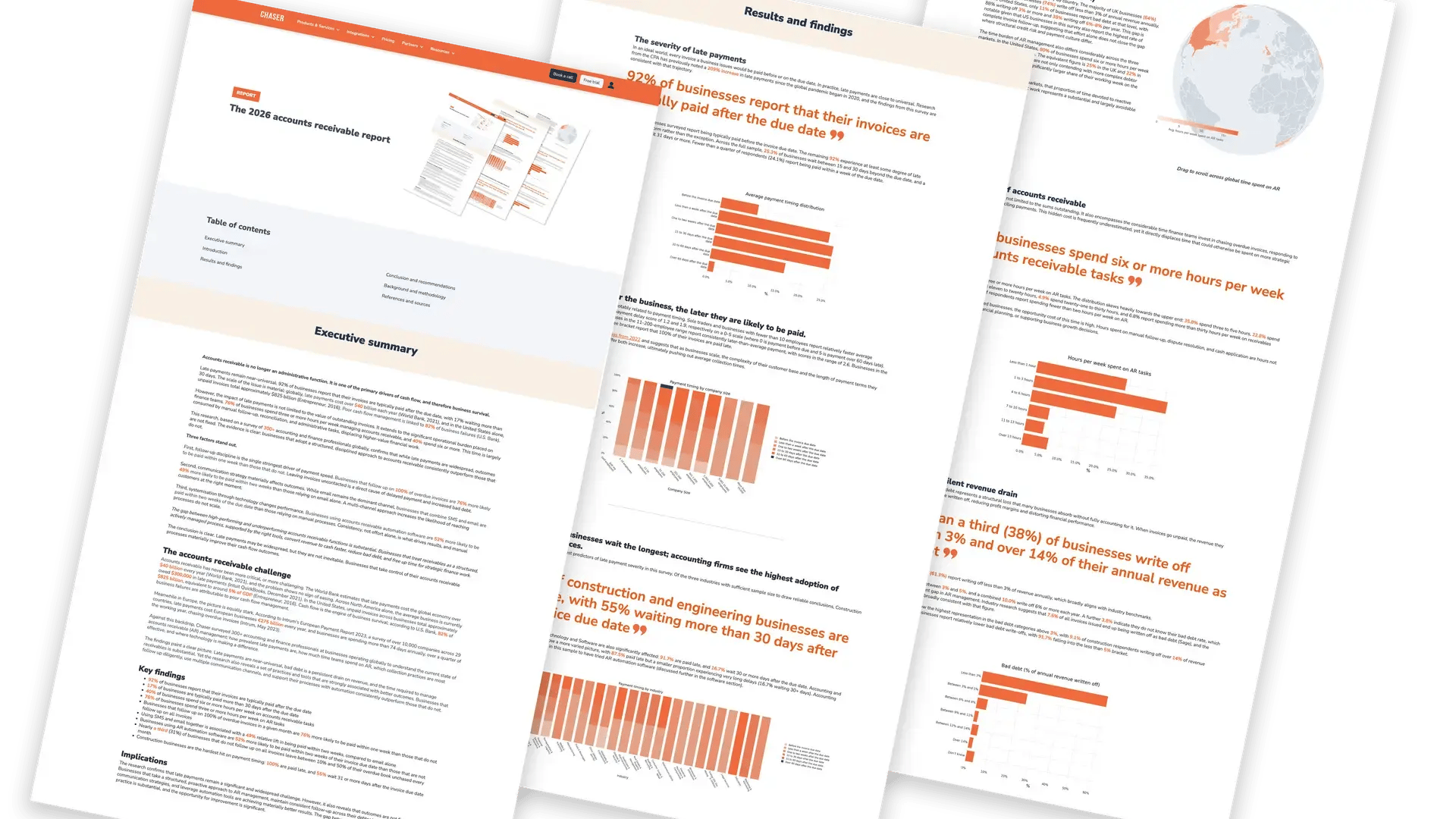
The problem these tools exist to solve is consistent. According to Chaser's 2026 accounts receivable report, 92% of businesses say their invoices are typically paid after the due date and 17% typically wait more than 30 days past it. The same research found 40% of finance teams spend six or more hours every week on receivables work. Accounts receivable software is judged here on how much of that week it gives back, and how much sooner the money arrives.
Accounts receivable software vs accounting software: the distinction that matters
This is the first thing to get straight, because it decides whether you need to buy anything at all.
Your accounting system (QuickBooks, Xero, Sage, NetSuite) records the invoice, tracks what is owed, and produces the aged debtors report. Most also send basic automatic reminders. For a small business with a handful of invoices a month, that is often enough.
Accounts receivable software sits on top of that ledger and manages the work of getting paid: reminder sequences that escalate as an invoice ages, segmentation so your best customers and your worst payers are treated differently, a payment portal in every message, dispute handling, cash application, and forecasting of when payments will land. It reads from your accounting system and writes back to it, so the ledger stays the single source of truth.
The signal that you have outgrown your accounting system's built-in reminders is usually one of three things: you have started keeping a chasing spreadsheet alongside the ledger, nobody can tell you what was last said to a given customer, or your DSO is drifting and you find out weeks late.
How this list is ordered, and how the tools were chosen
The list runs from the smallest businesses to the largest, not from best to worst. Every platform here is a serious product, and the single biggest predictor of whether one will suit you is the size and complexity of your business rather than any overall score. So the tools that serve small and growing finance teams come first, and the enterprise platforms come last. Where you sit in that range is where you should start reading.
Every tool below is a dedicated AR platform rather than a general accounting package. Each was assessed on the same six criteria, and every rating and price was checked against G2 or the vendor's own pricing page on 3 September 2026 rather than copied from another comparison.
- Ledger and ERP fit. Native integration with at least one of QuickBooks, Xero, Sage, NetSuite, Microsoft Dynamics, SAP or Oracle.
- Collections automation. Reminder sequences that can be segmented, personalized and escalated, not a single flat reminder schedule.
- Payment path. A portal or payment link inside every reminder, because friction at the point of paying undoes the chasing.
- Cash visibility. Forecasting, payment-behavior data or cash application, so you can see what is coming rather than only what is late.
- Independent review evidence. A G2 rating with a review count, so you can weigh the score against the sample size.
- Honest pricing. Published pricing where it exists, and a plain statement of "contact sales" where it does not. No invented ranges.
Quick comparison: 12 accounts receivable software platforms
| # | Platform | Best for | Key integrations | Pricing | G2 (reviews) |
|---|---|---|---|---|---|
| 1 | Centime | Smaller finance teams wanting AR, AP and cash monitoring in a single tool | QuickBooks, NetSuite, Sage Intacct, Dynamics Business Central | Contact sales | 4.5 (56) |
| 2 | Chaser | Growing businesses that want collections, risk insight and human-sounding chasing in one place | Xero, QuickBooks, Sage 50/200/Intacct, NetSuite, Dynamics 365 Business Central, AccountsIQ, CSV | Published by region | 4.3 (70) |
| 3 | BILL AP/AR | Businesses wanting payables and receivables on one ledger, mainly North America | QuickBooks, Xero, NetSuite, Sage Intacct, Microsoft Dynamics | Plan and per-transaction fees published | 4.4 (1,811) |
| 4 | Upflow | B2B SaaS and services companies billing through NetSuite, Stripe or Chargebee | NetSuite, QuickBooks, Xero, Sage Intacct, Stripe, Chargebee | Free plan; paid plans by quote | 4.8 (234) |
| 5 | Growfin | Mid-market SaaS finance teams wanting AI-assisted collections workflow | NetSuite, Salesforce, Slack | Contact sales | 4.5 (70) |
| 6 | Invoiced by Flywire | Mid-market teams wanting invoice-to-cash automation with strong reconciliation | NetSuite, QuickBooks, Sage Intacct, Xero, Microsoft Dynamics | Contact sales | 4.5 (417) |
| 7 | Tesorio | Finance teams whose priority is cash forecasting accuracy, not just chasing | NetSuite, QuickBooks, Sage Intacct | Contact sales | 4.7 (238) |
| 8 | Quadient AR (YayPay) | Mid-market teams wanting customer portals and invoice delivery alongside collections | NetSuite, Sage Intacct, Dynamics, QuickBooks, SAP, Oracle, Acumatica | Contact sales | 4.4 (155) |
| 9 | Versapay | Teams wanting customers and AR staff resolving invoices in a shared workspace | NetSuite, Sage Intacct, Microsoft Dynamics 365, SAP, Oracle | Contact sales | 4.1 (101) |
| 10 | Billtrust | Distributors and manufacturers wanting full order-to-cash with its own payments network | Major ERPs | Contact sales | 4.4 (511) |
| 11 | Esker | Enterprises standardizing AR across entities inside a wider finance automation suite | SAP, Microsoft Dynamics 365, Oracle | Contact sales | 4.2 (33) |
| 12 | HighRadius | Large enterprises needing credit, collections, cash application and deductions in one platform | SAP, Oracle, NetSuite, Dynamics | Contact sales | 4.3 (238) |
Ordered by the size of business each platform suits, smallest first. G2 ratings and review counts observed on 3 September 2026. "Contact sales" means the vendor publishes no list price; each pricing page was checked directly rather than assumed.
Reading the review counts
A 4.9 from 20 reviews tells you far less than a 4.4 from 500. The largest review bases in this category belong to BILL (1,811), Billtrust (511) and Invoiced (417). Among tools with a few hundred reviews, Upflow (4.8) and Tesorio (4.7) score highest. Treat anything under about 50 reviews as directional only.
The 12 best accounts receivable software platforms in 2026
1. Centime: best for AR, AP and cash monitoring together
Best for: smaller finance teams that want one tool covering money in, money out and the cash position between them.
Centime bundles AR automation, accounts payable, cash forecasting and banking into a single product, aimed at teams too small to buy three tools and integrate them. The trade-off is depth: each module is lighter than a specialist equivalent, so if collections is genuinely your bottleneck you will feel the ceiling.
Integrations: QuickBooks, NetSuite, Sage Intacct and Microsoft Dynamics Business Central.
Pricing: no published pricing; a product tour is offered rather than a free trial.
Ratings: 4.5 out of 5 from 56 reviews on G2.
Consider something else if: chasing is the main problem you are solving, rather than general finance admin.
2. Chaser: best for collections, risk and human-sounding automation in one platform
Best for: growing businesses on Xero, QuickBooks or Sage that want to get paid faster without hiring, and without sounding automated.
Chaser connects to your accounting system in about five minutes and works the whole receivables cycle from there. It pulls every open invoice, segments customers into workflows by payment behavior or risk, and sends reminders by email, SMS, letter or automated phone call from your own address with your own signature. Replies, call notes and payment history sit in one timeline per customer, so anyone can pick up a conversation without asking who spoke to them last.
Two things separate it from the reminder tools at the small end and the suites at the large end. First, risk data: credit checks and payment-behavior tracking flag customers drifting toward late payment before the invoice is overdue, so you chase the right accounts first. Second, escalation that does not require a new supplier. When chasing stops working, Chaser's own collections service takes the debt on inside the same platform, with the history and tone intact. Teams who would rather not chase at all can add Chaser Care, an outsourced credit control service, to any plan.
Integrations: Xero, QuickBooks Online, Sage 50, Sage 200, Sage Business Cloud, Sage Intacct, NetSuite, Microsoft Dynamics 365 Business Central and AccountsIQ, with CSV import for any other system, plus CRM logging into HubSpot, Salesforce and Zoho. Ledger-specific guides: Xero credit control and QuickBooks accounts receivable.
Pricing: published by region, with plans set by your annual revenue rather than per user or per invoice. Current figures are on the Chaser pricing page. A free 10-day trial is available on all plans, with no setup required.
Ratings: 4.3 out of 5 from 70 reviews on G2, and 4.98 out of 5 from 374 reviews on the Xero App Store, where Chaser was App Partner of the Year in 2023.
Reported outcomes: Chaser reports an average 10-day reduction in DSO and 15 or more hours saved per week. Vendor-reported, so measure it on your own ledger during the trial.
Consider something else if: you need deductions management or touchless cash application at enterprise volume, or your business runs on an ERP with no connector on the list above.
3. BILL AP/AR: best for payables and receivables in one place
Best for: North American businesses that want to run money out and money in through a single system, particularly on QuickBooks.
BILL is best known for accounts payable, and its AR side benefits from that: one platform, one set of approvals, one view of cash. It handles invoicing, payment collection across ACH, card and check, and reminders, with credit lines available alongside. For a finance team that spends as much time paying as chasing, the consolidation argument is strong.
Integrations: two-way sync with QuickBooks Online, QuickBooks Pro, Premier and Enterprise, Xero, Oracle NetSuite, Sage Intacct and Microsoft Dynamics.
Pricing: subscription plans plus a published per-transaction fee schedule (for example ACH at $0.59, checks at $1.99, international USD wire at $19.99). AR-specific pricing is not listed separately.
Ratings: 4.4 out of 5 from 1,811 reviews, by a distance the largest review base in this category.
Consider something else if: collections is your actual problem. BILL's chasing is lighter than the dedicated AR platforms here, and its fee model suits US payment rails rather than UK or EU ones.
4. Upflow: best for B2B SaaS and subscription businesses
Best for: SaaS and services companies billing through NetSuite, Stripe or Chargebee that want AR analytics before committing budget.
Upflow's free Discover plan gives you an AR health dashboard benchmarked against other B2B companies without paying anything, which makes it unusually easy to evaluate. Paid plans add collections workflows, a payment portal and financing. It holds the highest G2 score in this list at a meaningful review count.
Integrations: NetSuite, QuickBooks, Xero, Sage Intacct, Microsoft Dynamics Business Central, Stripe, Chargebee and Salesforce.
Pricing: free Discover plan for AR visibility; paid plans are quote-based and tiered by annual invoiced revenue, with unlimited user seats. Its optional payment gateway, Upflow Payments, carries separate fees.
Ratings: 4.8 out of 5 from 234 reviews on G2.
Consider something else if: you are a UK business on Xero or Sage. It connects, but the product and pricing are built around US SaaS billing stacks.
5. Growfin: best for AI-assisted collections in mid-market SaaS
Best for: mid-market SaaS finance teams wanting collections workflow tied into CRM data.
Growfin treats collections as a workflow problem: who owns which account, what the next action is, and how AR ties back to the customer relationship in Salesforce. Its AI features draft and prioritize outreach.
Integrations: NetSuite and Salesforce are the connections it promotes, with Slack for team workflow. Check your own ledger with Growfin directly before shortlisting it.
Pricing: no published pricing.
Ratings: 4.5 out of 5 from 70 reviews on G2.
Consider something else if: you are not on NetSuite or Salesforce, since a good part of its differentiation is that link.
6. Invoiced by Flywire: best for invoice-to-cash with strong reconciliation
Best for: mid-market finance teams wanting automated billing, collections and cash application without enterprise implementation timelines.
Invoiced, now part of Flywire, covers billing, payment portals, collections workflow and cash application, with a focus on matching payments accurately back to invoices. The company reports a 14-day average DSO improvement and 70% time saved on manual tasks; those are its own figures, so treat them as claims to test rather than benchmarks.
Integrations: NetSuite, QuickBooks (Online and Desktop), Sage Intacct, Xero and Microsoft Dynamics.
Pricing: no published pricing; demo-led.
Ratings: 4.5 out of 5 from 417 reviews, one of the stronger combinations of score and sample size in the category.
Consider something else if: you want to trial before talking to sales.
7. Tesorio: best for cash flow forecasting accuracy
Best for: finance teams whose board question is "when will the cash land?" rather than "who owes us?"
Tesorio approaches AR from the forecasting end. It scores invoices by expected payment behavior, surfaces which accounts are drifting, and builds a forward cash view from that, with collections workflow attached. For a CFO managing runway, the forecast is the product and the chasing is how the forecast improves.
Integrations: NetSuite, QuickBooks and Sage Intacct.
Pricing: no published pricing.
Ratings: 4.7 out of 5 from 238 reviews, among the highest scores in the category at a serious sample size.
Consider something else if: your ledger is Xero or Sage 50, which sit outside its core integrations.
8. Quadient AR (YayPay): best for customer portals and invoice delivery
Best for: mid-market teams whose customers want a portal to view, query and pay invoices themselves.
Quadient AR combines collections automation with customer-facing portals, invoice delivery and predictive analytics on payment timing. It sits deliberately between the small-business tools and the enterprise suites, and integrates unusually widely for its tier.
Integrations: NetSuite, Sage Intacct, Microsoft Dynamics, QuickBooks, SAP, Oracle and Acumatica.
Pricing: no list price; Quadient states cost varies by business size, process complexity and features required.
Ratings: 4.4 out of 5 from 155 reviews.
Consider something else if: your customers are small businesses who will never log into a portal.
9. Versapay: best for collaborative invoice resolution
Best for: businesses where disputes and queries, rather than forgetfulness, are what delays payment.
Versapay's distinguishing idea is a shared workspace where your AR team and your customer's AP team resolve an invoice together, rather than trading emails. Where a meaningful share of your overdue ledger is disputed or under query, that changes the shape of the problem.
Integrations: NetSuite, Sage Intacct, Microsoft Dynamics 365 (Business Central and Finance & Supply Chain), SAP and Oracle. No published QuickBooks or Xero connector, which places it firmly in the mid-market and above.
Pricing: no pricing page.
Ratings: 4.1 out of 5 from 101 reviews, the lowest score among the mid-market suites here, which is worth reading alongside the collaboration premise: it asks your customers to adopt something too.
Consider something else if: your customers will not engage with a shared portal, in which case the model's main advantage does not apply.
10. Billtrust: best for order-to-cash with its own payments network
Best for: distributors, manufacturers and wholesalers, mostly in the US, invoicing at high volume.
Billtrust covers the full order-to-cash path: invoice delivery in whatever format the customer demands, a payments network, cash application, credit and collections. Its strength is the messy reality of B2B billing, where large customers insist on their own portals and formats. Nearly 25 years in the market shows in the depth.
Integrations: major ERPs.
Pricing: no pricing page; contract-based.
Ratings: 4.4 out of 5 from 511 reviews.
Consider something else if: you are outside North America or want to be live in weeks. This is an implementation, not an integration.
11. Esker: best for enterprises standardizing AR across entities
Best for: large organizations running finance transformation across several countries, entities and ERPs.
Esker's AR product covers credit, invoice delivery, collections, cash application and disputes, and sits alongside its accounts payable and order management suites. Its buyers are typically standardizing processes across a group rather than solving a single team's chasing problem.
Integrations: SAP, Microsoft Dynamics 365 and Oracle.
Pricing: no pricing page.
Ratings: 4.2 out of 5 from 33 reviews, a small sample for a vendor of this size, so weigh references more heavily than the score.
Consider something else if: you want value inside a quarter.
12. HighRadius: best for enterprise AR at scale
Best for: large enterprises with dedicated credit and collections functions, high invoice volumes and multiple business units.
HighRadius is the most complete platform here: credit risk, collections, cash application, deductions and cash forecasting, with AI agents across all of them. It is built for organizations where AR is a department rather than a task, and its published outcome claim is a DSO reduction of up to 10%.
Integrations: SAP, Oracle, NetSuite and Microsoft Dynamics.
Pricing: subscription-based, no figures published.
Ratings: 4.3 out of 5 from 238 reviews.
Consider something else if: you are mid-market. The breadth that justifies the price at enterprise scale is cost you will not use.
How to choose accounts receivable software
Work from your ledger and your bottleneck, in that order.
- Start with the integration, not the feature list. A platform with a native two-way connection to your accounting system will be live in days and stay in sync. Anything relying on file exports will quietly drift out of date, and you will end up back in a spreadsheet.
- Name the bottleneck. If invoices go unchased, you need collections automation. If they are chased and still disputed, you need dispute workflow and a shared history. If payments arrive but nobody can match them, you need cash application. If the board wants to know when cash lands, you need forecasting. These are four different products.
- Check the escalation path. Ask what happens at day 60 and day 90. A tool that hands you back to a separate collections agency loses the entire customer history at the moment it matters most.
- Weigh the review count, not just the score. A 4.9 from 20 reviews is a rounding error away from a 4.5.
- Treat "contact sales" as information. Published pricing usually means self-serve onboarding and a short path to value. No published pricing usually means an implementation project and a negotiation, which may still be the right answer at enterprise scale.
- Test on your own ledger. A trial against real overdue invoices tells you more in a fortnight than any demo. Chaser and Upflow both offer that; most of the enterprise platforms here do not.
FAQs
What software is used for accounts receivable?
Most businesses use two things together: an accounting system that records invoices and what is owed (QuickBooks, Xero, Sage, NetSuite), and a dedicated accounts receivable platform that automates chasing, payments and forecasting on top of it. Common AR platforms include Chaser, BILL, Billtrust, Invoiced, HighRadius, Tesorio, Upflow, Quadient AR, Versapay and Esker. Very small businesses often manage with their accounting system's built-in reminders alone.
What is the best accounts receivable software?
There is no single best platform, because the right answer changes with company size and ledger. For growing businesses on Xero, QuickBooks or Sage that want collections, risk data and escalation to collections in one place, Chaser is the strongest fit and publishes its pricing. For large enterprises with dedicated credit teams, HighRadius and Billtrust offer the most depth. For B2B SaaS billing through Stripe or NetSuite, Upflow holds the highest independent rating in this list at 4.8 from 234 reviews.
What is the best software for automating accounts receivable?
For automation specifically, look for three things: reminder sequences that segment and escalate automatically, a payment link or portal inside every message, and automatic reconciliation back to the ledger so nobody chases an invoice that has been paid. Chaser, Invoiced, Quadient AR and HighRadius all cover the full loop; the difference between them is scale and price rather than whether the automation exists.
What is the best accounting software for accounts receivable?
If you want your accounting system to handle receivables on its own, the practical options are QuickBooks Online, Xero, Sage Intacct and NetSuite, all of which record invoices, produce aged debtor reports and send basic automatic reminders. They are strongest at recording what is owed and weakest at working the ledger: they do not segment customers by payment behavior, escalate to a senior contact, or forecast when cash will actually arrive. That is the gap AR software fills.
What are the 5 C's of accounts receivable management?
The five C's are a credit-assessment framework applied to customers before you extend terms: character (their payment history and reputation), capacity (whether their cash flow can service the debt), capital (their financial reserves), collateral (assets securing the credit), and conditions (the wider economic and sector context). In receivables management they inform who gets credit, how much, and on what terms, which in turn decides how hard you will have to chase later.
How much does accounts receivable software cost?
Published prices vary widely, and most vendors do not publish at all. Upflow offers a free analytics plan and quotes its paid plans by annual invoiced revenue, and Chaser publishes its plans by region on its pricing page, set by annual revenue. HighRadius, Billtrust, Esker, Versapay, Quadient AR, Invoiced, Tesorio, Growfin and Centime all quote per customer based on invoice volume, modules and implementation. Smaller UK-focused credit control tools start lower, and are compared in the guide to the best credit control software.
What is the difference between accounts receivable software and debt collection software?
Accounts receivable software manages the whole invoice lifecycle, from issuing through reminders to payment and reconciliation. Debt collection software concentrates on what happens once an invoice is seriously overdue: escalation, formal demands, and recovery. Several platforms do both, and a full comparison of collections tools is in the guide to the best debt collection software.
See how much sooner you could get paid
Chaser connects to Xero, QuickBooks or Sage in about five minutes, chases every overdue invoice in your own voice, shows you which customers are drifting toward late payment, and escalates to collections when chasing is not enough.
Start your free trial Book a demoG2 ratings and review counts were observed on 3 September 2026. Pricing was taken from each vendor's own pricing page on the same date; where a vendor publishes no price, the entry says so rather than estimating. Late payment statistics are from Chaser's 2026 accounts receivable report. DSO and time-saved figures are vendor-reported and attributed to the vendor claiming them. Last reviewed 3 September 2026.