

















.svg.png?height=48&name=Zoho_CRM_(application).svg.png)






%20-%20AR%20turnover%20formula.png?length=1248&name=Blog%205%20(Oct)%20-%20AR%20turnover%20formula.png)
Accounts receivable turnover (ART) shows how efficiently you turn credit sales into cash. Used alongside Days Sales Outstanding (DSO), ART helps you judge cash-collection performance and prioritize follow-ups.
If you’re running finance at a growing company where revenue looks healthy, but payroll is tight because receivables are moving slowly, your accounts receivable calculation might be the culprit. Small errors in the ART calculation can skew decisions and slow cash collection.
In this guide, you’ll learn how to:
- Calculate ART correctly: You’ll isolate net credit sales and use a period-appropriate average (e.g., opening+closing AR or monthly AR averages for seasonal businesses).
- Diagnose low turnover: You’ll separate policy issues (credit terms), receivable quality (disputes, returns, credit memos), and process issues (inconsistent chasing, weak audit trails).
- Improve ART without harming relationships: You’ll learn how to standardize follow-ups, keep a clear audit trail across the team, and make payment the easy next step.
Before exploring improvement tactics, let’s lock in a reliable calculation method. When your formula and inputs are consistent, your ART reflects reality, and you can forecast accurately and decide who to chase next.
The formula to calculate accounts receivable turnover
To calculate ART, you need to divide the Net Credit Sales by the Average Accounts Receivable.
This is the basic formula:
AR Turnover = Net Credit Sales ÷ Average Accounts Receivable
The individual components:
- Net credit sales: This is the total of your credit sales after subtracting returns, allowances, and discounts. Ensure you exclude any cash sales from this figure for accuracy.
- Average accounts receivable: This is calculated as the sum of the beginning and ending accounts receivable divided by two.
That means: If there are $500,000 USD in net credit sales and the average accounts receivable is $50,000 USD, the annual turnover is 10x. For perspective, you can relate this to Days Sales Outstanding (DSO) using this conversion: DSO = 365 ÷ AR Turnover.
However, many teams miscalculate ART when they use total sales instead of net credit sales and average receivables in ways that distort seasonality.
Let's discuss what those common pitfalls look in practice and why finance teams fall for them:
The net credit sales trap (why your numerator is probably wrong)
A common operational hurdle is extracting accurate net credit sales figures. Systems like QuickBooks and SAP often don't isolate this data automatically. It's crucial to manually subtract the following:
- Sales returns: Products sent back by customers.
- Sales allowances: Price reductions due to defects or errors.
- Sales discounts: Incentives like '2/10 Net 30' for early payment.
Using total sales instead of net overstates turnover by more than 10% in the following example.
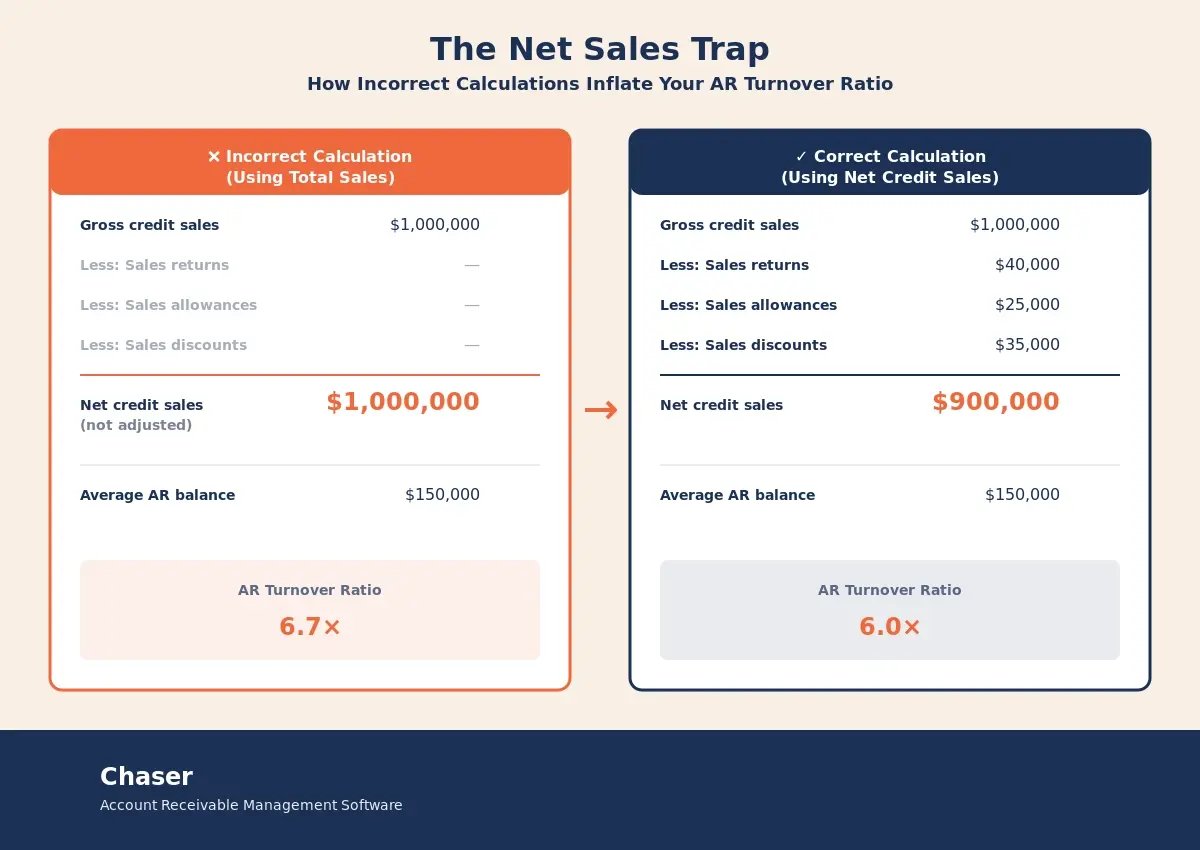
That gap can mislead teams into believing collections are healthier than they actually are, masking issues such as:
- Hidden delinquency pockets
- Overly generous credit terms
- Underperforming follow-up processes
Failing to adjust for these elements means relying on "total sales" instead of "net credit sales," which inflates the ART ratio and obscures real collection inefficiencies.
While manually isolating those elements can generate errors, a seamless accounting integration, like Chaser's two-way sync, can completely remove this friction. You automatically reconcile data between Chaser and an accounting system like Xero.
That way, changes made in one system, such as a payment being received through Chaser, are automatically updated in the other system to keep them synchronized.
The seasonality blind spot (why your denominator is misleading)
The method of two-point averaging may fail for businesses with seasonal cycles. Let’s explore this with numbers:
- Scenario A: A retail business has a January AR of $50,000 USD and a December AR of $150,000 USD, giving a naive average of $100,000 USD, producing an 8x turnover, which appears healthy.
- Scenario B: Incorporating a July peak of $300,000 USD would yield a $180,000 USD average, resulting in a 4.4x turnover, revealing potential issues.
Scenario A might lead to complacency, while Scenario B would prompt necessary intervention. The recommended approach for seasonal businesses is to utilize monthly weighted averaging. This means combining the sum of the 12 monthly AR balances and dividing by 12.
Now that calculations are accurate, it's time to benchmark your number.
What's a good accounts receivable turnover ratio?
There's no universal "good" ART number. It varies significantly by industry benchmarks, which vary by sector, customer mix, and credit terms.
As a rule of thumb:
- Retail often trends higher with 10–15x annually, reflecting high sales frequency and shorter repayment terms.
- Manufacturing sits mid-range at 6–8x annually, due to longer B2B payment cycles.
- Construction is lower (3–5x annually), driven by project-based billing and milestones.
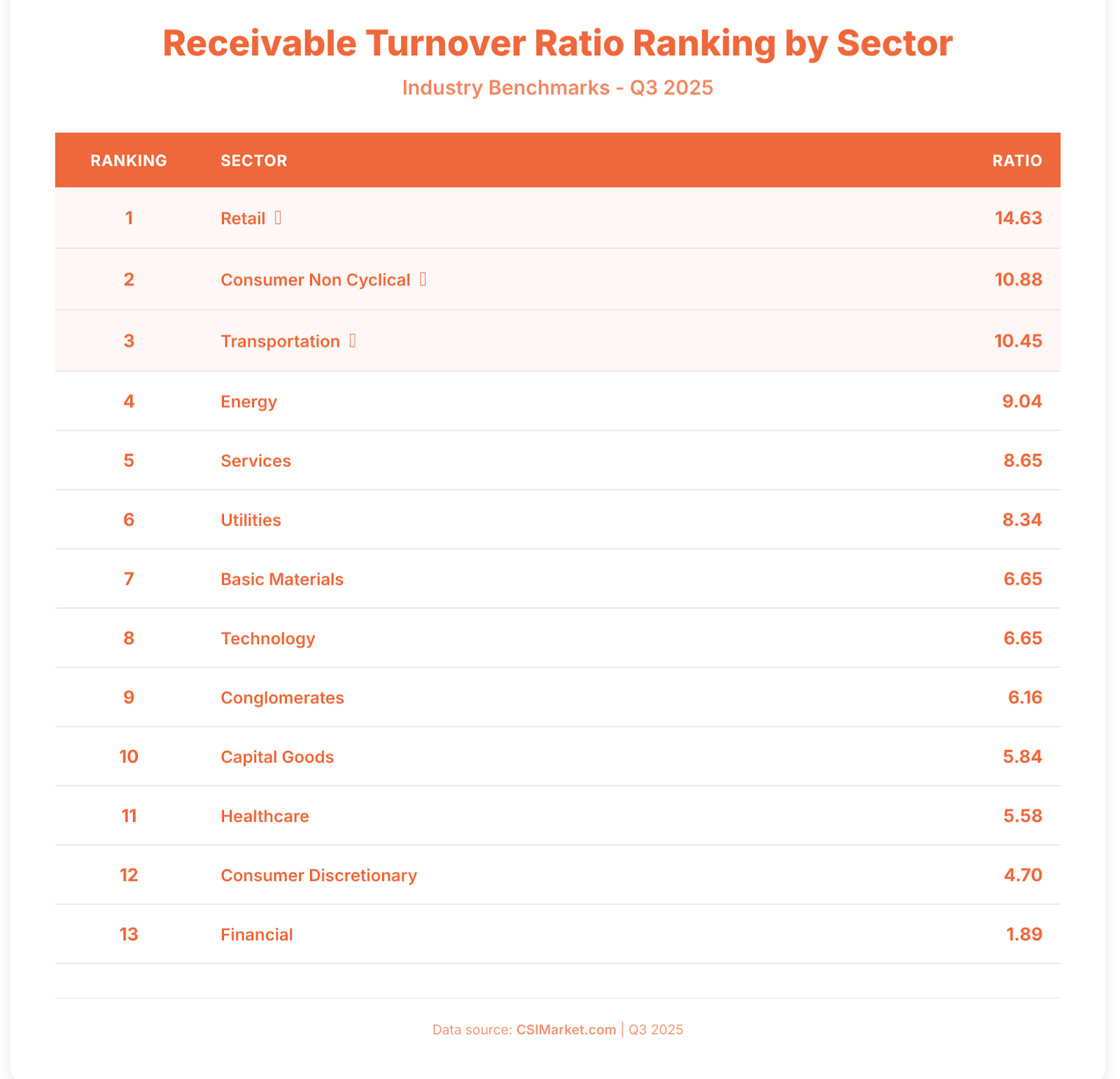
Source: CSIMarket.com
Achieving the right balance is strategic. A very high ratio may indicate an overly restrictive credit policy, which could lead to lost sales opportunities. Conversely, a low ratio signals a cash flow crisis, which hampers your ability to meet financial obligations.
Converting your ART into DSO provides another layer of analysis. The formula is straightforward:
DSO = 365 ÷ AR Turnover
For instance, an ART of 10x translates to a collection period of 36.5 days. Your DSO should ideally match or undercut your company’s stated credit terms. If offering Net 30 terms, collection should occur within 30 days or less.
To gain more comprehensive insights into your accounts receivable performance, you may want to explore additional key performance indicators. These KPIs provide a broader understanding and can help refine your overall strategy. A deeper look into various AR metrics will equip you with the necessary tools to optimize cash flow effectively.
If your ratio falls below the industry benchmark or your DSO exceeds credit terms, you are facing a collection challenge.
But what's causing it? Let's delve deeper to identify core issues and corrective actions.
The three hidden causes of low ART (and how to diagnose which one is yours)
If your team is aware that the ART ratio is lower than desired, but struggles to identify the root cause, consider the following hidden causes:
- Cause #1 - credit policy (terms are too lenient)
- Cause #2 - customer quality (you're serving high-risk payers)
- Cause #3 - collection process (internal execution is failing)
Cause #1: credit policy (terms are too lenient)
If you’re offering longer payment terms or higher credit limits than what’s typical in your sector, your AR will turn more slowly by design.
You would know this is the case when your DSO lands roughly where your stated terms do (e.g., Net 60 collects in about 60 days), but your turnover still looks weak.
For instance, a manufacturer on Net 90 will almost always show a lower turnover than competitors on Net 60, even with flawless collections.
Instead of chasing harder, your next move is to bring terms closer to the norm for similar customers, tighten limits to match risk, and strengthen upfront credit vetting so you’re not creating a collections problem on day 61.
Cause #2: customer quality (you're serving high-risk payers)
If too much of your receivables sits in the 60-day or 90-day aging buckets – and the same names keep showing up —you’re likely extending credit to customers with a history of paying late or defaulting.
The key is to separate a good payer hitting a temporary snag from a chronic risk that needs escalation. Instead of trawling aging reports by hand, switch to a payer rating segmentation system that groups customers by observed behavior over time (e.g., “reliably on time,” “occasionally late,” “consistently late”).
With that lens, you can tighten terms or limits for the riskiest bands, monitor them more closely, and keep flexibility for otherwise solid customers who are just working through a short-term issue.
You’ll come out with a book of receivables that matches your risk appetite—without punishing the customers who usually do the right thing.
Cause #3: collection process (internal execution is failing)
Here, your credit terms align with industry standards, and your customers are generally creditworthy, but your internal follow-up is slow or inconsistent.
To diagnose the root cause, notice if your DSO significantly exceeds your stated credit terms (such as collecting Net 30 in 55 days), but your credit policy and customer quality are in order. This could be due to delayed invoicing, inconsistent reminders, or slow reconciliation.
The hidden cost adds up: for example, 15+ hours a week spent on manual chasing can translate to roughly $1,125 USD per week (about $58,500 USD a year), pulling senior capacity away from analysis and forecasting.
In that case, start with visibility: track a rolling six-month DSO trend and tag accounts where the gap to terms is widening. Then standardize the cadence (invoice promptly, remind early and politely, escalate predictably), automate the routine touches, and remove friction at payment.
With real-time diagnostic systems, such as Chaser’s revenue forecast tool, you can visualize monthly DSO trend analysis over six months, and generate insights (color-coded: green for improving, red for declining) to predict and improve ART.
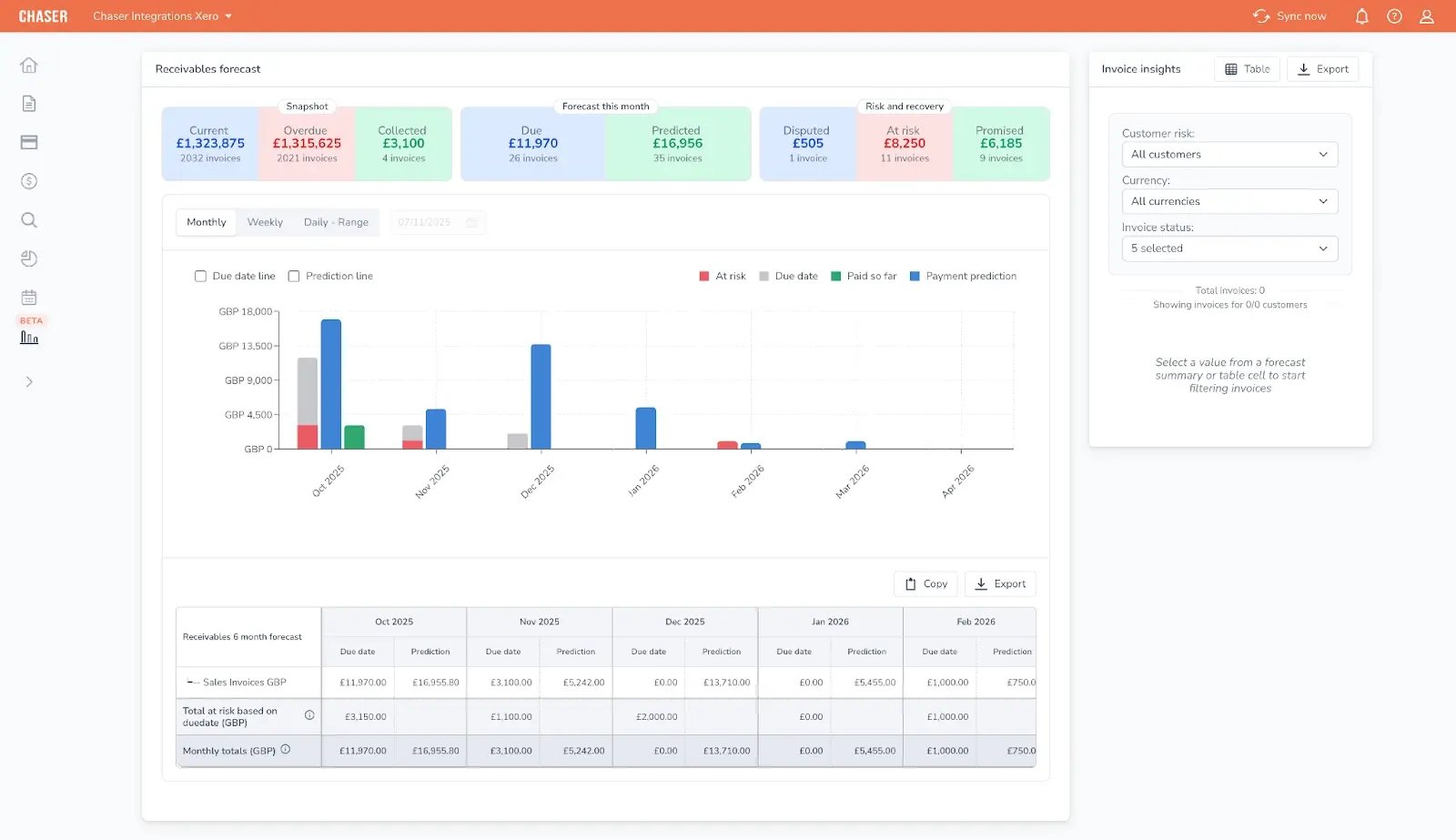
Once you can see where time is slipping, the improvements in the next section become straightforward to apply.
How to improve your accounts receivable turnover ratio
Enhancing your accounts receivable turnover ratio requires targeted actions based on the specific diagnostic causes identified earlier. This section offers prescriptive solutions tailored to each root cause: credit policy issues, customer quality challenges, and collection process inefficiencies.
By applying the right strategies to these areas, you can effectively improve AR performance and strengthen your cash flow. Let's dive into the actionable steps designed to address each of these diagnostic causes.
Fixing credit policy issues
To address credit policy issues, the key is to tighten payment terms in a way that makes sense for your industry.
For example, consider transitioning from Net 90 to Net 60 or even Net 30 terms. Implementing rigorous credit vetting is crucial, which involves running credit checks on new customers and setting customer-specific credit limits based on their payment history and financial health.
Utilizing tools like Chaser's credit monitoring feature can provide automatic alerts when customers approach their credit thresholds, helping to maintain control.
Developing a robust credit policy framework is an effective way to support your AR management. Consider exploring the detailed insights in the Chaser accounts receivable management guide for more details.
Managing customer quality issues
Conduct regular credit reviews of both new and existing customers to manage customer quality issues effectively. Use behavioral data to distinguish between chronic late payers and those temporarily struggling.
Offering payment plans can help maintain relationships with good customers facing short-term financial difficulties. Chaser’s Payer Rating system aids in instant segmentation without requiring manual analysis, simplifying these decisions.
Strategically, it's wise to retain good payers by offering flexible terms, while tightening or eliminating terms for problematic customers. If necessary, escalate to collections, using Chaser's integrated no-win-no-fee debt recovery service for invoices that are over 90 days past due.
Accelerating collection processes
The key insight here is that most collection failures stem from friction and inconsistency, not unwillingness to pay.
The communication problem
Manual follow-up might be too aggressive or too passive, which either damages relationships or allows invoices to age. Using automated yet personalized reminder sequences can solve this issue.
Chaser features custom scheduling based on customer characteristics such as nationality and relationship status. Emails appear hand-typed, sent from your actual email address with your signature, and the AI email generator facilitates professional responses to disputes or payment promises. Multi-channel escalation helps reach customers through email, SMS, auto-calls, and letters.
The payment friction problem
Payment friction can delay even willing customers. Traditional invoicing involves a lengthy process, but Chaser Pay's embedded payment links enable one-click payments with auto-reconciliation, speeding up the process to the same day. The payment portal offers multiple methods such as bank transfers, cards, Apple Pay, and Google Pay.
The intervention timing problem
Timing is critical in collections. Traditional methods react only after invoices become overdue, missing the critical 45-day threshold where collection probability diminishes. Chaser's Late Payment Predictor offers a proactive approach, analyzing invoice data and historical behavior to provide risk scores. This allows for intervention as soon as signs of delinquency appear.
Behavioral incentives
Behavioral incentives like early payment discounts, automatically applied to invoices paid before the due date, and late payment fees for overdue invoices can further improve your AR collection processes.
Once these strategies are implemented, your accounts receivable turnover should improve, leading to enhanced cash flow and financial stability.
From static metric to strategic advantage: why automation matters
Transitioning from manual to automated processes in managing accounts receivable can turn a static metric into a strategic advantage. Manual calculations of ART come with fundamental limitations.
They are often conducted retrospectively on a quarterly basis. You might calculate ART at the end of the quarter, discover it's not where it should be, and scramble to address the issue, only to find that invoices have already aged past the critical 45-day threshold.
The manual approach is a resource drain, consuming valuable finance team capacity through tasks such as:
- Extracting data and creating custom accounts receivable reports manually
- Performing spreadsheet calculations that are prone to error
- Making phone calls and sending follow-up emails
- Conducting manual payment reconciliation
A shift from reactive to predictive AR management provides a significant upgrade. Instead of asking, "Why didn't they pay?" automation allows companies to anticipate, "This customer is likely to pay late, so intervention is needed now." Real-time monitoring offers a host of advantages, including:
- Continuous tracking of DSO, with a monthly breakdown over six months showing color-coded trends, instead of relying on quarterly snapshots
- Automated weighted calculations that account for high-value invoices and seasonality
- Proactive risk detection by flagging at-risk invoices before they become overdue
- Reallocating capacity so finance staff can focus on strategic credit analysis instead of manual chasing
The Love Brand’s story illustrates these benefits: the company reduced its DSO by 60%, from 60 days to 24.
Despite collecting Net 30 invoices in 60 days, the real issue was with internal execution rather than policy. Automation enabled systematic day-one follow-up, eliminated payment frictions, and provided real-time visibility, helping this company collect payments in 24 days.
This led to them outperforming their Net 30 terms and eliminating the need for a line of credit. This also meant getting paid 54 days faster, effectively reclaiming two full billing cycles.
Chaser goes beyond calculating your ART. It transforms that metric from a static, retrospective report into a predictive and continuous competitive advantage.
Success metrics: Charting your AR successes
Defining success when addressing accounts receivable turnover requires clear and measurable outcomes. Here are the key metrics to track in order to ensure your ART problem is solved.
Primary metric: DSO equals or beats stated credit terms
Achieving a DSO that meets or exceeds your stated credit terms is crucial. For example, if you offer Net 30 terms and collect in 28 days on average, this indicates not only compliance with policy but also execution efficiency.
Secondary metric: turnover ratio reaches or exceeds industry benchmark
Your accounts receivable turnover ratio should meet or surpass industry standards to confirm competitive performance. Remember the target benchmarks:
- Retail should aim for 10-15x,
- Manufacturing for 6-8x,
- Construction for 3-5x,
- and a general benchmark is 5-10x.
Financial outcomes
Improving these metrics leads to noticeable financial benefits:
- Cash flow improves: The need for short-term borrowing decreases or may disappear entirely.
- Bad debt exposure drops: Proactive collection prevents invoices from aging past 90 days, reducing financial risk.
- Write-offs decline measurably: Fewer aged debts mean fewer write-offs.
Operational outcomes
On the operational side, success is marked by:
- Team capacity shifts: Finance staff spend less time chasing overdue payments and more on strategic analysis.
- Forecasting becomes reliable: Stable payment patterns enable confident financial planning.
- Customer relationships improve: Automated and professional follow-ups replace last-minute, panicked phone calls, fostering better rapport.
Leading indicator
One of the key leading indicators of success is the improvement in month-over-month DSO trends. This can be effectively measured through color-coded tracking that highlights improvements at a glance.
For an alternative way to measure these improvements, the Average Collection Period (ACP) provides valuable insights and approaches.
Tracking and achieving these metrics ensures that your ART issues are effectively resolved, leading to stronger financial and operational health for your business.
Getting your ART calculation right (and reaping the benefits)
The manual calculation of accounts receivable turnover is fraught with structural flaws. These issues stem primarily from challenges in isolating net credit sales and distortions due to seasonality.
Before implementing solutions, it is crucial to diagnose whether your problem lies in credit policy, customer quality, or process inefficiencies. Understanding which issue you're facing is essential for effective intervention.
The urgency of addressing these issues cannot be overstated. Each day an invoice remains unpaid past the 45-day mark significantly decreases the likelihood of collection, leading to potential permanent revenue loss and adversely impacting cash flow.
Transforming your approach to ART from a quarterly retrospective metric to a continuous predictive advantage is a game-changer. When combined with automation, your ART ratio becomes more than just a financial reporting number. It evolves into a real-time diagnostic tool that helps prevent cash flow crises before they occur.
To assist in these efforts, consider using the Free AR Performance Tracker. This tool allows you to calculate manually and track performance consistently.
Additionally, you can explore Chaser’s automated ART monitoring by booking a demo. Discover how you can reduce DSO by 60% with real-time intelligence and automated collections for more effective financial management.
FAQ